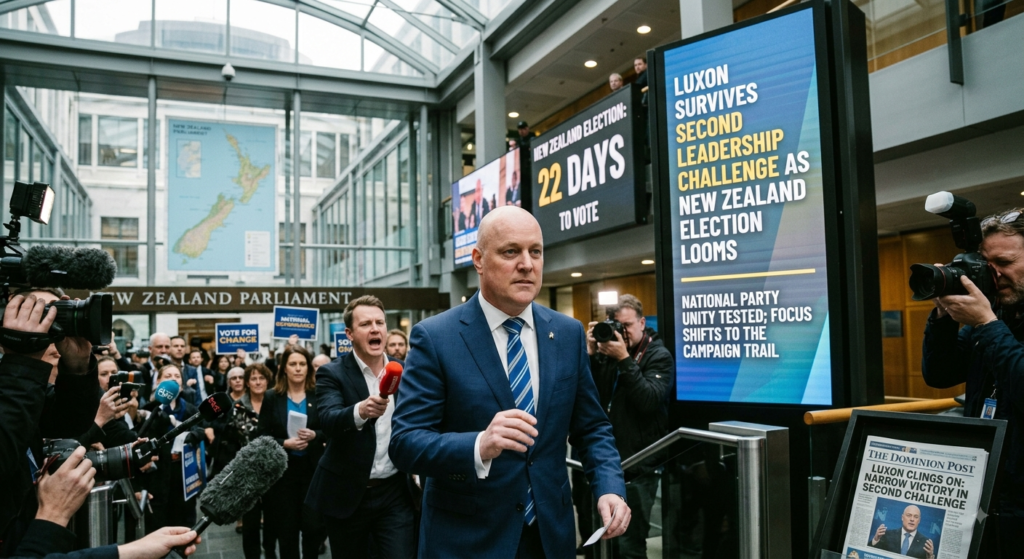
New Zealand PM Christopher Luxon fended off a second leadership challenge from within his own party just months before the November election, despite sliding poll numbers and a series of political missteps.
New Zealand Prime Minister Christopher Luxon has weathered another internal party revolt, surviving a confidence vote among his own National Party lawmakers less than three months before the country heads to the polls. It marks the second time this year Luxon has been forced to fight for his job from within his own ranks.
How the Vote Unfolded
The challenge came to a head Wednesday during a hastily arranged, closed-door meeting of National Party lawmakers at Parliament in Wellington that stretched on for more than three hours. MPs were reportedly required to hand in their phones before entering the room, and a large banner was hung across the caucus room to prevent anyone from seeing inside during deliberations.
Luxon emerged afterward flanked by senior colleagues, including speculated leadership rivals Erica Stanford, Mark Mitchell, and Chris Bishop, presenting a unified front as he confirmed the outcome. “There was a confidence vote in my leadership this morning at our caucus meeting, and I have the full support of our caucus,” he told reporters. “Our caucus is united, and it is determined to win this election.” He did not disclose how many lawmakers had voted in his favor, as such internal ballots are typically conducted in secret.
The developments moved quickly. Luxon had taken the unusual step of publicly acknowledging the growing speculation on social media just a day earlier, writing on X that he believed “division and disunity are a major distraction only 90 days out from the election,” and announcing he would convene the caucus meeting to resolve the matter directly.
A Second Challenge in Four Months
Wednesday’s vote marked the second formal challenge to Luxon’s leadership since April, when he survived an earlier confidence vote amid reports that National Party members were unhappy with the party’s polling numbers, which had dropped below 30%. The recurring pattern of internal challenges, particularly with an election so close, has raised real questions about the stability of Luxon’s leadership heading into the campaign’s final stretch.
Luxon has led New Zealand since 2023, when he guided the centre-right National Party to victory on promises to tame inflation and bring down interest rates, famously telling voters at the time, “My pledge to you is that our government will deliver for every New Zealander.” Since then, however, his government has struggled to translate those campaign promises into strong public approval.
Why Luxon’s Leadership Has Come Under Pressure
Several factors have combined to erode confidence in Luxon’s leadership over the past year. New Zealand’s economy has continued to stall, with unemployment climbing to 5.6%, an 11-year high. A recent 1News Verian poll showed Luxon’s preferred prime minister rating slipping to just 17%, a new low for his time in office, though he still holds a lead over other candidates included in the survey.
Beyond the economic numbers, a series of political missteps has compounded the pressure. Just last week, Luxon drew significant backlash after suggesting, on live radio and without prior consultation with his own party colleagues, the possibility of a referendum on New Zealand’s mixed-member proportional voting system — a notably unpopular idea among voters. He also faced criticism after it emerged he had used a military aircraft to return to Wellington following a political party fundraiser.
Luxon’s broader political challenges trace back to how he formed his government in the first place. As a former Air New Zealand CEO with no prior political experience, he took over six weeks to broker a three-way coalition with the populist New Zealand First party and the right-wing libertarian ACT party — an arrangement he has struggled to manage consistently throughout his time as prime minister. His difficulty reining in coalition partners, combined with a string of gaffes and communication missteps, has been a persistent drag on his public standing.
What’s at Stake in November
New Zealand’s next general election is scheduled for November 7, and polling has suggested that even some of Luxon’s most senior ministers could lose their seats in parliament when voters head to the polls. Despite Wednesday’s show of unity, the recurring leadership challenges leave genuine uncertainty hanging over the National Party’s campaign heading into its final stretch before the vote.
Speaking after the vote, Luxon attempted to reframe the moment as a rallying point rather than a distraction, casting the upcoming election as a contest between “an opposition that wants to take New Zealand backwards” and a National-led government he said would “take New Zealand forward.” He closed his remarks simply: “We’re going back to work and we’re moving on.”
Frequently Asked Questions
Q: Did Christopher Luxon survive the leadership challenge? Yes. Luxon won a confidence vote among his National Party’s lawmakers on Wednesday, confirming he retains the “full support” of his caucus.
Q: How many leadership challenges has Luxon faced this year? This was the second formal challenge to his leadership in 2026, following an earlier confidence vote he survived in April.
Q: When is New Zealand’s next general election? New Zealand’s general election is scheduled for November 7, 2026, giving Luxon and the National Party less than three months to campaign following Wednesday’s vote.
Q: Why has support for Luxon declined? Contributing factors include stalling economic growth, unemployment rising to an 11-year high of 5.6%, a recent poll showing his preferred PM rating at a career-low 17%, and several political missteps, including an unpopular proposal for a referendum on the voting system.
Q: How did Luxon originally become prime minister? Luxon, a former Air New Zealand CEO, led the National Party to victory in the 2023 election, subsequently forming a three-way coalition government with the New Zealand First and ACT parties after roughly six weeks of negotiations.