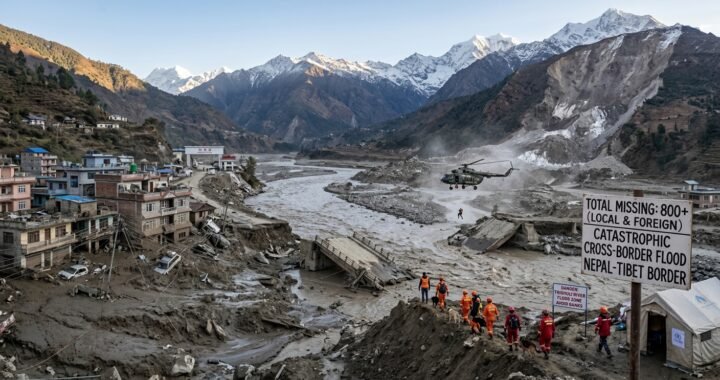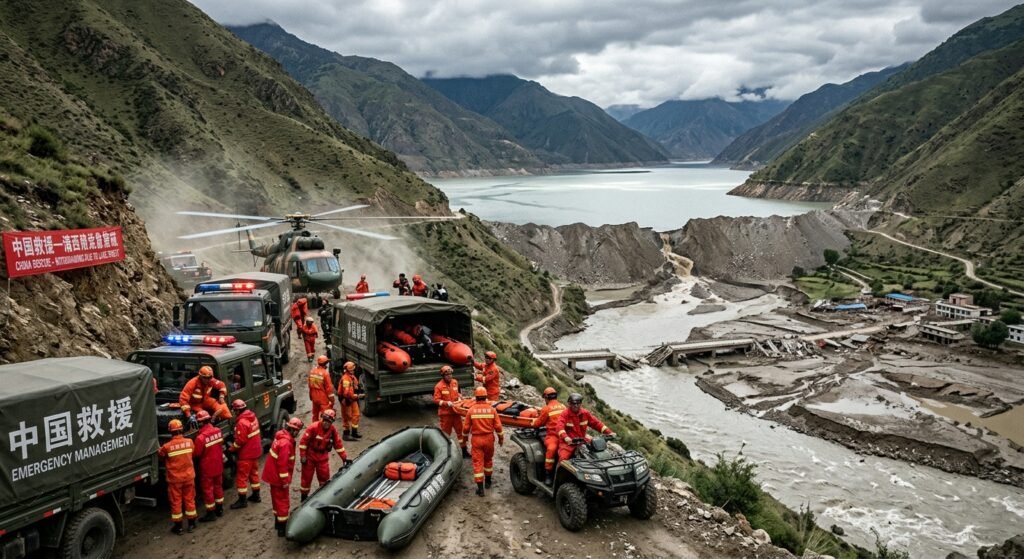
Chinese authorities have suspended rescue operations at Gyirong Port after a rapidly growing “barrier lake” formed upstream, raising fears of a second devastating flood just days after the initial disaster killed hundreds.
Rescue operations along the Nepal-Tibet border have been thrown into further crisis, with Chinese authorities pulling back emergency teams from Gyirong Port over fears that a newly formed, rapidly expanding lake upstream could burst and unleash a second catastrophic flood on a region already reeling from disaster.
A Dangerous New Threat Emerges
The new danger comes from what officials are calling a “barrier lake,” formed by mudslides near where Nepal’s Chhochen Khola river meets the Purepu Tsangpo river, which flows into China. According to Nepal’s National Disaster Risk Reduction and Management Authority, the lake sits roughly 11 miles upstream of Rasuwagadhi and has already grown to cover approximately 27 acres.
China’s Ministry of Water Resources estimated Thursday that the lake currently holds around 2 million cubic meters of water — roughly 528 million gallons. With more rain in the forecast, officials expect the lake to absorb an additional 3 million cubic meters, or about 793 million gallons, over just the next three days. The ministry has warned the lake is already overflowing and faces a high risk of a sudden, uncontrolled release that could send another wave of flooding directly into Gyirong Port, the same critical China-Nepal trade crossing devastated by the initial disaster earlier this week.
Why Rescue Teams Are Being Withdrawn
Given the danger this poses specifically to emergency responders working in the area, Chinese authorities have suspended active rescue operations at Gyirong Port, pulling teams back from the immediate danger zone rather than risk a repeat catastrophe striking rescuers directly. Officials have dispatched a specialized team of experts to Gyirong county specifically to assist with managing the barrier lake threat, given the area’s existing vulnerability to landslides, mudslides, and further flash flooding.
The Toll From the Original Disaster
This new threat comes just days after the initial glacier collapse and resulting flash flood devastated the region on Wednesday, August 26. As of Thursday’s update, Nepal’s disaster authority confirmed 359 bodies had been recovered in the country, with another 910 people still out of contact. Across the border, Chinese officials in the Gyirong disaster command reported three confirmed deaths and 558 people missing in Tibet, including 260 foreign nationals.
The scale of destruction from the original flood was severe: at least 19 bridges and roughly 40 kilometers (25 miles) of roads were washed away as the surge of water, mud, and rock tore through the Lhende Khola river valley, engulfing villages and critical infrastructure along the way.
Difficult Conditions Continue to Hamper Rescue Efforts
Even before this new lake threat emerged, rescue operations had already been struggling against extremely difficult conditions. High river levels, damaged roads, and deep mud have all significantly complicated efforts to reach some of the worst-affected areas. On the Chinese side, deep sediment deposits have further delayed rescue teams trying to reach the border zone.
There have been some genuine successes amid the chaos. On Friday, Nepal’s army rescued approximately 350 workers and residents who had been trapped in a tunnel at the Upper Trishuli hydropower project, despite continued poor weather and high river flows complicating that operation as well.
An International Disaster With Global Reach
The scale of foreign nationals affected has turned this into a genuinely international story. Among the hundreds still missing are approximately 90 Americans, including Deepak and Madhu Ahuja, a couple from Texas who had traveled to the region on a religious pilgrimage to Mount Kailash in Tibet to celebrate Deepak’s 60th birthday, according to their children, who spoke with CNN.
The international response has moved quickly. India has sent a rescue aircraft carrying roughly 10 tonnes of emergency supplies, including temporary shelters, blankets, hygiene kits, solar lamps, and medicine. Indian Prime Minister Narendra Modi has spoken directly with Nepal’s Prime Minister Balendra Shah, pledging continued support. The International Federation of Red Cross and Red Crescent Societies has released 1 million Swiss francs (roughly $1.2 million) in emergency funding, while the United Nations has allocated $2 million from its Central Emergency Response Fund. Australia has committed $3.6 million in assistance and is sending additional consular staff to the region, and the European Union has activated its Copernicus Emergency Management Service to provide satellite-based mapping support for the ongoing response.
Restricted Access Complicates the Picture in China
Information about the disaster’s scope and China’s rescue efforts has remained notably harder to obtain than reporting from the Nepali side of the border. China’s border regions with Nepal, including Shigatse and the Everest scenic area, are already subject to tight travel restrictions, with local travelers required to obtain special permits and foreign travelers, journalists, diplomats, and academics working on sensitive topics often denied access altogether. China’s National Immigration Agency has additionally barred Chinese visitors from entering Shigatse’s border areas entirely as the crisis continues to unfold.
Despite those restrictions, China has committed significant resources to its own rescue effort: by Thursday evening, more than 681 firefighters, 13 rescue dogs, 113 vehicles, and 47 drones dispatched by China’s National Fire and Rescue Administration had arrived in the affected region, according to state broadcaster CCTV.
A Region With a Painful History of Glacial Disasters
This isn’t an isolated event for the Nepal-Tibet border region. In July 2025, a separate glacial lake outburst originating in Tibet triggered a flash flood through Nepal’s Rasuwa district, killing at least 11 people and sweeping away the Nepal-China Friendship Bridge entirely. That disaster halted cross-border trade for an extended period, forcing goods to be rerouted through India instead.
More broadly, glacial lake outburst floods have a long, documented history across this section of the Himalayas, driven in part by rapid glacier retreat linked to regional climate warming. Research has identified more than 200 glacial lakes across Bhutan, China, India, Nepal, and Pakistan that pose a high hazard risk to downstream Himalayan communities, underscoring that this week’s crisis, while severe, reflects a broader and growing pattern of risk across the region rather than an entirely unprecedented event.
What Happens Next
With the newly formed barrier lake continuing to grow and rescue operations at Gyirong Port now suspended as a precaution, the coming days represent a genuinely precarious moment for the disaster response. Officials on both sides of the border face a difficult balancing act: continuing search efforts for hundreds of people still missing from the original flood, while managing the very real risk that a second, potentially equally destructive flood could strike the same already-devastated area before recovery efforts can even properly begin.
Frequently Asked Questions
Q: Why did China suspend rescue efforts at Gyirong Port? Chinese authorities pulled back rescue teams due to the risk posed by a newly formed “barrier lake” upstream, which is rapidly filling with water and could burst, sending a second flood directly into the same area where rescue operations were taking place.
Q: How large is the new barrier lake? As of August 27, the lake was estimated to hold approximately 2 million cubic meters of water and covers roughly 27 acres, with an additional 3 million cubic meters of inflow expected over the following three days due to forecasted rainfall.
Q: How many people are still missing from the original flood? As of the latest updates, Nepal reported 910 people still out of contact with 359 bodies recovered, while China’s Gyirong disaster command reported 558 people missing, including 260 foreign nationals, with three confirmed deaths on the Chinese side.
Q: Has this kind of disaster happened before in this region? Yes. In July 2025, a separate glacial lake outburst flood struck the same general border region, killing at least 11 people and destroying the Nepal-China Friendship Bridge, reflecting a broader pattern of glacial flood risk across the Himalayas.
Q: What international aid has been sent to the region? India has sent emergency supplies via aircraft, the Red Cross has released $1.2 million in emergency funding, the United Nations has allocated $2 million, Australia has committed $3.6 million in assistance, and the European Union has activated satellite-based emergency mapping support.