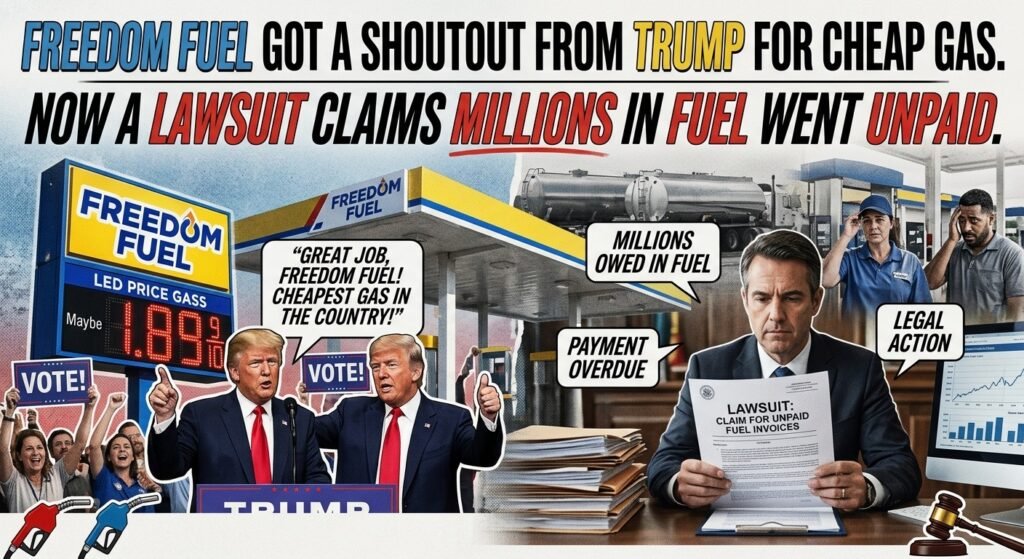
Freedom Fuel Network won praise from President Trump for selling discount gasoline in Philadelphia, but a new federal lawsuit alleges the network’s fuel supplier never paid a $4 million bill for over a million gallons of gas.
Freedom Fuel Network became something of a national story back in July, when President Trump publicly praised the small Philadelphia-area gas station chain for selling gasoline well below market price during a stretch of unusually high fuel costs. Now, a federal lawsuit is raising uncomfortable questions about how the network managed to keep its prices so low, alleging that millions of dollars’ worth of fuel supplied to its stations was never actually paid for.
How Freedom Fuel Caught Trump’s Attention
Freedom Fuel Network operates mostly in and around Philadelphia, and drew widespread attention in July after quietly rebranding roughly 25 gas stations and pricing gasoline noticeably below the competition. At the time, national gas prices were running more than 30% higher than a year earlier, making Freedom Fuel’s discount pricing especially eye-catching to drivers and media alike. The company’s stations were selling gas at $3.48 a gallon, well under the Pennsylvania state average of $3.99 at the time.
That discount didn’t go unnoticed at the highest levels. President Trump praised the chain directly in a July 1 Truth Social post, writing that Freedom Fuel was “taking the lead, and others should follow,” adding that “they are doing this because they love the USA.” In the same post, Trump predicted that gas prices nationally would soon return to “the record low prices Americans enjoyed at the pump before our very successful ‘excursion’ in Iran.”
That prediction hasn’t panned out as described. The conflict with Iran has continued rather than concluded, and national average gas prices remained above $4.00 as of this week, with AAA data showing a $4.08 national average and a $4.22 average specifically in Pennsylvania — both notably higher than when Trump’s original post was published.
Notably, throughout this period, Freedom Fuel itself had remained largely silent about exactly how it was able to consistently undercut competitors on price, or how long it intended to keep doing so.
What the New Lawsuit Alleges
According to a federal lawsuit filed August 19 in the US District Court for the Eastern District of Pennsylvania, Mansfield Oil Company, a fuel distributor based in Gainesville, Georgia, claims that businessman Syed Kazmi and his company, KRSM, obtained more than 1.1 million gallons of fuel from a Pennsylvania supply terminal between May and July of this year. When Mansfield sent an invoice for that fuel in July, totaling approximately $4 million, the bill allegedly went unpaid.
The lawsuit further alleges that KRSM subsequently sold a portion of that unpaid-for fuel to gas stations within the Freedom Fuel Network. According to Mansfield’s attorney, Urs Broderick Furrer, at least 1.12 million gallons of gas were delivered to a minimum of 10 different Freedom Fuel stations as part of this alleged chain of transactions.
Importantly, the lawsuit does not name Freedom Fuel Network itself as a defendant, and it does not accuse the company of any wrongdoing directly. The claims in the suit are centered specifically on the relationship between Mansfield Oil and KRSM, with Freedom Fuel appearing in the complaint primarily as a downstream recipient of fuel that Mansfield alleges it was never compensated for.
Freedom Fuel’s Expansion Continues Regardless
Despite the lawsuit, Freedom Fuel’s business hasn’t slowed down. According to the company’s website, it has added four additional stations to its network since its original 25 locations were rebranded just before the July 4th holiday weekend, suggesting the company has continued expanding even as this legal dispute over its fuel supply chain has unfolded in the background.
The White House Response
Asked about the situation, a White House spokesperson pushed back on any suggestion that Freedom Fuel’s low prices were connected to unpaid fuel or some form of external subsidy. “There is no other entity or person subsidizing the lower gasoline costs,” the spokesperson told CNN. “They are simply reducing their margin to make prices at the pump more affordable for drivers in Philadelphia and New Jersey.”
That statement frames Freedom Fuel’s pricing strategy as a legitimate business decision to accept thinner profit margins, a claim that stands somewhat in tension with the unanswered question at the center of Mansfield’s lawsuit: whether some of the fuel underlying those lower prices was ever actually paid for by the businesses supplying it to Freedom Fuel’s stations.
What Remains Unclear
Several important questions remain open at this stage. The lawsuit doesn’t allege that Freedom Fuel Network itself knew the fuel it was purchasing hadn’t been paid for further up the supply chain, nor does it accuse the network of any legal wrongdoing. The dispute, as currently framed, centers on the business relationship and alleged non-payment between Mansfield Oil and KRSM specifically.
It also remains unclear how, or whether, this unpaid fuel factored into Freedom Fuel’s ability to offer such steep discounts compared to competitors, or whether the network’s pricing strategy would have been sustainable through legitimate, fully paid fuel sourcing alone.
What Happens Next
With the lawsuit still in its early stages in federal court, the case is likely to bring more scrutiny to exactly how Freedom Fuel Network’s fuel supply chain operates, even though the company itself isn’t currently named as a defendant. Given the high-profile presidential attention the chain received just weeks before this lawsuit was filed, the case is likely to continue drawing media interest as it moves through the legal process, particularly if further details emerge about the relationship between Mansfield Oil, KRSM, and the broader network of stations that received the disputed fuel.
Frequently Asked Questions
Q: What is Freedom Fuel Network? Freedom Fuel Network is a gas station chain operating mostly in the Philadelphia area, which drew national attention and praise from President Trump in July for selling gasoline at prices roughly 50 cents per gallon below the local market average.
Q: What does the lawsuit against KRSM allege? Mansfield Oil Company alleges that Syed Kazmi and his company, KRSM, obtained more than 1.1 million gallons of fuel from a Pennsylvania supply terminal between May and July, then failed to pay a resulting $4 million invoice sent in July.
Q: Is Freedom Fuel Network being sued? No. The lawsuit names KRSM and Syed Kazmi as defendants, not Freedom Fuel Network. The complaint does not accuse Freedom Fuel of any wrongdoing, though it alleges some of the unpaid fuel was sold to at least 10 Freedom Fuel stations.
Q: What did the White House say about Freedom Fuel’s low prices? A White House spokesperson said no entity or person was subsidizing Freedom Fuel’s lower gas prices, stating the company was simply accepting a smaller profit margin to keep prices affordable for drivers in the Philadelphia and New Jersey area.
Q: Did Trump’s prediction about falling gas prices come true? No. Trump predicted in July that gas prices would return to record lows following the conclusion of the conflict with Iran, but as of this week, the national average remained above $4.00 per gallon, with the conflict still ongoing.