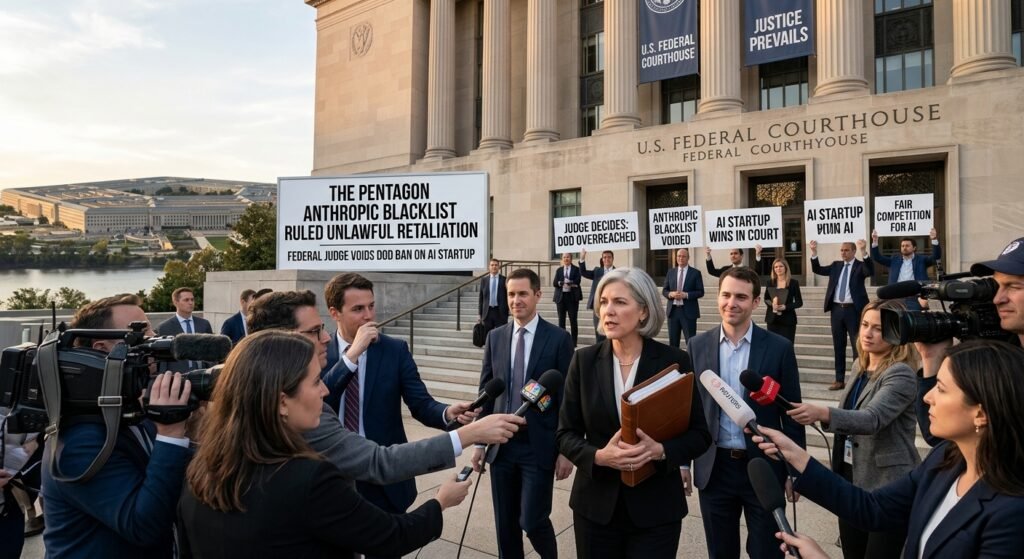
A California federal judge ruled the Trump administration illegally punished AI company Anthropic for criticizing Pentagon AI policy, finding the government’s “supply chain risk” designation violated the First and Fifth Amendments.
A federal judge in California has ruled that the Trump administration acted illegally when it blacklisted AI company Anthropic from working with the federal government, finding the move amounted to unconstitutional retaliation against the company for speaking out publicly about how its technology should be used.
What the Judge Ruled
In a 59-page decision issued Thursday evening, US District Judge Rita Lin of the Northern District of California determined that the Pentagon’s designation of Anthropic as a national security “supply chain risk” violated the company’s First Amendment rights. She also found the government had denied Anthropic the procedural protections required under the Fifth Amendment’s Due Process Clause.
“The empty invocation of national security is not a blank check to punish and retaliate against government critics,” Lin wrote. She was similarly direct elsewhere in her ruling: “Though the Department of War is undisputedly free to select the AI vendor of its choice, the evidence demonstrates that the broad measures imposed on Anthropic were illegal and baseless.”
Lin, a Biden appointee, went on to note that “neither the Constitution nor the federal statute invoked by defendants allows them to impose sweeping penalties based principally on Anthropic’s critique of the Administration’s views.”
How the Dispute Began
The conflict traces back to a proposed $200 million contract for Anthropic to supply AI technology to the Pentagon for use on classified systems. During negotiations, Anthropic sought explicit assurances that its Claude models would not be used for mass surveillance of Americans or in fully autonomous lethal weapons systems. The Pentagon pushed back, insisting it should be permitted to use the technology for all lawful military purposes without those kinds of restrictions.
When the two sides failed to reach an agreement, the dispute escalated dramatically. President Trump ordered federal agencies to stop using Claude entirely, and Defense Secretary Pete Hegseth formally designated Anthropic a “supply chain risk,” a label typically reserved for foreign intelligence entities or organizations linked to sabotage, effectively barring private defense contractors from using Anthropic’s technology in their own work for the military.
Why the Judge Rejected the Government’s National Security Argument
Central to Lin’s ruling was her finding that there was no legitimate factual basis for treating Anthropic as an actual security threat. She noted that the Pentagon had previously vetted and praised Anthropic as a trusted partner, and that it wasn’t until the company publicly raised concerns about how its technology could be used that the government’s posture shifted dramatically.
According to Lin, the Pentagon then “announced a plan to cripple Anthropic: to blacklist it from doing business with any company that services the U.S. military, to permanently cut off its ability to work with the federal government, and to brand it an adversary that could sabotage [the Department of War] and that posed a supply chain risk.” She characterized this as “classic First Amendment retaliation” for a company exposing a disagreement with the government.
Broad Support for Anthropic’s Legal Position
Anthropic’s challenge drew support from a notably wide range of outside organizations during the legal proceedings. Microsoft, the ACLU, and a group of retired military leaders all filed amicus briefs backing Anthropic’s position, reflecting how significant this case had become for the broader question of how AI companies can engage with government contracts without facing retaliation for asserting safety-related conditions.
The Government’s Response
The Trump administration is expected to fight the ruling. Emil Michael, the Pentagon’s Deputy Under Secretary of Defense for Research and Engineering, criticized the decision sharply on social media platform X, calling it “a disgrace” and asserting that the court’s order contained “dozens of factual errors.” Government lawyers had argued during the case that Anthropic’s refusal to lift its usage restrictions created uncertainty for military personnel and potential risks to defense systems, though the court found no factual basis for treating the company as a potential saboteur.
Anthropic, for its part, welcomed the ruling. In a statement, the company said it was “pleased the court has ruled that this supply-chain-risk designation was unlawful,” adding gratitude that the court had “moved swiftly” and agreeing that Anthropic was likely to succeed on the broader merits of its case.
Not the Final Word Yet
This ruling resolves only the first of two separate lawsuits Anthropic filed against the administration back in March. A second case, filed in the US Court of Appeals for the District of Columbia Circuit, remains ongoing. The Trump administration could choose to appeal Judge Lin’s decision directly, or wait for a ruling in that separate, still-pending case before deciding on its next legal steps.
Notably, this isn’t the government’s first attempt to challenge Lin’s involvement in the case. Back in March, when Lin first temporarily blocked the Pentagon’s ban on Anthropic through a preliminary injunction, the Trump administration filed a notice of appeal with the US Court of Appeals for the Ninth Circuit, signaling early on that it intended to fight the case through every available avenue.
Why This Case Matters Beyond Anthropic
Legal observers have described this dispute as touching on fundamental questions about how the government can, and cannot, use national security justifications when a company publicly disagrees with government policy. The case has intensified an unusually public and closely watched debate over how artificial intelligence should be permitted to be used in military and surveillance contexts, and how much leverage AI companies retain to set their own safety conditions when negotiating with the government, without facing retaliatory consequences for doing so.
With significant institutional voices like Microsoft and the ACLU weighing in on Anthropic’s side, the outcome of this case, and its eventual companion case in the DC Circuit, is likely to carry implications well beyond this single contract dispute, potentially shaping how future AI companies navigate similar negotiations with federal agencies going forward.
Frequently Asked Questions
Q: What did the judge rule in the Anthropic case? US District Judge Rita Lin ruled that the Trump administration’s designation of Anthropic as a “supply chain risk” was illegal, finding it violated the company’s First Amendment rights and constituted unlawful retaliation for Anthropic’s public stance on how its AI technology should be used.
Q: Why did the Pentagon label Anthropic a security risk? The dispute stemmed from a proposed $200 million Pentagon contract. When Anthropic sought guarantees that its technology wouldn’t be used for mass surveillance or fully autonomous weapons, and negotiations broke down, the Pentagon designated the company a “supply chain risk” and Trump ordered federal agencies to stop using its Claude AI models.
Q: Is this the final resolution of the dispute? No. This ruling resolves only one of two lawsuits Anthropic filed in March. A second case remains ongoing in the US Court of Appeals for the District of Columbia Circuit, and the Trump administration is expected to appeal this ruling as well.
Q: Which organizations supported Anthropic in this case? Microsoft, the ACLU, and a group of retired military leaders all filed amicus briefs supporting Anthropic’s legal position during the proceedings.
Q: How has the Trump administration responded to the ruling? The administration is expected to appeal. A senior Pentagon official, Emil Michael, publicly criticized the ruling on social media, calling it “a disgrace” and claiming the court’s order contained numerous factual errors.