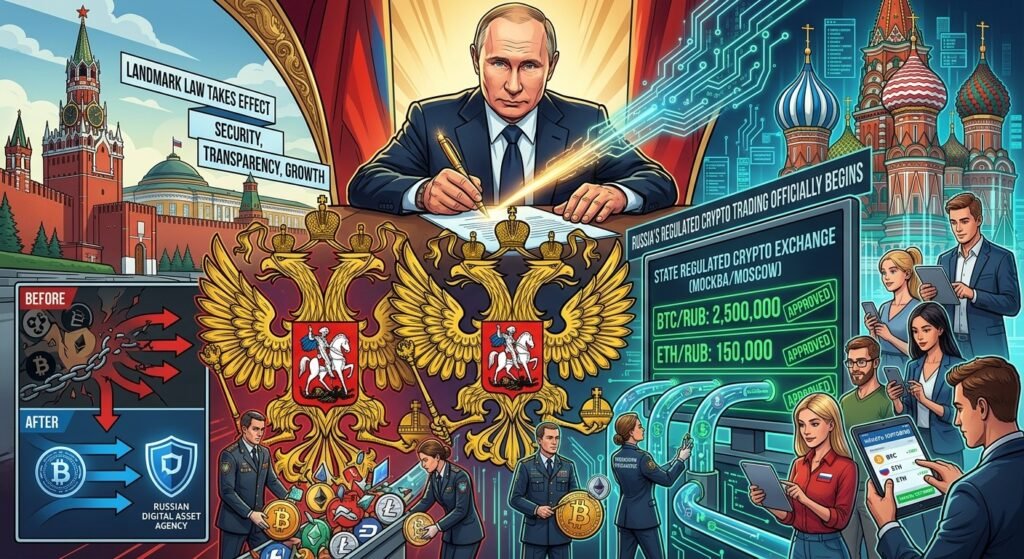
Russia’s first comprehensive crypto trading law takes effect September 1, allowing regulated retail investment through licensed intermediaries while keeping domestic crypto payments banned and opening unrestricted crypto use for foreign trade.
Russia has officially opened the door to regulated cryptocurrency trading, as landmark legislation signed by President Vladimir Putin takes effect September 1, marking the country’s first comprehensive legal framework governing digital assets.
What the Law Actually Establishes
The legislation creates a formal legal structure covering cryptocurrency ownership, licensed trading platforms, custody services, and cross-border settlements, while notably preserving Russia’s longstanding ban on using cryptocurrency to pay for goods and services domestically. Crucially, the law also recognizes cryptocurrencies as property under Russian law for the first time, providing clearer legal protections for holders and their assets, including judicial protection for digital currency holders even if those assets weren’t previously declared.
The framework establishes several new categories of licensed market participants, including crypto exchanges, digital depositories, brokers, management companies, trading venues, and clearing houses, all operating under oversight from the Bank of Russia.
How Retail Investors Can Participate
Under the new rules, both retail and “qualified” investors will be able to buy and sell cryptocurrencies, but under very different conditions. Retail investors must first pass a mandatory knowledge test before they’re permitted to trade, and even then, they’ll only be allowed to purchase the most liquid, officially approved cryptocurrencies through licensed intermediaries. Their activity is further capped at an annual purchase limit of 300,000 rubles (roughly $3,700 to $3,800) per individual intermediary.
Qualified investors, by contrast, face no such restrictions and will be able to purchase any cryptocurrency without the testing requirements or purchase caps applied to retail participants.
Strict Requirements for Exchanges and Platforms
Crypto exchanges hoping to operate legally in Russia will need to join a government-maintained “special registry” and meet a minimum equity requirement of 15 million rubles (approximately $185,000 to $187,000). They’ll also be required to join a financial market self-regulatory organization as part of their compliance obligations. Digital depositories face even steeper capital requirements, ranging from 50 million to 250 million rubles depending on the specific services they provide.
Banks operating in Russia will also play an enforcement role under the new law, required to refuse transfers if they suspect an unauthorized entity is operating an unlicensed cryptocurrency exchange.
A Boost for International Trade, Not Domestic Spending
While Russians still can’t use crypto to buy everyday goods and services at home, the law carves out a significant exception for international trade. Exporters and importers will be permitted to use cryptocurrency for cross-border settlements under foreign trade contracts with non-residents, with no quantitative limit on transaction amounts. These transactions can be conducted either directly through digital wallets or via approved intermediaries, though businesses must still report the transactions and pay applicable taxes.
This provision builds on a pattern that reportedly began in 2024, when Russia started allowing limited crypto use in international trade as a way to counter Western sanctions. Analysts suggest this expanded framework could further encourage the use of cryptocurrencies and stablecoins in Russian international trade, particularly in situations where traditional payment channels face sanctions-related restrictions.
It’s worth noting, though, that this framework doesn’t override foreign sanctions regimes. US sanctions still generally apply to crypto transactions involving blocked Russian parties, and foreign exchanges, wallet providers, and offshore companies remain obligated to comply with the sanctions laws of their own jurisdictions, regardless of what Russia’s domestic framework permits.
A Phased Rollout, Not an Instant Launch
While the core provisions of the law take effect September 1, several important pieces of the framework will roll out gradually over the following year. Market participants have a transition period lasting until July 1, 2027, to obtain the necessary licenses and come into full compliance with the new regulatory standards. Additional technical rules governing digital financial assets, nominal holders, and depositories aren’t set to begin until September 1, 2027, a full year after the law’s initial effective date.
In practice, this means retail access won’t necessarily be fully functional right away. The Bank of Russia still needs to finalize several supporting elements of the system, including the official list of cryptocurrencies eligible for retail trading, investor testing procedures, and detailed rules governing organized trading, pricing methodology, and digital custody. The central bank published draft proposals covering these areas back on July 27, but the practical test now will be whether licensed intermediaries can actually secure approvals and launch compliant products on schedule.
Advertising and Payment Restrictions Remain Strict
Despite opening the door to regulated investment, the law maintains firm restrictions in certain areas. Advertising cryptocurrencies remains banned in Russia, with narrow exceptions carved out specifically for foreign trade settlements and crypto obtained through mining activities. The prohibition on using crypto to pay for goods, services, information, or intellectual property within Russia remains fully intact, reinforcing that this framework is designed to expand investment access and international settlement capability, not to replace the ruble in everyday domestic commerce.
Tighter Rules for Mining Too
Alongside the new trading framework, Russian officials have separately advanced longer-term restrictions on cryptocurrency mining in Moscow, the surrounding region, and parts of Kursk. These measures relate specifically to electricity consumption and mining oversight rather than retail trading activity, reflecting a broader Russian government effort to bring multiple corners of the crypto industry, from trading to mining, under more formal regulatory control simultaneously.
What This Means Going Forward
Russia’s move gives cryptocurrency significantly greater legal recognition within one of the world’s largest economies, a meaningful shift for a country that has historically taken an ambiguous or restrictive stance toward digital assets. That said, analysts caution the framework’s immediate impact on global crypto markets is likely to be measured rather than dramatic, given the retail investment caps, mandatory testing requirements, and the fact that the Bank of Russia hasn’t yet published its list of approved cryptocurrencies for regulated trading.
The real test of this law’s practical impact will likely play out over the coming months, as licensed intermediaries work to secure approvals, the central bank finalizes its remaining technical rules, and both retail and institutional participants begin actually operating within this newly formalized system.
Frequently Asked Questions
Q: When does Russia’s new crypto law take effect? The core provisions take effect September 1, 2026, though market participants have until July 1, 2027, to obtain licenses, and some technical rules won’t be implemented until September 1, 2027.
Q: Can Russians use cryptocurrency to buy everyday goods? No. The law maintains Russia’s existing ban on using cryptocurrency as payment for goods and services domestically. The new framework focuses on investment access and cross-border settlement rather than everyday commerce.
Q: How much can retail investors buy under the new law? Retail investors face an annual purchase limit of 300,000 rubles (roughly $3,700-$3,800) per licensed intermediary, and must first pass a mandatory knowledge test before trading. Qualified investors face no such restrictions.
Q: Does this law help Russia avoid Western sanctions? The law does permit unrestricted cryptocurrency use for cross-border trade settlements between Russian residents and foreign non-residents, which could support alternative payment channels. However, the framework doesn’t override foreign sanctions, and international parties dealing with sanctioned Russian entities remain subject to their own countries’ sanctions laws.
Q: What capital requirements do crypto exchanges face in Russia? Exchanges must join a special government registry and maintain a minimum equity of 15 million rubles (about $185,000-$187,000), while digital depositories face steeper requirements ranging from 50 million to 250 million rubles depending on the services they offer.