
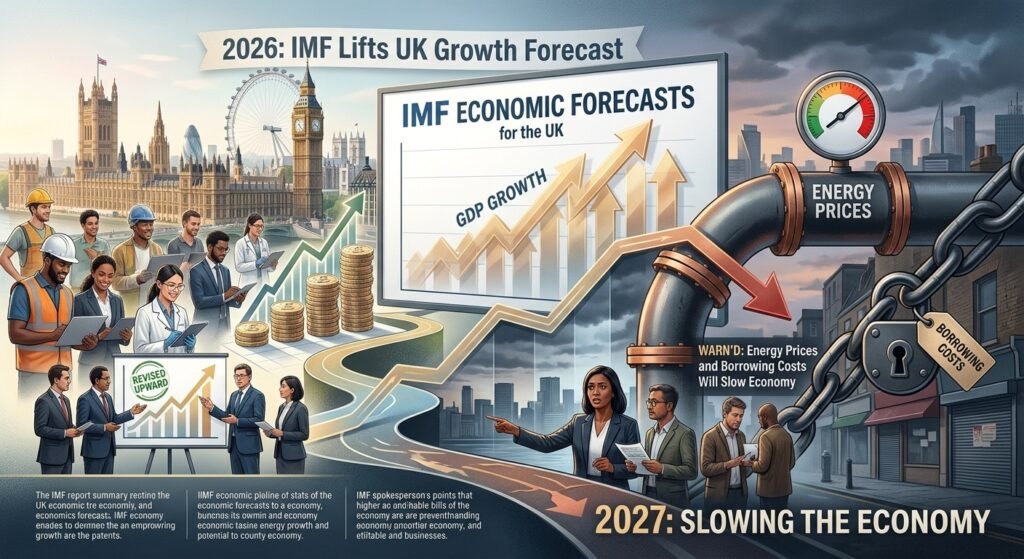
The IMF has raised its UK growth forecast for this year to 1.3%, but says higher energy prices and long-term interest rates will drag growth down to 1.2% in 2027, adding pressure on the Chancellor ahead of the autumn Budget.
There is good news and bad news for the UK economy in the latest forecast from the International Monetary Fund. The fund has upgraded its estimate for growth this year, but it expects the benefit to fade in 2027 as higher energy prices and borrowing costs start to bite.
The Upgrade
In its October World Economic Outlook, published Tuesday, the IMF said it now expects the UK economy to grow by 1.3% in 2026. That compares with 1.0% in its July forecast and 0.8% in April, so the estimate has risen at each update this year.
The upgrade is notable given how gloomy some forecasters were earlier in 2026. In March, for example, KPMG UK had predicted growth of just 0.7% this year, citing the impact of a fresh energy price shock and weak household spending.
The Warning for 2027
For next year, the IMF expects growth to slow slightly to 1.2%, down from its previous forecast of 1.3% for 2027. In its section on Britain, the fund said higher energy prices and long-term interest rates will weigh on consumption and investment.
The IMF places the UK in the middle of the pack among major advanced economies. According to one report on the outlook, the 2026 figure leaves Britain the joint second-fastest-growing economy in the G7, alongside Germany.
Inflation and Jobs
The IMF forecasts that UK inflation will average 3.3% in 2026 and 2.8% in 2027, which is above the Bank of England’s 2% target in both years. Those numbers are close to its predictions for the euro zone and the United States. It also expects unemployment to rise to around 5.3%.
The Bank of England itself has said the global surge in energy prices is likely to push inflation above 4% early next year, in part because the household energy price cap goes up in January. Unlike the European Central Bank and the US Federal Reserve, the Bank of England has not raised interest rates since the US-Iran war began in February, but a higher inflation peak makes a rate rise more likely.
Borrowing Costs at a 28-Year High
One of the IMF’s biggest concerns is the cost of government borrowing. Long-term UK borrowing costs hit their highest level since 1998 last week. Higher yields don’t just make it more expensive for the government to borrow. They also feed through to mortgages, business loans, and investment decisions, which is why the IMF flags long-term rates as a drag on growth.
Risks Beyond the Forecast
The IMF said its outlook depends on how the conflict in the Middle East develops. If it drags on or widens, food and energy costs could stay high and volatile, holding back growth and straining public finances. It also pointed to extreme weather, cyber attacks, and strikes on energy infrastructure as further risks.
More broadly, the IMF’s global outlook says artificial intelligence is supporting growth worldwide, but it warns that rising public debt is a growing risk across many economies.
Political Pressure on the Chancellor
The forecast arrives at a delicate moment for the government. Chancellor John Healey is under mounting fiscal pressure ahead of the autumn Budget, with growth expected to slow and borrowing costs elevated.
Opposition parties have already seized on the figures. Conservative shadow chancellor Andrew Griffith said that if Healey reaches for further tax rises in his Budget, he would be choosing slower growth and working people would pay for it.
What It Means for Households and Businesses
For most people, the practical message is that 2027 may feel tougher than 2026. Energy bills are set to rise in January, inflation is forecast to stay above target, and borrowing remains expensive. For businesses, higher long-term rates can make it harder to justify new investment, which is one reason the IMF expects the slowdown.
At the same time, a 1.3% growth rate this year is a modest but real improvement, and the IMF’s view that the UK sits in the middle of the pack suggests Britain is not an outlier either way.
Frequently Asked Questions
Q: What is the IMF’s new growth forecast for the UK? It expects 1.3% growth in 2026, up from 1.0% in July and 0.8% in April, followed by a slowdown to 1.2% in 2027.
Q: Why will growth slow in 2027? The IMF says higher energy prices and long-term interest rates will weigh on consumer spending and business investment.
Q: What does the IMF expect for UK inflation? Inflation is forecast to average 3.3% in 2026 and 2.8% in 2027, both above the Bank of England’s 2% target. The Bank itself expects a peak above 4% early next year.
Q: Has the Bank of England raised interest rates? Not since the US-Iran war began in February, unlike the European Central Bank and the US Federal Reserve, according to Reuters.
Q: What are the main risks to the forecast? A longer or wider Middle East conflict that keeps food and energy prices high, as well as extreme weather, cyber attacks, and strikes on energy infrastructure.


