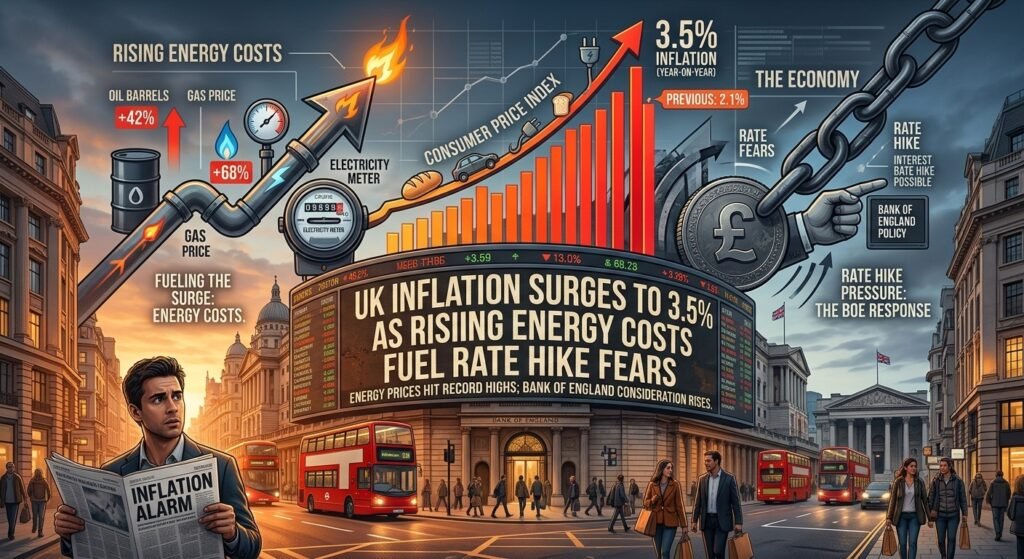
UK annual inflation jumped to 3.5% in September, exceeding forecasts and solidifying expectations that the Bank of England will raise interest rates to tame persistent energy-driven price pressures.
The UK economy faced renewed headwinds as official data revealed annual consumer price index (CPI) inflation accelerated to 3.5% in September, up from 3.1% in August. The hotter-than-expected reading exceeded consensus forecasts and triggered a sharp repricing across financial markets, cementing expectations for an upcoming benchmark interest rate hike by the Bank of England.
The primary catalyst behind the spike was a continued surge in energy and transportation costs, exacerbated by international supply chain disruptions and elevated crude oil prices. Fuel prices, alongside airfares and service industry costs, contributed significantly to the upward trajectory, forcing policymakers to confront stubborn inflationary pressures across the broader economy.
The unexpected jump in headline inflation puts substantial pressure on the Bank of England to tighten monetary policy. Financial markets quickly priced in a higher probability of an upcoming rate increase as central bankers seek to prevent higher energy costs from spilling over into broader wage-price spirals. Consequently, government bond yields rose while equity benchmarks struggled to maintain upward momentum due to fears of rising corporate borrowing costs and squeezed consumer demand.
From an equity perspective, higher interest rates present distinct challenges across cyclical and growth-oriented sectors. Consumer discretionary and housing-related equities faced immediate selling pressure, as elevated mortgage rates and persistent cost-of-living increases continue to weigh on household budgets. Investors now turn their attention to upcoming fiscal announcements and monetary policy commentary to evaluate the long-term durability of corporate earnings in a higher-for-longer rate environment.
Disclaimer: This article is for informational purposes only and does not constitute financial, investment, or trading advice. Readers should conduct their own research or consult with a licensed professional before making any investment decisions.
Frequently Asked Questions (FAQs)
1. Why is a jump in inflation bad for the stock market?
Rising inflation erodes corporate profit margins, reduces consumer purchasing power, and prompts central banks to raise interest rates. Higher rates increase borrowing costs for businesses and lower stock valuations.
2. How does the Bank of England respond to higher inflation?
To tame rising inflation, the Bank of England typically increases its benchmark interest rate. Higher rates raise the cost of borrowing across the economy, slowing economic activity to cool price growth.
3. Which stock market sectors are most vulnerable to inflation and rate hikes?
Growth stocks (like technology companies), housing developers, and consumer discretionary sectors (like retail and leisure) tend to suffer most because higher rates lower future valuation multiples and reduce consumer spending.
4. Are any sectors favored during inflationary environments?
Certain defensive sectors—such as utilities, consumer staples, and financial institutions (like commercial banks)—can sometimes navigate rate hikes better due to essential demand or improved net interest margins.
5. What was the main cause of the UK inflation jump to 3.5%?
The inflation spike was predominantly driven by rising energy input costs, surging domestic fuel prices, and higher service costs filtering through supply chains.