
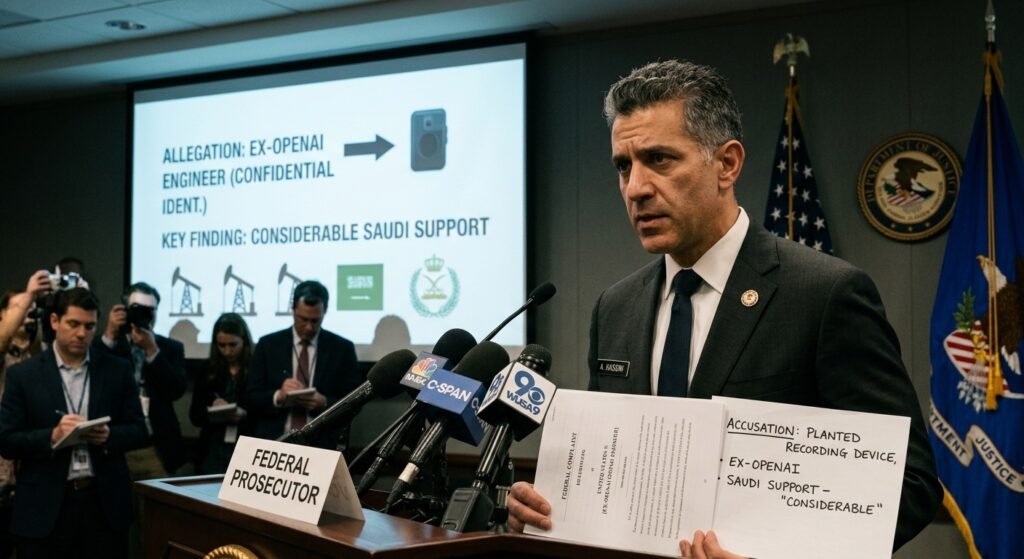
US prosecutors say a former OpenAI engineer charged with planting a recording device in an executive conference room appears to have received considerable support from the Saudi government. He has not been convicted, and the allegations are unproven.
A court filing in San Francisco has added a major new dimension to a case that began with a hidden recording device in an OpenAI conference room. US prosecutors say the former OpenAI engineer accused of planting it appears to have had considerable support from the Saudi government.
The Allegations
Abdulrahman Alfozan, a Saudi national and lawful permanent resident of the United States, was charged last week with using an electronic device to intercept oral communications. According to the criminal complaint, he plugged a recording device into the back of a television in an executive conference room at one of OpenAI’s San Francisco buildings.
OpenAI has said it discovered the device on September 30 and referred the matter to the FBI. According to reporting based on the filing, the recorder was found plugged into the back of the television and covered with toilet paper. A camera was later installed in the room, and prosecutors allege it filmed Alfozan entering the room and looking behind the television on October 5. He was arrested on October 9, and OpenAI ended his contract. Alfozan, who had worked at OpenAI for about a year, is entitled to the presumption of innocence and has not been convicted of anything.
What the Court Filing Says
Prosecutors laid out their case for detaining Alfozan in a filing made public on Monday. They argued that his alleged conduct could pose “a danger to the national security of the United States,” in part because executives from the company met government officials in the affected room while the device is believed to have been installed.
The filing also alleges significant ties between Alfozan and the Saudi government. According to messages cited by prosecutors, a member of the Saudi royal family sought to recruit him for an AI-focused role in Saudi Arabia, writing: “Saudi needs you more then [sic] the US!” Alfozan replied: “100.” Reporting on the filing also says prosecutors state that a planned trip to Saudi Arabia was booked and paid for by a Saudi military official.
The Defence’s Position
Alfozan’s lawyer, William Pernik, previously asked for him to be released from custody under conditions, including location monitoring and surrendering his passport. He said Alfozan has lived in the US for 15 years and has applied to become a citizen.
The lawyer also said Alfozan’s planned trip to Saudi Arabia this month was booked before he came under investigation and was for “family and immigration reasons,” according to a court filing. Alfozan was scheduled to appear in federal court in San Francisco on Monday.
The Saudi Government’s Response
The Saudi government has not publicly responded to the allegations in the filing. Al Jazeera said it had contacted the Saudi embassy for comment.
Why the Case Matters
The case has highlighted security challenges around sensitive AI research as companies and governments compete fiercely for an edge in the technology. A recording device in an executive room could, in theory, capture discussions about strategy, security, and government contacts.
It also echoes earlier cases involving Silicon Valley and Saudi Arabia. In 2019, two former Twitter employees were charged with spying on users on behalf of the Saudi government, and one of them was later convicted. That case, like this one, raised questions about how well technology companies can protect staff and data from foreign influence.
What Happens Next
The immediate question is whether Alfozan will be released or detained while his case proceeds. After that, the case will turn on whether prosecutors can prove the charge, and whether they can show the links to Saudi Arabia they have described. Those links are, for now, allegations made in a court filing and have not been tested in court.
Frequently Asked Questions
Q: Who is Abdulrahman Alfozan? A Saudi national and lawful permanent resident of the US who worked as an engineer at OpenAI for about a year. He is accused of planting a recording device and has not been convicted.
Q: What is he charged with? Using an electronic device to intercept oral communications, according to the criminal complaint.
Q: What did prosecutors say about Saudi Arabia? They said in a court filing that he appears to have received considerable support from the Saudi government and cited messages in which a member of the Saudi royal family tried to recruit him.
Q: What does his lawyer say? His lawyer has asked for his release under conditions and says a trip to Saudi Arabia was booked before the investigation, for family and immigration reasons.
Q: Has Saudi Arabia responded? Not as of the latest reports. Al Jazeera said it had asked the Saudi embassy for comment.


