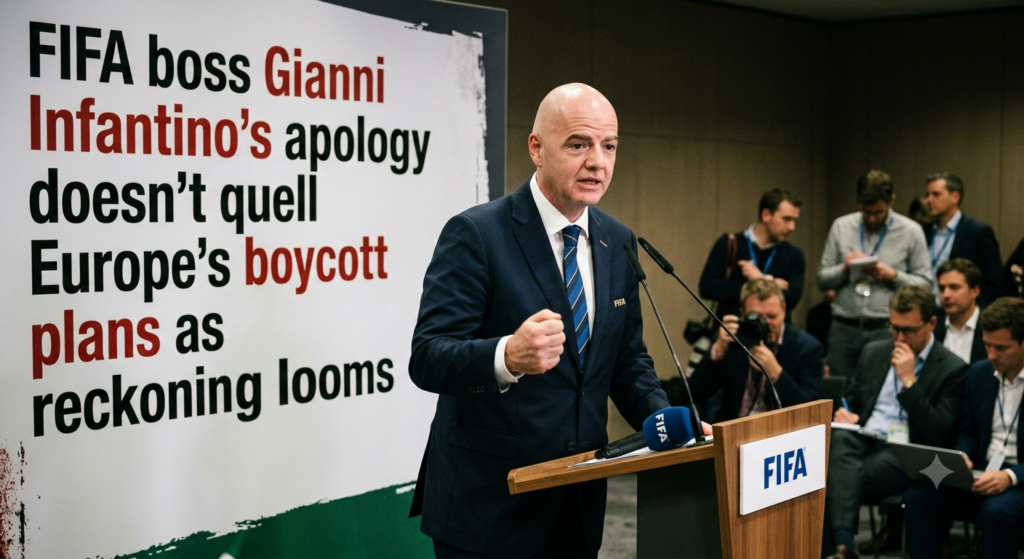
FIFA apologized for its scrapped World Cup privatization plan, but UEFA and Europe’s football bodies are standing firm on a boycott. Here’s what’s driving the standoff.
An apology is supposed to be the moment a crisis starts winding down. For FIFA president Gianni Infantino, it appears to have done the opposite. Just a day after FIFA’s leadership rallied behind him following a tense closed-door meeting in Morocco, Infantino found himself facing an even louder chorus of criticism — and a boycott threat from European football that shows no sign of softening.
At the center of it all is a plan that never actually happened, but has already done serious damage to Infantino’s standing atop world football’s governing body.
The Plan That Sparked the Firestorm
The controversy traces back to a proposal known internally as FIFA Forward Enterprise, which would have sold a minority stake in the commercial and operational rights to the World Cup to private investors. When word of the plan surfaced, the backlash was immediate and severe. Continental football bodies, including UEFA in Europe, along with the global players’ union FIFPRO, condemned the proposal as a threat to the integrity of the sport’s most valuable and symbolically important tournament.
UEFA didn’t stop at public criticism. Its 55 member federations formally agreed to boycott all FIFA competitions, including the World Cup itself, for as long as the privatization plan remained on the table. That kind of coordinated threat from Europe — home to some of the sport’s most powerful federations and wealthiest clubs — represented one of the most serious institutional challenges to Infantino’s leadership since he took office.
Facing that level of resistance, FIFA ultimately withdrew the plan entirely.
Why the Apology Didn’t Land
On the surface, FIFA’s response looked like a reasonable attempt at damage control. Following a crisis meeting in Rabat, Morocco, FIFA and secretary general Mattias Grafström issued a joint statement acknowledging that mistakes had been made in how the plan was developed and rolled out, admitting that member associations were left feeling excluded from a process that should have included them from the start.
But the same statement also revealed why the apology failed to defuse the situation: FIFA’s senior leadership used the moment to reaffirm their full support for Infantino’s presidency, rather than addressing the deeper question UEFA and others were actually asking — whether Infantino should remain in charge at all.
UEFA’s response came fast and left little room for ambiguity. The organization said the conditions it had set for ending its boycott threat simply hadn’t been met. Withdrawing the proposal was only step one; UEFA had also demanded guarantees that an attempt like this would never be repeated, along with a broader reckoning over Infantino’s leadership. Since neither condition had been satisfied, UEFA reiterated that it had lost confidence in his presidency and that its position remained unchanged.
A Wider Rebellion Taking Shape
UEFA isn’t alone in pushing back. FIFPRO, football’s global players’ union, went further than most, accusing Infantino of a serious abuse of presidential power. England’s Football Association also pulled its support for his upcoming reelection bid. Even outside the sport, Amnesty International weighed in, framing the episode as evidence of a deeper need for governance reform within FIFA’s structure.
South America’s governing body, CONMEBOL, added its own concerns, criticizing the lack of transparency that surrounded the plan’s development in the first place — a signal that discontent isn’t confined to Europe alone, even if UEFA has been the most forceful and organized in its response.
Not every confederation has turned against Infantino, though. Africa’s governing body, CAF, publicly reaffirmed its backing for his presidency shortly after the Morocco meeting, with its leadership crediting Infantino’s support for African football over the years. That split reaction — vocal European rebellion against continued support elsewhere — highlights just how divided global football’s power structure has become over this episode, and hints at how contentious the next presidential election could get.
What’s Actually at Stake
FIFA’s next presidential election is scheduled for March 2027, and this controversy is quickly becoming the defining issue heading into that race. A boycott from UEFA’s 55 member nations would be almost unthinkable in practical terms — Europe fields some of the most competitive national teams and generates a massive share of football’s global commercial value. Even the credible threat of that outcome gives UEFA enormous leverage in this standoff, regardless of whether the boycott is ever actually carried out.
FIFA, for its part, appears to be betting that presenting a unified internal front will be enough to ride out the storm until tensions cool. Its statement following the Morocco meeting was explicit about that strategy, closing with a warning that FIFA would no longer tolerate what it characterized as attacks on its integrity and governance now that the privatization plan has been withdrawn.
Whether that approach works largely depends on how UEFA and its allies choose to escalate — or whether they hold their position purely as leverage heading toward March. Either way, an apology alone clearly wasn’t enough to close this chapter. If anything, it’s exposed just how fragile the coalition backing Infantino’s leadership has become.
What to Watch Next
The coming weeks are likely to bring more pressure rather than resolution. Watch for whether other confederations align more closely with UEFA’s position or, like CAF, continue backing Infantino. Also worth tracking: whether a credible challenger emerges ahead of the March 2027 election, and whether FIFA offers any additional governance concessions beyond simply withdrawing the original plan. For now, the reckoning UEFA warned about hasn’t arrived — but it hasn’t gone away either.
Tags: Gianni Infantino, FIFA, UEFA, World Cup boycott, FIFA presidency, FIFA Forward Enterprise, football governance, FIFPRO, soccer news 2026, sports politics
FAQs
1. Why did UEFA threaten to boycott FIFA competitions? UEFA and other football bodies opposed FIFA’s now-scrapped plan to sell a minority stake in the World Cup’s commercial and operational rights to private investors, arguing it threatened the tournament’s integrity and excluded member associations from the decision-making process.
2. Did FIFA apologize for the World Cup privatization plan? Yes. Following a crisis meeting in Morocco, FIFA issued a statement acknowledging mistakes were made in how the plan was developed and communicated, though it did not address calls for Infantino to resign.
3. Is UEFA still planning to boycott the World Cup? As of the latest statements, UEFA says its conditions for ending the boycott threat have not been met and that its 55 member federations maintain their position.
4. Are other football organizations supporting the boycott? FIFPRO and South America’s CONMEBOL have both raised concerns, while England’s Football Association withdrew its support for Infantino’s reelection. However, Africa’s governing body, CAF, has publicly reaffirmed its backing for Infantino.
5. When is the next FIFA presidential election? FIFA’s next presidential election is scheduled for March 2027, and this controversy is expected to significantly shape that race.
6. What was the FIFA Forward Enterprise plan? It was a proposal to sell a minority stake in the commercial and operational rights to the World Cup to private investors, which FIFA ultimately withdrew after facing widespread opposition from continental football bodies and players’ organizations.