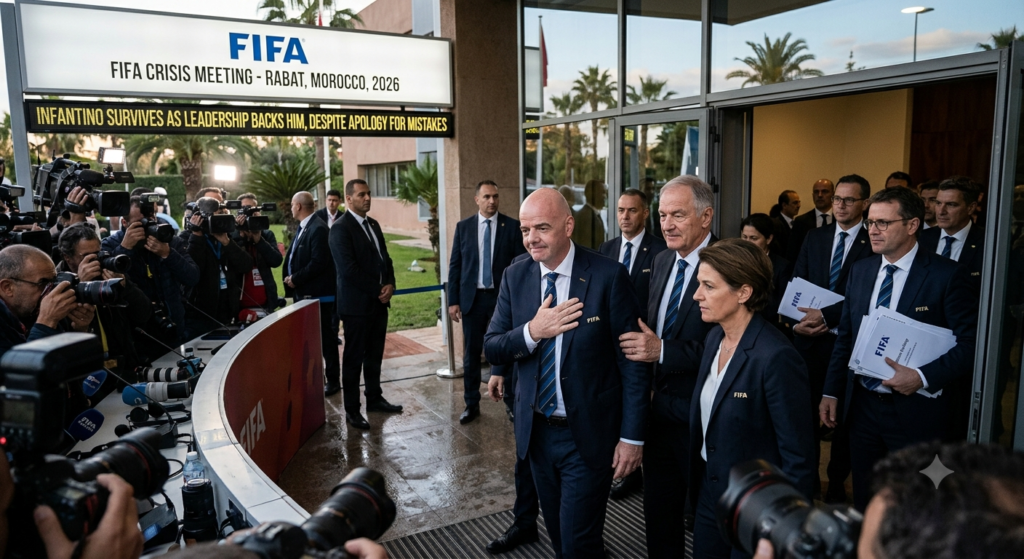
FIFA president Gianni Infantino apologized for “mistakes” over a scrapped World Cup commercial rights plan, but retained the backing of FIFA’s leadership following crisis talks in Morocco.
FIFA president Gianni Infantino has weathered the biggest challenge to his leadership since taking office in 2016, emerging from marathon crisis talks in Morocco with the continued backing of the organization’s management board — despite issuing a formal apology for what FIFA called “mistakes.”
The seven-hour meeting in Rabat came after weeks of mounting pressure over a now-abandoned proposal to sell commercial rights tied to the World Cup through a new entity called FIFA Forward Enterprise (FFE). The plan, which leaked to media before member associations were formally consulted, triggered a wave of criticism from major soccer bodies and reignited long-simmering concerns about how FIFA is governed.
What FIFA Said After the Meeting
In a statement released following the talks, FIFA acknowledged that “mistakes” had been made in how the proposal was handled, adding that it was “not the intention for the FIFA Council and FIFA Member Associations to feel excluded from the process” and that “the process should have been handled differently.” The organization also admitted that further errors occurred after the plan was leaked to the press.
FIFA confirmed that a formal apology had been sent in a letter to the FIFA Council and member associations, with a commitment to “ensure they do not happen again.” The statement framed the outcome of the meeting as one that would “strengthen FIFA’s governance” and “help restore confidence in the organisation.”
Secretary General Mattias Grafström and other members of the management board who attended the Rabat meeting reaffirmed their “full support” for Infantino’s presidency. Infantino later posted a photo on Instagram showing himself sitting beside Grafström, both giving a thumbs-up — a notable image given that Grafström had, only days earlier, publicly described the World Cup proposal as “a sad and reproachable series of events.”
Growing Calls for Infantino to Step Down
Not everyone was satisfied with the outcome. Criticism of Infantino has come from multiple directions in recent weeks. UEFA said it had “lost confidence in the current FIFA leadership,” while England’s Football Association called for a “full and robust review” of how FIFA is run. The head of Jordan’s football association went further, accusing Infantino of “blackmail.”
Former Portuguese football great Luis Figo, who once ran against Infantino for the FIFA presidency, called for his resignation, describing his conduct as among “the lowest, most deceitful and cravenly self-interested behaviour” he has witnessed. Figo has continued pressing the point since, saying Infantino has “debased the office.”
Political voices weighed in too. Canadian Prime Minister Mark Carney — whose country co-hosted the most recent World Cup alongside the US and Mexico — said the controversy should be “fatal” to Infantino’s position as FIFA president.
A Divided Response Across Confederations
The backlash hasn’t been uniform across global soccer. Governing bodies representing Europe, Asia, and North and Central America all criticized the FFE proposal, and the association representing Europe’s top domestic leagues — including the Premier League, La Liga, and Serie A — separately called for governance reforms at FIFA, describing the scrapped plan as “dangerous.”
The Confederation of African Football, notably, has not taken an official stance against Infantino. Reuters reported that five prominent African football administrators have publicly backed him, a dynamic partly explained by African soccer’s heavier financial dependence on FIFA-distributed funding compared to other continents.
Adding another layer to the controversy, FIFA denied a British media report alleging that Infantino, while seeking support for his position, had offered Morocco hosting rights for the 2030 World Cup final. Morocco is one of three co-hosts for that tournament, alongside Spain and Portugal, and its football association has publicly reaffirmed its support for Infantino throughout the crisis.
What Happens Next
While Infantino has secured backing from FIFA’s management board for now, the episode has clearly exposed deep divisions within global soccer’s governing structure. Several major confederations and leagues have indicated that trust will need to be rebuilt through actual governance reform, not just an apology. Until that happens, some bodies have said they will resist any “expansion or creation” of new FIFA competitions.
Whether this crisis meeting marks the end of the controversy or simply a pause before renewed pressure remains to be seen.
Frequently Asked Questions
Q: What was the FIFA Forward Enterprise (FFE) proposal? It was a plan from Infantino to sell commercial rights linked to the World Cup through a newly created commercial subsidiary. The proposal was scrapped after it leaked to the media and drew widespread criticism from FIFA member associations and confederations.
Q: Did Gianni Infantino apologize? Yes. FIFA sent a formal letter of apology to its Council and member associations, acknowledging “mistakes” and “errors” in how the proposal was handled and how information was managed after it leaked.
Q: Is Infantino stepping down as FIFA president? No. Following the crisis meeting in Morocco, FIFA’s management board, including Secretary General Mattias Grafström, reaffirmed its full support for his presidency.
Q: Which organizations have criticized Infantino? UEFA, the English FA, and the association representing Europe’s major domestic leagues have all been vocal critics, alongside individual figures like Luis Figo and Canadian Prime Minister Mark Carney.
Q: Has every football confederation opposed the plan? No. While Europe, Asia, and North/Central America’s governing bodies criticized the proposal, the Confederation of African Football has not taken an official stance, and several senior African football officials have expressed support for Infantino.