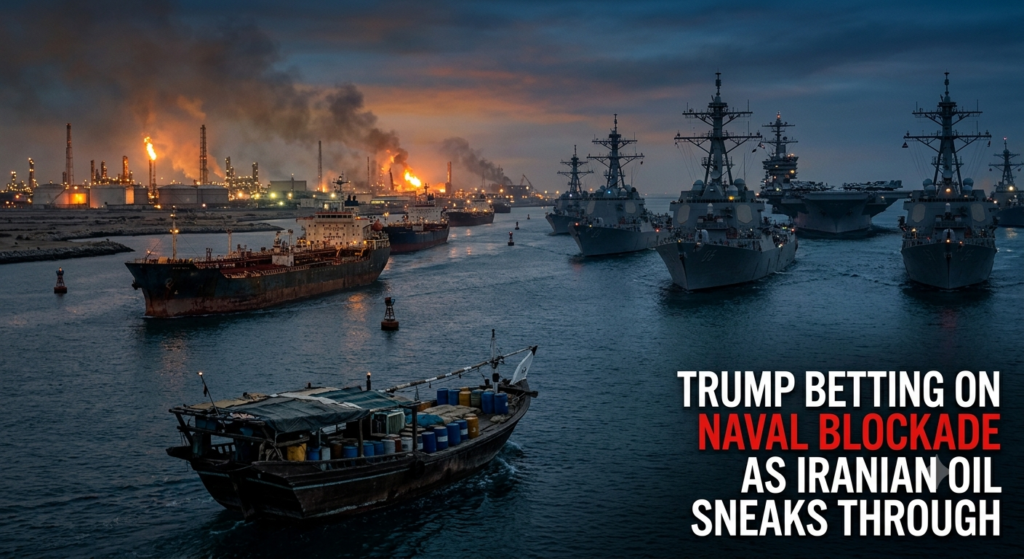
President Trump is betting that a prolonged US naval blockade can weaken Iran’s economy enough to force concessions, even as reports suggest millions of barrels of oil are still leaving the Gulf undetected.
After stepping back from renewed full-scale military action against Iran, President Trump is now leaning into a different kind of pressure campaign — one built around economic strangulation rather than airstrikes. His bet: that Iran’s collapsing economy, worsened by an ongoing US naval blockade, can accomplish what weeks of bombing couldn’t.
Trump’s “Low-Key” Strategy
In a weekend interview, Trump described the current approach as “low keying it,” characterizing ongoing engagement with Iran as only “semi-negotiating.” His comments suggest a deliberate strategy of letting economic pressure do the heavy lifting rather than pushing for a fast resolution through military escalation.
“We are just watching Iran with its huge inflation and the fact they have no money,” Trump said, adding that Tehran is struggling to even pay its own troops. He described Iran’s economy as being in “very bad shape,” directly crediting the naval blockade for deepening the country’s financial crisis.
Notably, this shift in strategy has come with a side benefit for American consumers: oil prices have eased as Trump has pulled back from resuming large-scale combat operations, giving diplomatic efforts more room to play out.
Why a Full Reopening of Hormuz Remains Elusive
While Iran and Oman have been negotiating over how to manage traffic through the Strait of Hormuz, any resulting agreement wouldn’t automatically restore the waterway to normal operations. Iran has made clear that a full reopening depends on the US meeting a list of demands first.
Over the weekend, Iran’s Supreme National Security Council formally called on the US to lift the naval blockade, end sanctions, withdraw military forces from the region, pay war reparations, unfreeze Iranian financial assets, halt attacks on Iran’s regional proxies, and stop what it characterized as ongoing threats against the country. That list of conditions makes clear just how far apart the two sides remain, even amid signs of progress on narrower shipping arrangements.
Cracks Beneath Iran’s Public Confidence
Despite the defiant tone from senior Iranian officials, real anxiety about the country’s economic trajectory appears to be building beneath the surface. High inflation and a currency collapse already triggered nationwide protests earlier this year, which were met with a harsh government crackdown in January.
According to sources cited by the Wall Street Journal, more moderate voices within the regime have grown increasingly concerned that the reimposed naval blockade is pushing Iran’s economy toward the brink of collapse. Iran’s own deputy foreign minister has acknowledged that the country urgently needs the kind of sanctions relief that a deal with Washington could unlock. That admission echoes earlier reporting that Iran’s president and central bank chief had privately warned the country’s supreme leader that the initial blockade was severely damaging the economy.
Trump, for his part, sounded cautiously optimistic about where things are headed, telling interviewers, “It will work out. It always works out. It’s like a chess game” — even as both sides continue accusing each other of acting in bad faith.
Military Limits Behind the Strategy Shift
Trump’s apparent willingness to let economic pressure play out over time also reflects a narrowing set of military options. Despite roughly 40 days of sustained bombardment followed by another two weeks of renewed strikes last month, US forces were unable to fully reopen the Strait of Hormuz through military means alone.
Compounding the issue, US munitions stockpiles — including interceptors critical for defending against Iranian drone and missile attacks — have reportedly grown thin. Adding to the pressure, the Pentagon’s top military officer is said to be actively seeking an “off-ramp” from further direct conflict, according to earlier reporting.
One US official suggested to Axios that the absence of active war may actually work in Washington’s favor strategically, arguing that ongoing combat had previously given Iran’s regime a convenient excuse to avoid confronting its economic failures directly. Without that distraction, the argument goes, economic strain becomes harder for Tehran to deflect.
Oil Is Still Quietly Leaving the Gulf
Even amid the blockade, oil isn’t fully cut off. A US official told Axios that roughly 8 million barrels are slipping out of the Persian Gulf each night through a southern lane of the Strait of Hormuz, reportedly with quiet assistance from the US military — and that this arrangement will likely continue as long as no formal deal is reached.
This mirrors an earlier pattern from before the ceasefire collapsed, when US forces guided tankers along an alternate route hugging the Omani coastline, providing enough protection to ease pressure on global oil markets. That arrangement fell apart after Iran began targeting vessels attempting to bypass its own designated shipping corridor, which reignited hostilities and led to the current standoff.
Publicly available maritime traffic data has shown little movement through the strait recently, but that picture may be incomplete — it likely doesn’t capture vessels that have gone “dark” by disabling their transponders to avoid detection while still moving oil out of the region.
A Deepening Divide Inside Iran’s Government
Any additional flexibility the US gains in global oil markets could also work to widen existing divisions within Iran’s leadership. On one side sit pragmatists, including President Masoud Pezeshkian, who appear increasingly focused on the economic toll and are pushing for a deal with Washington that could unlock meaningful concessions.
On the other side are hardliners, led by the Islamic Revolutionary Guard Corps, who remain firmly opposed to any negotiations with the US. These tensions have occasionally spilled into public view, even through Iran’s own state-run media. Deputy Foreign Minister Kazem Gharibabadi, a key negotiator viewed as part of the more pragmatic camp, pushed back on domestic critics of negotiation, saying he struggles to understand what reality opponents of talks are operating in.
What Could Change the Calculus
Trump’s patience with this slower, economically driven approach may still be tested. With oil inventories reportedly dwindling toward critically low levels, a sudden supply crunch that sends energy prices spiking again could complicate the strategy and increase pressure for a faster resolution — whether through renewed military action or a more urgent push toward a negotiated deal.
For now, though, the standoff continues along two tracks simultaneously: quiet economic pressure squeezing Iran from the outside, while internal political divisions over how to respond continue playing out within Tehran itself.
Frequently Asked Questions
Q: Is the US still bombing Iran? No. Trump has stepped back from renewed full-scale military action for now, instead relying on the ongoing naval blockade and economic pressure as his primary strategy.
Q: Has the Strait of Hormuz fully reopened? No. While Iran and Oman have discussed a shipping arrangement, Iran insists the strait won’t fully reopen until the US meets a list of demands, including lifting the naval blockade and ending sanctions.
Q: How much oil is still leaving the Persian Gulf despite the blockade? A US official told Axios that roughly 8 million barrels are exiting the Gulf nightly through a southern lane of the strait, reportedly with US military assistance.
Q: Why hasn’t the US fully reopened Hormuz through military force? Despite roughly 40 days of bombing and additional strikes last month, US forces were unable to fully secure the strait militarily, and US munitions stockpiles have reportedly grown thin.
Q: Is Iran’s government united on how to respond to the US? No. Reports point to a divide between pragmatists like President Masoud Pezeshkian, who favor a deal to ease the economic crisis, and hardliners within the Islamic Revolutionary Guard Corps who oppose negotiating with the US.