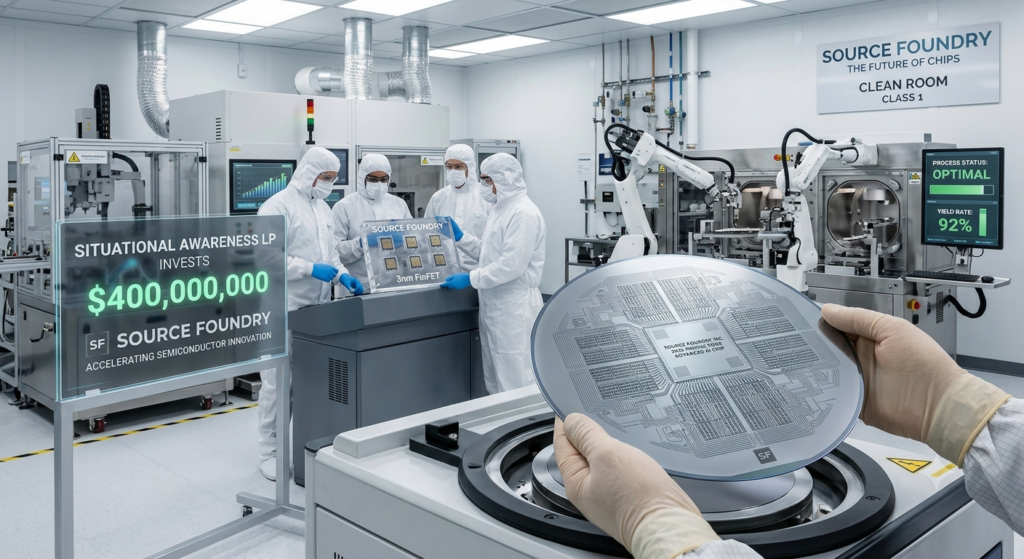
AI-focused hedge fund Situational Awareness has invested $400 million more into chip startup Source Foundry, bringing its total stake to $500 million, just weeks after selling most of its public portfolio to survive steep losses.
Six weeks ago, Situational Awareness looked like it might become a cautionary tale about the dangers of betting everything on a single conviction. Now, the AI-focused hedge fund founded by former OpenAI researcher Leopold Aschenbrenner is back to writing nine-figure checks — this time into Source Foundry, a Stanford-founded startup working to reinvent how computer chips get manufactured.
The Details of the Deal
According to reporting from the Wall Street Journal, Situational Awareness has committed $400 million in fresh capital to Source Foundry this week, bringing the fund’s total investment in the company to $500 million, including an earlier $100 million position. Source Foundry, reportedly now valued at around $5 billion, was founded last year by Stanford researchers Abdulmalik Obaid and Joe Burg, and has also previously drawn backing from Sequoia Capital.
Unlike traditional chip manufacturers, Source Foundry isn’t building its own fabrication plants to compete directly with giants like TSMC. Instead, the startup is focused on developing tools aimed at solving a major bottleneck in semiconductor production: lithography, the precision process used to etch circuit patterns onto silicon wafers. Sequoia partner Stephanie Zhan has previously described the company’s mission as targeting one of the most persistent chokepoints in modern chip manufacturing.
A Fund That Nearly Didn’t Survive July
This new investment comes at a striking moment for Situational Awareness. Just weeks earlier, the fund was forced to offload the vast majority of its public stock holdings to Ken Griffin’s Citadel in what one prominent investor described as the most catastrophic hedge fund blowup of the year. Assets under management at Situational Awareness reportedly peaked near $45 billion before crashing to roughly $10 billion amid a broader downturn in AI infrastructure stocks. Investor Ross Gerber has pointed to the fund’s forced unwind as a major contributor to last month’s wider tech-sector selloff.
Despite the scale of that collapse, Situational Awareness held onto its position in one company throughout the turmoil: Anthropic. That decision to preserve its Anthropic stake, even while liquidating the rest of its public portfolio, suggests the fund’s leadership still sees long-term conviction in select AI-related bets, even after taking a major hit elsewhere.
Who Is Leopold Aschenbrenner?
Aschenbrenner launched Situational Awareness in 2024 while still in his mid-twenties and with no prior trading experience. A former OpenAI researcher, he’s perhaps best known for authoring a widely circulated 2024 essay, also titled “Situational Awareness,” which argued that AI development was progressing far faster than most people realized. That essay effectively became the intellectual foundation for the fund itself, and helped attract early backers including the Collison brothers and Nat Friedman.
The fund’s early returns were reportedly strong, riding the broader AI investment wave. But steep losses tied to declining AI infrastructure valuations in recent months forced the dramatic portfolio liquidation that nearly ended the fund entirely.
Betting Big Again, Just More Selectively
The Source Foundry investment signals that, even after a brutal stretch, Situational Awareness isn’t retreating from high-conviction, high-risk bets — it’s simply concentrating them more narrowly. Rather than spreading capital across a broad public portfolio, the fund now appears focused on a smaller number of private, high-upside positions in companies it believes are positioned at critical points in the AI supply chain.
Semiconductor manufacturing tools sit squarely in that category. As AI companies continue racing to build more powerful chips at greater scale, startups like Source Foundry that promise to speed up or reduce the cost of chip production represent exactly the kind of infrastructure bet that fits Situational Awareness’s original AI-focused thesis, even if the fund’s overall risk tolerance has clearly been tested this year.
What This Signals for AI Infrastructure Investing
Situational Awareness’s willingness to deploy hundreds of millions of dollars so soon after a near-collapse suggests continued institutional confidence in the semiconductor manufacturing space specifically, even as broader sentiment toward AI infrastructure stocks has cooled. It also reflects a broader pattern seen across venture and hedge fund investing this year: firms retreating from public equities exposed to AI hype cycles while doubling down on private companies solving more fundamental, infrastructure-level problems within the AI supply chain.
Whether this bet pays off will likely depend heavily on whether Source Foundry can deliver on its promise to meaningfully speed up and lower the cost of chip production — a technical challenge that has proven difficult for far more established players in the semiconductor industry.
Frequently Asked Questions
Q: How much has Situational Awareness invested in Source Foundry total? The fund’s total investment now stands at $500 million, including an initial $100 million position and a new $400 million infusion this week.
Q: What does Source Foundry actually make? Source Foundry develops tools aimed at improving semiconductor lithography, the precision process used to etch circuit patterns onto silicon chips, rather than manufacturing chips directly like TSMC.
Q: Why did Situational Awareness nearly collapse? The fund’s assets under management fell from roughly $45 billion to about $10 billion amid steep losses tied to a broader decline in AI infrastructure stocks, forcing it to sell most of its public portfolio to Citadel in late July.
Q: Who founded Situational Awareness? The fund was founded in 2024 by Leopold Aschenbrenner, a former OpenAI researcher who was in his mid-twenties at the time and had no prior trading experience.
Q: Did Situational Awareness sell all of its holdings during its portfolio liquidation? No. The fund sold the majority of its public stock portfolio to Citadel but retained its stake in Anthropic.