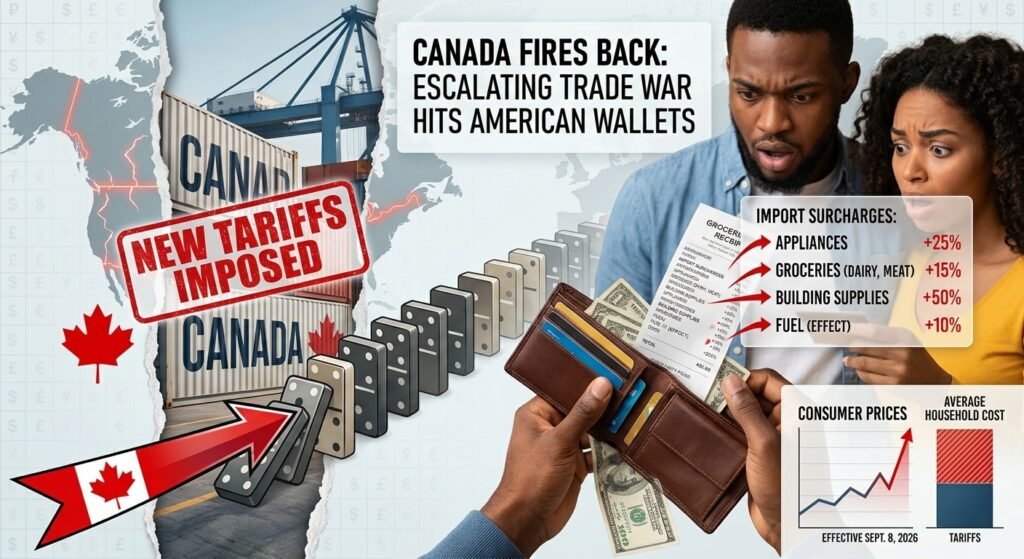
Canada is imposing tariffs of up to 50% on over 700 US goods starting September 8, matching Trump’s tariffs dollar for dollar. Here’s what it could mean for American jobs, prices, and everyday goods.
The trade dispute between the US and Canada has escalated into a genuine tit-for-tat fight, with Canada announcing sweeping new tariffs on American goods this week in direct retaliation for tariffs the Trump administration imposed just days earlier. For everyday Americans, the fallout could show up in higher prices, fewer product choices, and in some industries, real pressure on jobs.
What Canada Just Announced
Starting September 8, Canada will impose tariffs ranging from 15% to 50% on more than 700 American goods, an effort Canadian officials describe as matching US tariffs “dollar for dollar, rate for rate.” The new duties will cover roughly $20 billion worth of annual US exports to Canada, concentrated in sectors including steel, dairy, appliances, agricultural equipment, pulp and paper, and electronics.
Notably, Canada is doubling its duties on US steel and aluminum to 50%, mirroring the exact rate the US has imposed on Canadian steel and aluminum. Canadian Finance Minister François-Philippe Champagne framed the move as a direct response to failed negotiations: “When the United States asked too much and offered too little, we chose to stand up for Canadians.”
How We Got Here
This latest round of retaliation follows a rapid escalation over the past two weeks. Trade talks between the two countries collapsed on Friday after the US introduced last-minute conditions that Canadian Prime Minister Mark Carney called unacceptable. Just days later, the Trump administration imposed 50% tariffs on roughly $20 billion worth of Canadian goods, and Trump has since threatened even further measures, including a potential doubling of tariffs on Canadian cars and auto parts to 50%, starting January 1.
Trump has been notably blunt in his public criticism of Canada throughout this stretch, accusing the country on social media of “Ripping Off” the US for decades, and referring to Prime Minister Carney dismissively as “Governor Carney” — a jab referencing Trump’s past suggestions that Canada would be better off as a US state.
What This Actually Means for Americans
The core risk for American consumers and workers comes down to a fairly direct chain of cause and effect: when Canada imposes steep tariffs on US goods, it becomes more expensive for Canadian buyers to purchase those products, which can weaken demand. Weaker demand can then translate into American businesses cutting workers’ hours or, in more serious cases, resorting to layoffs.
This matters more than it might initially seem, because Canada isn’t a minor trading partner — it’s the second-largest export market for American goods overall, and the single largest export market for specific categories like US household appliances, which purchased more than $1 billion worth of American appliances last year. Most of those appliances will now face a 25% tariff entering Canada.
To put the scale of this dispute in context: the latest American tariffs cover about 5% of the goods the US imports from Canada, while Canada’s new retaliatory tariffs cover roughly 6% of the goods the US exports to Canada, according to US trade data.
Prices Americans Might Actually See Change
According to trade analysts, the most immediate effect on American consumers is likely to be uneven rather than a broad, uniform price increase across the board. Higher prices or reduced product selection are most likely for specific Canadian imports like wine, furniture, clothing, cement, and sporting equipment — categories where Canada has historically been a significant supplier to the US market.
On the flip side, American automobiles and the defense industry are considered particularly vulnerable to Canadian retaliation. If Canada were to impose a 25% tariff on all US automobile imports, for example, Canadian consumers would likely shift significantly toward Japanese, Korean, Chinese, and European vehicles instead — a real loss of market share for American automakers in one of their largest export markets.
The Bigger Threats Still on the Table
Tariffs aren’t the only tool Canada has available if this dispute continues to escalate. Ontario Premier Doug Ford said in an interview this week that Canada should be prepared to cut off electricity exports to the United States if the trade war worsens — a genuinely significant threat, given that Ontario supplies electricity to several US states, including New York, Michigan, and Minnesota. Carney echoed that sentiment on Monday, telling reporters plainly that “nothing is off the table.”
Beyond electricity, Canada could also restrict exports of other strategically important goods to the US, including energy products and potash, a key ingredient in fertilizer that American farmers rely on.
The Cost-of-Living Backdrop
This trade dispute isn’t unfolding in a vacuum — it’s landing at a moment when American household costs are already climbing. The overall cost of living is up 3.4% from a year ago, according to July Consumer Price Index data. Gas prices have jumped nearly 25% compared to last year, and the cost of powering homes has risen too, with both electricity and piped natural gas up roughly 4% annually. Any further price pressure stemming from this trade fight would be layered directly on top of those existing cost increases.
How Canada Is Cushioning the Blow at Home
Canadian officials aren’t just imposing new tariffs — they’re also trying to soften the impact on their own businesses. Alongside the retaliatory measures, Canada unveiled a support package worth roughly $7.5 billion Canadian dollars (about $5.4 billion USD) specifically aimed at helping domestic businesses hurt by the new duties. Canadian officials have also noted that the government has provided more than $30 billion Canadian dollars (around $21.7 billion USD) in tariff-related support since the start of 2025 — a figure that actually exceeds what Canada has collected in retaliatory tariffs so far, reflecting just how costly this trade fight has already become for Ottawa, even as it continues pushing back against Washington.
Real Businesses Caught in the Middle
Beyond the macro-level trade statistics, individual American business owners are already voicing concern about what a prolonged dispute could mean for them directly. Michael Howard II, who owns a furniture business in Warren, Michigan, near Detroit, said the tariffs threaten his ability to “put food on the table” for his family and to continue supporting his local community, after building the business with his wife over the past decade.
The Business Roundtable, a group representing roughly 200 chief executives from major US corporations, has also weighed in publicly, warning that the new tariffs “risk raising costs for American businesses and families” and calling on both governments to return to the negotiating table.
What Happens Next
With Canada’s new tariffs set to take effect September 8, and Trump having already signaled the possibility of further escalation on Canadian auto tariffs come January, the coming weeks are likely to determine whether this dispute stabilizes or continues intensifying. Given how deeply integrated supply chains are between the two countries across autos, energy, agriculture, and manufacturing, prolonged conflict carries real risk for businesses and workers on both sides of the border — a dynamic that’s likely to keep pressure on both governments to eventually find a path back to negotiation, even as neither side has shown signs of backing down just yet.
Frequently Asked Questions
Q: When do Canada’s new tariffs take effect? Canada’s retaliatory tariffs, ranging from 15% to 50% on more than 700 American goods, are set to take effect September 8.
Q: Why is Canada imposing these new tariffs? Canada is retaliating against 50% US tariffs imposed on roughly $20 billion worth of Canadian goods, following the collapse of trade negotiations between the two countries last week.
Q: What American products are most likely to be affected? Steel, dairy products, appliances, agricultural equipment, pulp and paper, and electronics are the primary sectors targeted by Canada’s new tariffs, covering roughly $20 billion worth of annual US exports.
Q: Could this trade war escalate further? Yes. Trump has threatened to potentially double tariffs on Canadian cars and auto parts to 50% starting January 1, while Canadian officials have suggested they could restrict exports of electricity, energy, and potash if tensions continue to worsen.
Q: How might this affect prices for everyday Americans? The impact is expected to be uneven rather than uniform, with higher prices or reduced availability most likely for specific goods like Canadian wine, furniture, clothing, cement, and sporting equipment, layered on top of already elevated costs for gas and household energy.