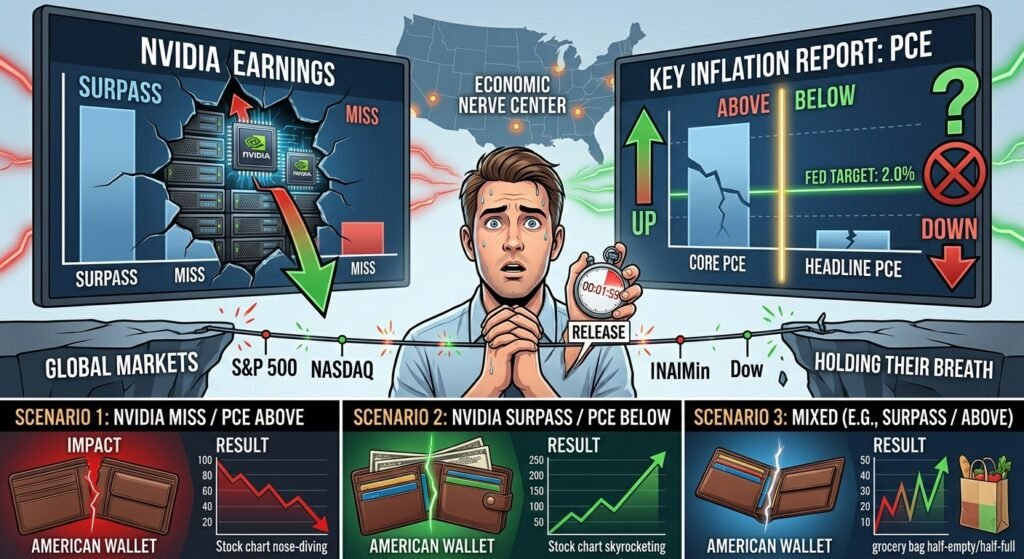
Stocks wavered and Treasury yields slipped Tuesday as traders stayed cautious ahead of Nvidia’s earnings and Friday’s PCE inflation report, with oil extending a third straight day of declines.
Wall Street spent Tuesday in a holding pattern, unwilling to make any big directional bets with two major catalysts looming just ahead: Nvidia’s earnings report and a closely watched inflation reading due later this week.
How Markets Traded
Futures for the S&P 500 slipped about 0.1%, while Nasdaq 100 futures were down roughly 0.2%, as traders held back from taking on additional risk ahead of Nvidia’s results, widely viewed as the single most important earnings report of the week given the company’s role as a bellwether for the broader AI trade. Treasuries retreated across the curve as investors looked ahead to July’s reading of the Federal Reserve’s preferred inflation gauge, shrugging off a third consecutive daily decline in oil prices. The dollar held roughly steady, while gold and Bitcoin both posted only modest moves.
That cautious tone followed a choppier session Monday, where major indexes actually managed a late recovery after slipping from early highs. The Nasdaq Composite led gains, up 0.7%, the Russell 2000 added 0.5%, and both the S&P 500 and Dow Jones Industrial Average rose 0.3%. Much of that support came from a reversal in two of the prior week’s biggest pressure points: Treasury yields fell sharply across the curve, with 2-, 10-, and 30-year yields all dropping around 7 basis points, partly on easing expectations for a Fed rate hike, while crude oil dropped more than 3% to around $82 a barrel on hopes that Pakistan could help revive stalled talks around the US-Iran conflict and the potential reopening of the Strait of Hormuz.
Chip Stocks Try to Find Their Footing
Semiconductor stocks have been at the center of market attention for days, and Tuesday brought some relief. Nvidia snapped a seven-session losing streak, its longest such stretch in roughly four years, climbing about 1.5-2% in a session that marked its first winning day in eight. AMD and Micron also moved higher, alongside Super Micro Computer, as the broader PHLX Semiconductor Index rose 1.4%. Even after the recent pullback, Nvidia shares remain up more than 13% for the year.
That rebound came directly ahead of Nvidia’s second-quarter fiscal 2027 earnings report, scheduled for release after the market closes Wednesday. Analysts currently expect Nvidia’s quarterly revenue to reach roughly $92.2 billion, nearly double the same quarter a year earlier, with earnings estimated around $2.09 per share. Given how central AI infrastructure spending has become to the broader market narrative this year, Nvidia’s results are widely expected to set the tone for tech sentiment heading into the fall.
What’s Been Pressuring Stocks Lately
The past week’s volatility has stemmed from a genuine convergence of pressures. Treasury Secretary Scott Bessent published a weekend op-ed declaring an “economic D-Day” against Iran, followed by a formal sanctions announcement, adding a fresh layer of geopolitical risk to markets already on edge. The ongoing closure of the Strait of Hormuz since February has kept energy prices elevated, sustaining inflation pressure that’s helped push the 30-year Treasury yield toward 5.27% at points recently, a level not seen since 2007, while reducing the likelihood of near-term Federal Reserve rate cuts.
Adding to the uncertainty, Fed Chair Kevin Warsh is scheduled to speak at the Jackson Hole symposium later this week, an event markets will be watching closely for further signals on the central bank’s policy direction.
The Canada Trade Dispute Adds Another Layer
Beyond the Nvidia and Fed storylines, ongoing trade tension between the US and Canada has also weighed on sentiment. Canada announced retaliatory tariffs Tuesday on roughly $20 billion worth of American goods, covering more than 700 products including steel, aluminum, dairy, and seafood, set to take effect September 8. The move came directly in response to the US imposing its own 50% tariffs on a range of Canadian products, including motor vehicles, alcohol, and dairy.
That trade friction has combined with a weaker-than-expected consumer confidence reading to weigh particularly hard on consumer-facing stocks. Dick’s Sporting Goods plunged 30% Monday, its worst single-day performance on record, following disappointing results. Walmart and Target also came under pressure, falling roughly 1% and nearly 4%, respectively, as consumer confidence data showed Americans growing notably more downbeat about the months ahead.
Some Relief From Oil and Diplomacy
Not all the recent news has been negative. Market sentiment got a genuine boost from reports that the US plans to redeploy diplomats to Middle Eastern embassies, easing fears of a broader regional conflict. Combined with a retreat in crude oil prices, that development has helped bond markets stabilize somewhat — the benchmark 10-year Treasury yield fell more than 7 basis points to around 4.625% in one recent session, while Brent crude settled below $90 a barrel as traders weighed the possibility of renewed energy transit through the Strait of Hormuz.
Oil’s recent decline is notable given the broader backdrop: crude fell more than 2% even despite the sweeping new US sanctions on Iran, marking its first daily decline in seven sessions and suggesting some traders are betting on eventual de-escalation rather than sustained supply disruption.
What’s Ahead This Week
Beyond Wednesday’s Nvidia report, investors are also watching results from CrowdStrike, along with several key economic data points: August consumer confidence figures, July new home sales, and the S&P Cotality Case-Shiller home price index for June. The week’s most significant data release, though, is likely to be July’s Personal Consumption Expenditures (PCE) price index, the Fed’s preferred inflation gauge, due out later this week alongside Warsh’s Jackson Hole remarks.
The Bigger Picture
This week’s market action captures a genuine standoff between several competing forces: renewed optimism around potential Middle East de-escalation and falling oil prices on one side, against persistent concerns about AI infrastructure spending, elevated bond yields, and fresh US-Canada trade tension on the other. With both Nvidia’s earnings and the Fed’s preferred inflation reading landing within days of each other, this week is shaping up as one of the more consequential stretches for markets in recent months — one likely to determine whether recent volatility settles down or intensifies heading into the fall.
Frequently Asked Questions
Q: Why are markets so focused on Nvidia’s earnings this week? Nvidia is widely viewed as a bellwether for the broader AI investment trade, and its results are expected to significantly influence sentiment toward AI-related stocks and infrastructure spending across the wider market.
Q: Why did Treasury yields fall earlier this week? Yields dropped partly on easing expectations for a near-term Federal Reserve rate hike, along with a decline in oil prices that eased some inflation concerns, though yields ticked back up ahead of this week’s key PCE inflation report.
Q: How is the US-Canada trade dispute affecting the stock market? Canada’s retaliatory tariffs on roughly $20 billion in US goods have added to market uncertainty and contributed to weaker consumer confidence, weighing particularly hard on consumer-facing retail stocks like Dick’s Sporting Goods, Walmart, and Target.
Q: Why did oil prices fall despite new US sanctions on Iran? Oil’s decline came alongside reports that the US plans to redeploy diplomats to Middle Eastern embassies, easing fears of broader regional conflict, along with speculation about a potential eventual reopening of the Strait of Hormuz.
Q: What economic data are investors watching this week besides Nvidia’s earnings? Key releases include July’s PCE inflation index (the Fed’s preferred inflation gauge), August consumer confidence data, July new home sales figures, and Fed Chair Kevin Warsh’s remarks at the Jackson Hole symposium.