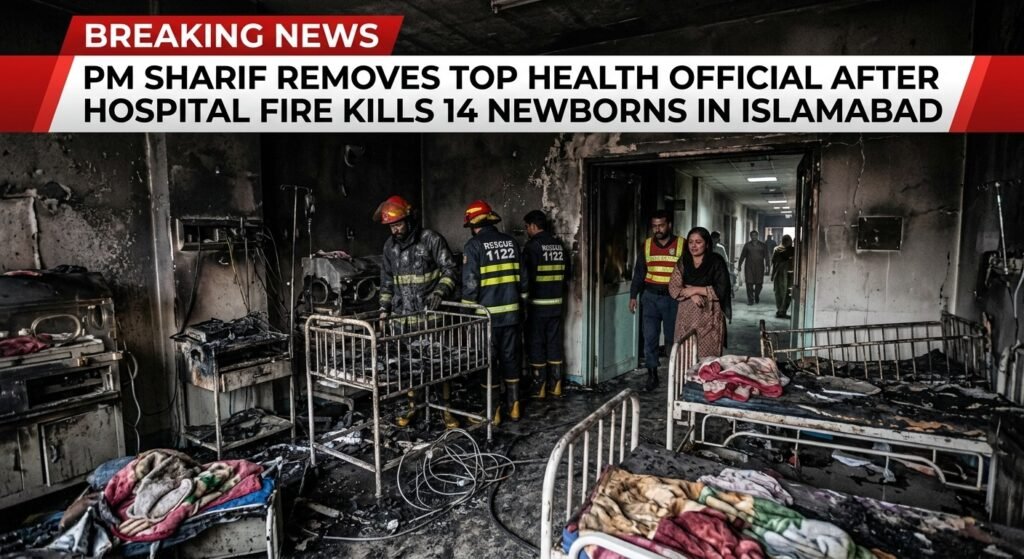
Pakistan’s Prime Minister Shehbaz Sharif ordered the removal of Health Secretary Aslam Ghauri after a fire in a hospital nursery killed at least 14 newborns in Islamabad, with an investigation now underway.
A fire tore through the nursery of Pakistan’s largest public hospital early Wednesday morning, killing at least 14 newborn babies and prompting Prime Minister Shehbaz Sharif to immediately remove the country’s top health official from office as anger and grief spread across the nation.
How the Fire Started
The fire broke out around 6:45 a.m. local time on the third floor of the Mother and Child Centre at the Pakistan Institute of Medical Sciences (PIMS) hospital in Islamabad, part of the facility’s gynecology ward. Rescue officials say the blaze began after the compressor of an air-conditioning unit exploded inside the nursery. Firefighters responded quickly, dispatching six fire engines and four ambulances, and the fire was extinguished with rescue teams then carrying out cooling operations at the site.
At least 15 newborns were present in the nursery when the fire broke out, according to hospital officials. Only one baby was rescued alive. Hospital spokesperson Dr. Aneeza Jalil confirmed that a doctor was responsible for saving that infant, and that all of the victims were newborns.
A Swift Government Response
Federal Health Minister Mustafa Kamal confirmed the death toll at 14, though some local media outlets, including Geo TV, initially reported figures as high as 15. Hours after the fire, Prime Minister Sharif ordered the removal of Health Secretary Aslam Ghauri, the health ministry’s highest-ranking civil servant, from his position.
Sharif’s office directed authorities to launch an immediate investigation, stating: “Those responsible should be identified, and the strictest action should be taken.” Pakistan’s President Asif Ali Zardari also issued a statement, calling the deaths “extremely heartbreaking and an irreparable loss,” and calling for those responsible to be identified and held accountable under the law. Zardari further urged hospitals nationwide to ensure proper fire-safety measures and emergency procedures are in place, specifically in wards caring for newborns.
The Islamabad district magistrate has since appointed a multiagency fact-finding committee, directing it to submit a report within 24 hours. The panel’s mandate includes investigating the cause and spread of the fire, determining whether adequate fire-safety measures were in place, and evaluating the emergency response.
Grief and Anger From Families
The tragedy has sent shock waves across the country. Police were deployed to the hospital as grieving parents and relatives gathered outside, some weeping, others demanding accountability and answers about how the fire started and whether the nursery had adequate firefighting equipment in place.
Javeria, a mother who lost her newborn in the fire, spoke outside the hospital: “Give me my child. I want justice.” Another parent, Mudasir, who also lost his child, said that all doors to the ward except one were shut at the time of the fire, and that there was “no fire security” in place.
By late morning Wednesday, the entrance to the maternity ward remained cordoned off with police tape, with roughly two dozen officers standing guard as officials worked to coordinate with affected families. According to Federal Health Minister Kamal, the immediate priority is supporting the parents and returning the infants’ bodies to their families; six bodies had already been handed over as of Wednesday, with the rest expected to follow shortly.
A System Already Under Strain
This tragedy has reignited long-standing concerns about the state of Pakistan’s public healthcare infrastructure. According to the World Bank, Pakistan’s healthcare expenditure ranks among the lowest in South Asia. Pakistan’s largest doctors’ association had previously warned, following the government’s approval of a new national budget in June, that the country’s healthcare infrastructure was in “a state of systemic collapse due to structural neglect.”
State-run healthcare facilities in Pakistan have faced repeated criticism over the years for being under-resourced, overburdened, and poorly managed. While government healthcare is subsidized, facility conditions and safety standards have remained a persistent source of public concern, and this incident is being described as one of the deadliest hospital fires the country has experienced in recent years.
What Happens Next
With the fact-finding committee’s report due within 24 hours, attention will now turn to what the investigation reveals about the specific safety failures that allowed the fire to spread and claim so many young lives. The removal of Health Secretary Ghauri signals that Pakistan’s government intends to demonstrate accountability at the highest levels, though grieving families and the broader public are likely to be watching closely to see whether that accountability extends further, and whether concrete changes to hospital fire-safety standards actually follow.
Frequently Asked Questions
Q: How many babies died in the Pakistan hospital fire? At least 14 newborns died, according to Federal Health Minister Mustafa Kamal, though some initial local media reports put the toll as high as 15. Only one baby was rescued alive.
Q: What caused the fire? Rescue officials say the fire began after the compressor of an air-conditioning unit exploded inside the hospital’s nursery, located in the Mother and Child Centre’s gynecology ward.
Q: Who has been held accountable so far? Prime Minister Shehbaz Sharif ordered the immediate removal of Health Secretary Aslam Ghauri, the health ministry’s top civil servant, hours after the fire. A formal investigation is also underway.
Q: Which hospital did the fire occur at? The fire broke out at the Pakistan Institute of Medical Sciences (PIMS), the largest public hospital in Islamabad, Pakistan’s capital.
Q: When will investigators release their findings? An Islamabad district magistrate has appointed a multiagency fact-finding committee, which has been directed to submit its report within 24 hours of the incident.