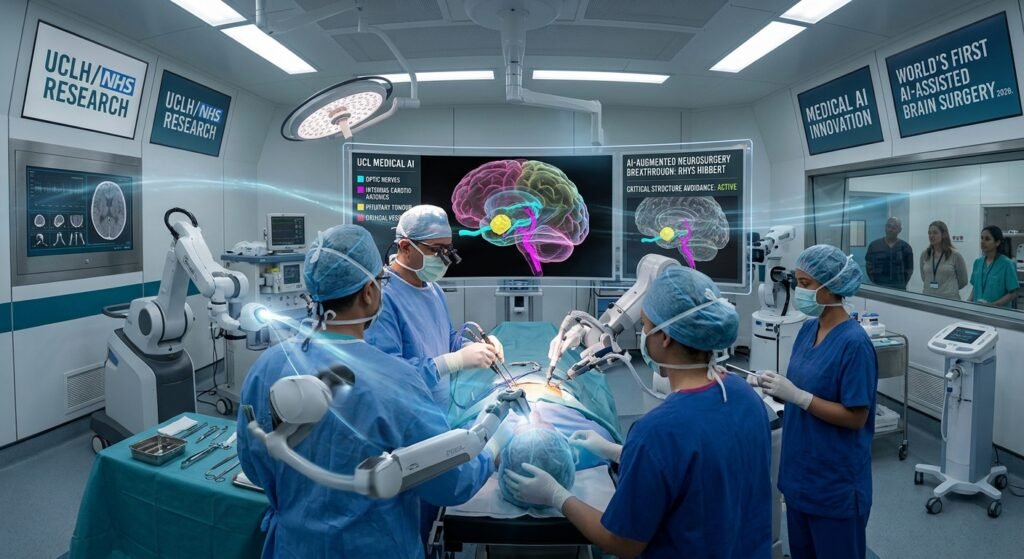
Rhys Hibbert became the first person in the world to have a brain tumour removed with the help of live AI guidance, in a landmark operation at London’s National Hospital for Neurology and Neurosurgery.
A 48-year-old man from Bedfordshire has become the first person in the world to undergo brain surgery guided by live artificial intelligence, in an operation doctors say saved his eyesight. Rhys Hibbert’s case marks a genuine milestone for neurosurgery, performed at the very hospital that pioneered the field more than 165 years ago.
What Made This Surgery Different
The operation took place in May at the National Hospital for Neurology and Neurosurgery (NHNN) in London, part of University College London Hospitals NHS Foundation Trust, though details were kept private until this week while Hibbert recovered. While the surgical team remained fully in control throughout the procedure, an AI system analyzed live camera footage in real time, helping identify critical structures — including nerves and blood vessels — that needed to be carefully avoided near an 11mm tumour on Hibbert’s pituitary gland.
The technology worked by color-coding tiny anatomical structures within the brain, giving surgeons a clearer, real-time picture of exactly which areas to steer away from during the procedure. Officials explained that in this particular region of the brain, the pituitary gland, blood vessels, and the nerves controlling vision sit extremely close together, meaning even a millimeter of error could have serious consequences.
A Fitting Location for a Medical First
Hibbert, who was diagnosed with the tumour in 2024, reflected on the significance of where the operation took place. “The National Hospital for Neurology and Neurosurgery was founded in 1859 and was the world’s first dedicated neurosurgical hospital,” he said. “So to me, it seems very fitting that the same hospital should also be the world’s first to carry out an AI-assisted neurosurgery.”
He also spoke about what it meant to be chosen for such a significant procedure: “I’m very pleased to have had the opportunity to be cared for in the hospital. I’m also very humbled to have been asked if I’ll be prepared to be the world’s first patient in this research.”
Neurosurgeon Hani Marcus, a professor at UCL who performed the operation, thanked the broader team behind the milestone: “Huge thanks to the trial participants and to the team committed to improving patient outcomes by taking this important first step.”
Protecting Sight That Could Have Been Lost
Without the surgery, doctors say the tumour could have eventually caused Hibbert to lose his sight entirely. Instead, the operation was successful, and Hibbert has since returned to his normal life — back at work as a customer services manager and continuing his role as a community volunteer.
Professor Mike Lewis, scientific director for innovation at the National Institute for Health and Care Research (NIHR), which funded the operation as part of a clinical trial, described the achievement as a genuine breakthrough. He said the “pioneering surgery” demonstrates the real potential for advanced AI to support surgeons directly during operations and improve outcomes for future patients.
Part of a Broader Wave of AI and Robotics in Neurosurgery
Hibbert’s operation adds to a growing list of technological milestones in brain surgery over the past year. In October 2025, surgeons at King Faisal Specialist Hospital and Research Centre in Riyadh, Saudi Arabia, performed what they described as the world’s first robotic intracranial tumour resection, removing a 4.5-centimeter tumour from a 68-year-old patient using robotic arms guided by 3D optical imaging. That patient was discharged fully conscious within 24 hours, a recovery time roughly four times faster than typical for comparable procedures.
Beyond live-surgery applications, researchers at UC San Francisco and the University of Michigan have separately developed a tool called FastGlioma, which uses AI to help surgeons see in real time where tumor cells have spread into surrounding brain tissue that would otherwise appear normal to the naked eye — addressing a longstanding challenge in ensuring as much of a tumor as safely possible is removed during surgery.
What This Means for the Future of Neurosurgery
While Hibbert’s surgeons remained in full control of the procedure throughout, with AI functioning purely as a real-time guidance and identification tool rather than an autonomous surgical system, this case represents a significant proof of concept for how artificial intelligence could be integrated into some of medicine’s highest-stakes procedures. Given how tightly packed critical structures can be in areas like the pituitary gland, tools capable of helping surgeons distinguish healthy tissue from tumor tissue, or vital nerves from surrounding anatomy, in real time carry the potential to meaningfully reduce surgical risk in future operations.
As this technology continues to be studied through clinical trials like the one Hibbert participated in, researchers will be watching closely to see whether these early results can be replicated consistently across a broader range of patients and tumor types, potentially paving the way for AI-assisted guidance to become a more standard part of complex neurosurgical procedures in the years ahead.
Frequently Asked Questions
Q: Who was the first patient to undergo live AI-assisted brain surgery? Rhys Hibbert, a 48-year-old man from Bedfordshire, England, became the first person in the world to have a brain tumour removed with the assistance of live AI guidance.
Q: What did the AI system actually do during the surgery? The AI analyzed live camera footage during the operation, using color-coding to help identify critical structures like nerves and blood vessels that needed to be avoided while removing the tumour, though the surgical team remained fully in control throughout.
Q: Where did this historic surgery take place? The operation was performed at the National Hospital for Neurology and Neurosurgery (NHNN) in London, part of University College London Hospitals NHS Foundation Trust, which was founded in 1859 as the world’s first dedicated neurosurgical hospital.
Q: What would have happened without the surgery? Doctors say the tumour, located on Hibbert’s pituitary gland, could have eventually caused him to lose his sight if left untreated.
Q: Is AI-assisted brain surgery now a widely available treatment? No, not yet. This procedure was performed as part of a clinical trial funded by the National Institute for Health and Care Research (NIHR), and further research will be needed before AI-assisted guidance becomes a standard part of neurosurgical procedures more broadly.