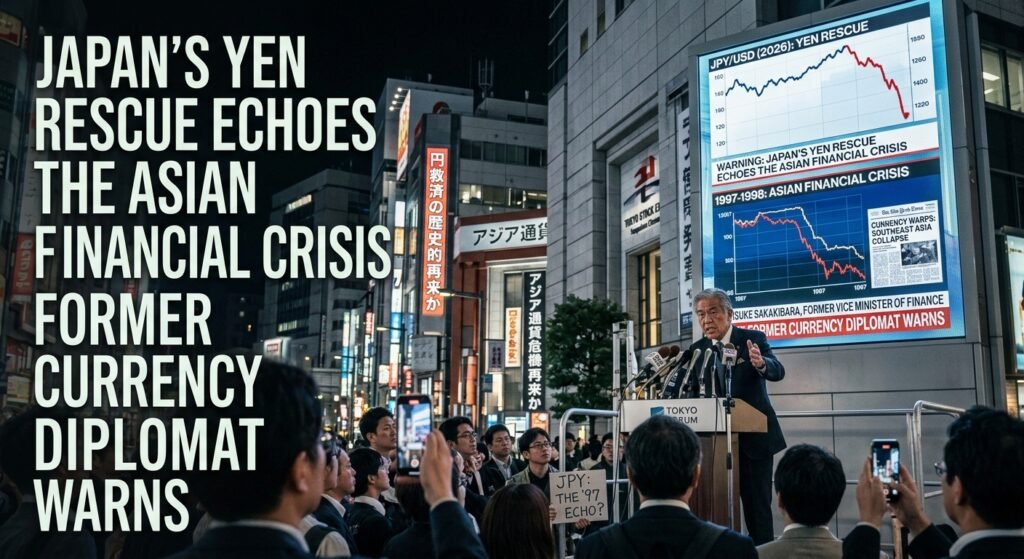
Japan’s latest yen intervention, backed by US dollar swap lines rather than Treasury sales, is stirring uncomfortable memories of the late-1990s Asian financial crisis, says former IMF deputy chief Naoyuki Shinohara.
Japan’s newest attempt to shore up a struggling yen bears little resemblance to how such interventions have traditionally worked, and that’s exactly what’s worrying a former top currency diplomat. Naoyuki Shinohara says the operation’s structure is stirring uncomfortable parallels to the Asian financial crisis of the late 1990s.
What’s Different About This Intervention
Earlier this month, Washington announced it had joined Tokyo’s efforts to halt the yen’s decline. But rather than the traditional approach, where Japan might sell US Treasury holdings to raise dollars for intervention, US Treasury Secretary Scott Bessent specifically encouraged Japan to draw on dollar swap lines instead.
That distinction matters more than it might initially appear. Speaking to Reuters, Shinohara, who previously served as the IMF’s deputy managing director following a stint as Japan’s vice finance minister for international affairs, said the setup revives memories of a genuinely difficult period in Asian economic history. “Japan today is nowhere near Thailand’s situation. But the dynamic is uncomfortably similar,” he said. “Being asked by Washington to use swap lines and avoid selling Treasuries evokes memories of that period.”
The Asian Financial Crisis Parallel
During the Asian financial crisis in the late 1990s, access to dollar liquidity became a critical, defining issue across the region. At the time, the United States, Japan, and the International Monetary Fund stepped in to provide Thailand with dollar funding specifically to help bolster its foreign currency reserves as the crisis unfolded.
Shinohara isn’t suggesting Japan’s current economic position resembles Thailand’s during that crisis. Rather, his concern centers on the mechanics of the current arrangement, being encouraged to rely on swap lines rather than Treasury sales carries an echo of that earlier era’s crisis-management playbook, even if the underlying economic circumstances are entirely different today.
Not a Traditional Coordinated Intervention
Beyond the swap-line detail, Shinohara pointed to several other ways the joint Japan-US action, which took place on July 31, diverged sharply from how coordinated currency interventions have historically been conducted.
Traditionally, coordinated interventions have been built on a shared assessment among major economies regarding currency movements, typically reinforced by formal statements from G7 nations. According to Shinohara, that process appears to have been notably absent this time. “There is no sign that such a process took place this time,” he said. “Normally, there would be a joint statement from the G7 at some stage, but we haven’t seen one yet.”
He also flagged the near-total absence of central banks from the operation as unusual, since central banks typically work alongside finance ministries during coordinated interventions of this kind. “Messaging is the most important element of coordinated intervention. Without central banks, the message is not very powerful,” Shinohara said.
A Symbolic Message to Tokyo
According to Shinohara, the US involvement in this intervention wasn’t really about the mechanics of currency support at all; it was about sending a pointed signal. “The U.S. participation was a symbolic gesture with a hidden message urging Japan to get its act together on policy,” he said, specifically pointing to the need for the Bank of Japan to move faster on interest rate hikes.
Shinohara estimated the BOJ likely needs to raise interest rates to around 1.5%, up from the current 1%, as soon as possible. However, he cautioned that even one or two additional rate increases probably wouldn’t be enough on their own to fully reverse the yen’s ongoing downtrend.
What Could Actually Turn the Yen Around
Rather than domestic policy alone solving the problem, Shinohara suggested external factors may end up playing a larger role in stabilizing the currency. He pointed specifically to a potential slowdown in US economic growth, or an easing of tensions in the Middle East that would reduce the cost of oil imports, as developments that could meaningfully support the yen going forward.
Above all, Shinohara emphasized that the real risk isn’t yen weakness itself, but the pace at which it happens. “The one thing that must be avoided is a rapid depreciation of the yen,” he said. “A country does not collapse because its currency gets stronger. It runs into trouble when its currency becomes too weak.”
Shinohara’s Background on This Issue
Shinohara isn’t speaking from the sidelines on this topic. He was directly involved in global economic policymaking at Japan’s Ministry of Finance during the Asian financial crisis itself, giving him firsthand experience with exactly the kind of dollar-liquidity dynamics he sees echoed in today’s situation. He later served as Japan’s top currency diplomat from 2007 to 2010, further cementing his expertise on precisely this intersection of currency policy and international coordination.
What This Means Going Forward
Shinohara’s comments suggest that while Japan’s current economic fundamentals remain far stronger than Thailand’s were during the 1990s crisis, the structural approach being used to support the yen, leaning on swap lines, sidelining central banks, and skipping the usual G7 coordination, represents a genuine departure from established practice. Whether that departure reflects a deliberate new strategy or simply the unusual circumstances of this particular moment remains an open question, one that’s likely to shape how markets and policymakers interpret any further intervention efforts in the weeks ahead.
Frequently Asked Questions
Q: What is unusual about Japan’s latest yen intervention? Rather than following the traditional approach of selling US Treasury holdings to fund intervention, Japan was encouraged by the US Treasury to use dollar swap lines instead, a structural difference that former diplomat Naoyuki Shinohara says echoes dynamics from the Asian financial crisis.
Q: Is Japan’s current situation similar to Thailand’s during the Asian financial crisis? Not directly, according to Shinohara. He stressed that “Japan today is nowhere near Thailand’s situation,” but noted that the mechanics of the current intervention, specifically the reliance on swap lines, revive uncomfortable memories of that earlier crisis period.
Q: Why does the absence of central banks matter in this intervention? Central banks typically work alongside finance ministries during coordinated currency interventions to reinforce policy messaging. Their near-total absence this time, according to Shinohara, weakens the overall strength of the message being sent to markets.
Q: What does Shinohara think the Bank of Japan needs to do? He believes the BOJ likely needs to raise interest rates to around 1.5% from the current 1% as soon as possible, though he cautioned that even this increase alone probably wouldn’t be enough to fully reverse the yen’s downtrend.
Q: What could help stabilize the yen besides interest rate hikes? Shinohara pointed to external factors such as a slowdown in US economic growth or easing tensions in the Middle East, which could reduce oil import costs, as potential developments that could help support the yen going forward.