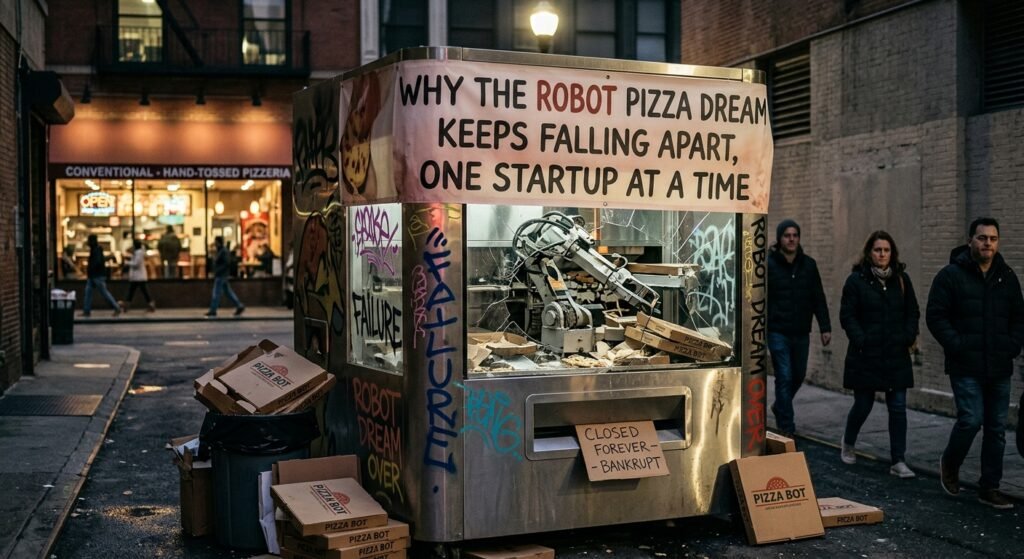
From Zume’s half-billion-dollar collapse to Picnic’s recent shutdown after partnering with Domino’s, robotic pizza-making startups keep failing. Here’s why automating pizza turns out to be so much harder than it looks.
Pizza seemed like the perfect candidate for robotic automation: a relatively standardized product, high demand, and a labor-intensive process that machines should, in theory, handle easily. Yet time and again, ambitious, well-funded startups built specifically to automate pizza-making have collapsed, one after another, raising a genuine question: why does something as seemingly simple as making a pizza keep breaking robots and burning through hundreds of millions of dollars in the process?
A Pattern of High-Profile Failures
The most recent casualty is Picnic, a Seattle-based startup that raised more than $53 million to build robots capable of automating restaurant food preparation, and had even partnered with major pizza chain Domino’s along the way. According to legal documents, Picnic shut down after becoming insolvent, liquidating all of its assets, with its intellectual property sold off to an unnamed buyer. Warning signs had been building for a while: the company laid off employees in 2023 citing the “current economic environment,” and went through two separate CEO departures in recent years.
Picnic isn’t an isolated case. It’s the latest in a genuinely long line of robotic pizza ventures that have struggled or outright failed to make automated pizza-making commercially viable.
Zume: The Half-Billion-Dollar Cautionary Tale
The most infamous failure in this space belongs to Zume, a Silicon Valley startup backed by Japanese investment giant SoftBank. Founded in 2015, Zume set out to deliver pizzas cooked by robots inside moving delivery trucks, using GPS-equipped automated ovens that would finish baking pies en route to customers.
The concept burned through nearly half a billion dollars in investment, including $375 million from SoftBank alone, before the company ultimately shut down. Zume’s downfall came down to a problem that sounds almost comically simple but proved genuinely difficult to solve: keeping melted cheese from sliding off pizzas while they baked inside moving trucks. Motion, heat, and melting cheese turned out to be a combination the company’s engineers never fully cracked. Zume eventually pivoted away from pizza entirely, shifting toward sustainable food packaging in 2020, before that pivot failed too, and the company folded completely by 2023.
Not Just a Zume Problem
Zume’s cheese-sliding struggles weren’t unique to that one company. Multiple robotic pizza ventures across Silicon Valley have run into strikingly similar physical and mechanical challenges, suggesting the difficulty isn’t tied to one company’s specific engineering choices, but to something more fundamental about automating pizza itself.
Stellar Pizza, founded by a former SpaceX rocket engineer, took a different approach, building a fleet of trucks staffed by robotic pizza chefs that handle the cooking while human drivers manage delivery. The company has continued operating and expanding, suggesting a more sustainable model than Zume’s fully robotic, driverless approach, though it has faced its own share of technical hurdles along the way.
Picnic Works, before its recent collapse, took yet another approach: a modular assembly line called the “Picnic Pizza Station” capable of producing up to 100 pizzas an hour, but still requiring a single human attendant to oversee the process rather than operating fully autonomously. Picnic’s machines had been used by major names including Domino’s, SeaWorld, and Chartwells, the school cafeteria vendor, giving the company real commercial traction before its eventual insolvency.
Why Pizza Turns Out to Be Deceptively Hard to Automate
Industry voices have pointed to several genuine technical challenges that make pizza a trickier automation target than it might first appear. Cheese, in particular, has proven to be a recurring headache across multiple companies. According to Picnic’s former CEO Clayton Wood, cheese is both “the most expensive ingredient on the pizza” and “the most overtopped,” with human workers typically adding around 40% too much cheese by hand, an inconsistency robots are meant to solve, but one that also highlights just how much precision, texture-sensing, and physical dexterity are actually required to handle a topping most people think of as simple.
Beyond cheese specifically, the broader challenge lies in pizza’s combination of soft, sticky, irregular ingredients (stretchy dough, melting cheese, unevenly shaped toppings) with a cooking process that involves significant heat and, in cases like Zume’s, active motion. Robots generally excel at precise, repeatable tasks involving rigid or predictable materials; pizza-making, by contrast, involves constantly shifting textures and physical properties that are genuinely difficult to model and control mechanically at scale.
A Broader Pattern in Food Automation
These pizza-specific struggles fit into a wider pattern seen across the food robotics industry more broadly. Even as artificial intelligence has advanced rapidly in other domains, practical, physical robotics ventures in food service have continued to face significant real-world obstacles that don’t show up in a lab or demo environment. Building a robot capable of handling food consistently, safely, and cost-effectively at commercial scale, day after day, in a working restaurant environment, has repeatedly proven far harder than initial pitches and prototype demonstrations suggested.
This gap between promising early demonstrations and sustainable commercial operation has become something of a recurring theme across the sector: San Francisco alone saw multiple robotic restaurant concepts struggle or shut down even before the pandemic further complicated the picture for food service automation broadly.
What This Means for the Future of Robotic Food Service
Despite this string of failures, the underlying appeal of automating pizza-making hasn’t disappeared. The pizza industry remains worth tens of billions of dollars in the US alone, and companies continue to see genuine commercial logic in solving problems like labor shortages and topping consistency through automation. Whether these repeated failures point to a fundamentally unsolvable set of technical challenges, or simply reflect an industry still working through the difficult, expensive process of iterating toward a viable model, remains an open question.
What does seem clear from this pattern of collapses is that success in this space likely requires a more measured approach than some of the most ambitious early ventures attempted. Companies pursuing hybrid models, combining robotic assistance with human oversight rather than pursuing full autonomy, appear to have had somewhat more staying power than those chasing a completely driverless, fully automated vision from the outset.
Frequently Asked Questions
Q: Why did Zume’s robot pizza company fail? Zume struggled primarily with keeping melted cheese from sliding off pizzas while they baked inside moving delivery trucks, a technical challenge the company was never able to fully solve, ultimately burning through nearly $500 million in investment before shutting down.
Q: What happened to Picnic, the Domino’s-partnered robotics startup? Picnic, which had raised more than $53 million and partnered with Domino’s, SeaWorld, and Chartwells, shut down after becoming insolvent, liquidating its assets after several years of layoffs and leadership departures.
Q: Why is cheese specifically such a challenge for pizza robots? Cheese is difficult to apply consistently by machine due to its texture and tendency to overtop or shift during cooking and handling, particularly in mobile or motion-based cooking setups like Zume’s delivery trucks.
Q: Are all robotic pizza companies failing? Not entirely. Companies like Stellar Pizza, which uses robotic chefs alongside human drivers, have continued operating, suggesting hybrid models combining automation with human oversight may be more sustainable than attempts at full autonomy.
Q: Is pizza automation harder than other types of food robotics? Pizza presents specific challenges due to its combination of soft, irregular ingredients like dough and melting cheese, combined with high-heat cooking processes, which are generally harder for robots to handle consistently than more rigid or predictable food preparation tasks.