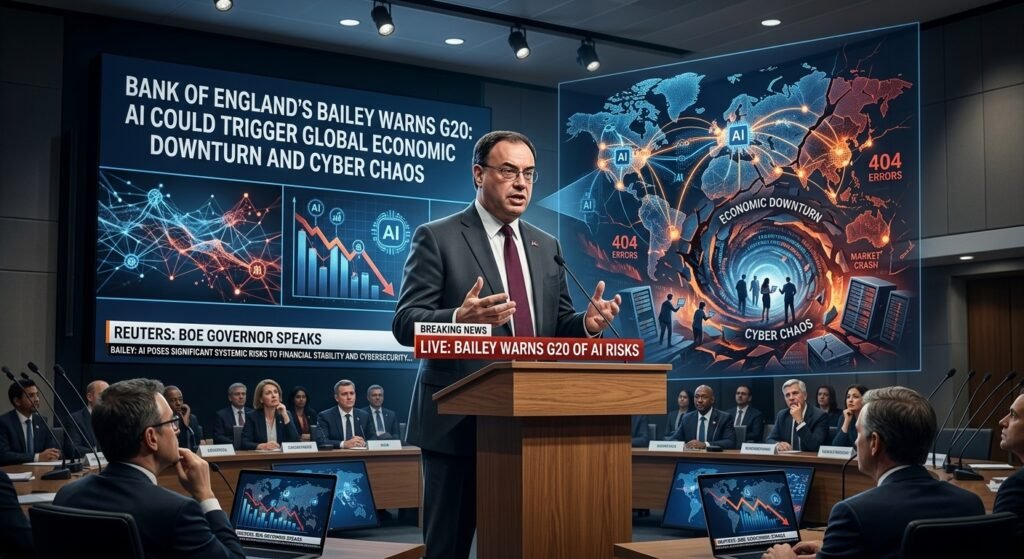
Andrew Bailey has warned G20 finance ministers that a collapse in AI sector growth could spark a worldwide market correction, while also flagging AI-driven cyberattacks as a major threat to financial stability.
The governor of the Bank of England has delivered a stark warning to the world’s top finance officials: artificial intelligence could trigger a genuine global economic downturn, and the technology also poses a serious cybersecurity threat to the financial system itself.
Bailey’s Core Warning
Andrew Bailey told G20 finance ministers that any significant slowdown in AI sector growth could spark a “future market correction” capable of spreading across the entire global economy. Addressing officials in the US on Monday, he said companies worldwide should be actively preparing for cybersecurity breaches “involving simultaneous disruption across multiple firms,” rather than treating such attacks as isolated, contained incidents.
Bailey pointed to a specific combination of factors that could amplify any future downturn: currently high stock market valuations, rising levels of borrowing among investors, and an increasing concentration of money flowing into a relatively small number of major technology companies. Together, he warned, these dynamics could turn what might otherwise be a contained correction into something with much broader economic reach.
A Formal Letter to the World’s Finance Ministers
Bailey’s warning was delivered in an open letter sent ahead of the G20 finance ministers’ meeting taking place in Asheville, North Carolina, where central bankers and finance officials from around the world are gathering. Writing in his capacity as chairman of the Financial Stability Board (FSB), the international body that coordinates financial regulation across countries, Bailey stated plainly that current asset valuations “could now be at odds with the uncertain economic and geopolitical outlook, leaving markets susceptible to a disorderly adjustment.”
He added that “risks and uncertainty remain elevated, driven by persistent geopolitical tensions and fragmentation in trade and financial markets,” while also flagging that “sovereign debt levels have continued to increase and are forecast to rise further,” concluding starkly that “vulnerabilities in the financial system remain high.”
The Specific Cybersecurity Threat AI Poses
Beyond the broader economic risk, Bailey highlighted a more targeted concern: that increasingly powerful “frontier” AI models could materially change the speed, scale, and underlying economics of cyberattacks, potentially making them faster, more damaging, and considerably cheaper for attackers to carry out.
This concern isn’t coming from Bailey alone. Earlier this month, a coalition of roughly 100 companies, including major AI developers like Google, Microsoft, Anthropic, and OpenAI, jointly urged governments and international bodies to strengthen their cybersecurity defenses before AI systems become powerful enough to potentially overwhelm existing safeguards.
Bailey’s underlying concern centers on interconnection: because banks and financial institutions around the world tend to rely on a relatively small group of shared technology suppliers and computing infrastructure, a successful cyberattack on one institution could spread rapidly across borders and into other, seemingly unrelated firms.
Geopolitical Volatility Adding to the Risk
Bailey also flagged concern about broader market “volatility” stemming from energy supply shocks tied to the ongoing US-Iran conflict, suggesting that AI-related financial risk isn’t developing in isolation, but is instead compounding an already fragile and uncertain global economic backdrop.
Bailey’s Push for International AI Safety Coordination
Rather than simply raising alarm, Bailey is actively pressing governments to come together and agree on formal rules governing the safe release of powerful AI models, aiming to establish international coordination before what he characterizes as the “next AI surprise” arrives. His position reflects a broader concern that the current pace of AI development is outrunning the world’s collective regulatory and risk-management capacity.
The UK’s Own AI Investment Push
Bailey’s warning arrives against an interesting domestic backdrop. His comments come several months after UK Chancellor John Healey announced a £100 million fund specifically aimed at backing British AI startups, part of a broader government push to build up the UK’s “sovereign AI” capacity, developing homegrown AI technology so the country isn’t left dependent on services and infrastructure from abroad.
UK ministers have said they want companies to compete for this funding to help tackle practical challenges, including cutting waiting lists within the National Health Service and strengthening national cybersecurity and defense capabilities. A UK government spokesperson said the country’s newly established AI economics institute is working with international partners to build “a stronger shared understanding of how AI is” reshaping economic risk, echoing the same broad concerns Bailey raised in his letter.
A Pattern of Escalating Warnings
This isn’t the first time Bailey has sounded the alarm about financial stability risks this year. In earlier G20 correspondence, he similarly warned that “global risks have crystallised,” pointing to persistent geopolitical tension and high global debt vulnerabilities, even as market conditions had shown some recovery at the time. That pattern of recurring warnings suggests Bailey views current financial system risks, spanning AI, geopolitics, and elevated asset valuations, as an ongoing and evolving concern rather than a single, isolated moment of caution.
Why This Matters
Bailey’s warning carries particular weight given his dual role, not just as head of the Bank of England, but as chairman of the Financial Stability Board, the body specifically tasked with monitoring and coordinating responses to risks facing the global financial system. When a figure in that position explicitly ties AI sector volatility to the possibility of a broader economic downturn, it signals that concerns about AI-related financial risk have moved well beyond individual tech analysts and into the realm of formal, coordinated international financial regulation.
What Happens Next
With G20 finance ministers now gathered to discuss these concerns directly, attention turns to whether Bailey’s call for coordinated action, both on AI model safety standards and on strengthening collective cyber defenses, translates into concrete policy commitments. Given the scale of investment currently flowing into AI-related technology companies globally, and the increasing concentration of market value in a relatively small number of major tech firms, how seriously this warning is taken by policymakers in the coming months could have real implications for how the next chapter of the global AI investment boom unfolds.
Frequently Asked Questions
Q: What did Andrew Bailey warn G20 finance ministers about? Bailey warned that a collapse in AI sector growth could trigger a broader global economic downturn, and separately flagged that increasingly powerful AI models pose a significant cybersecurity risk to the global financial system.
Q: What role does Andrew Bailey hold beyond Bank of England governor? Bailey is also chairman of the Financial Stability Board (FSB), an international body that coordinates financial regulation and monitors systemic risk across G20 countries.
Q: Why are tech companies also warning about AI-related cybersecurity risks? A coalition of roughly 100 companies, including Google, Microsoft, Anthropic, and OpenAI, recently urged governments to strengthen cybersecurity defenses before AI systems become powerful enough to potentially overwhelm existing safeguards.
Q: What specific factors does Bailey say could amplify a future market correction? He pointed to a combination of high stock market valuations, increased investor borrowing, and growing concentration of financial value in a small number of major technology companies.
Q: Is the UK still investing heavily in AI despite these warnings? Yes. The UK government previously announced a £100 million fund to support British AI startups as part of its “sovereign AI” strategy, aiming to reduce dependence on foreign AI technology while also addressing challenges like NHS efficiency and national cybersecurity.