Treasury Secretary Scott Bessent tried his own version of yield-curve control this week, but 10-year yields snapped back within days. Here’s why the forces pushing bond yields higher may be beyond his control.
Treasury Secretary Scott Bessent spent years criticizing his predecessor for trying to manipulate the world’s largest bond market. This week, he tried his own version of exactly that — and the results suggest the forces driving yields higher may be bigger than anything his office can control.
What Bessent Actually Did
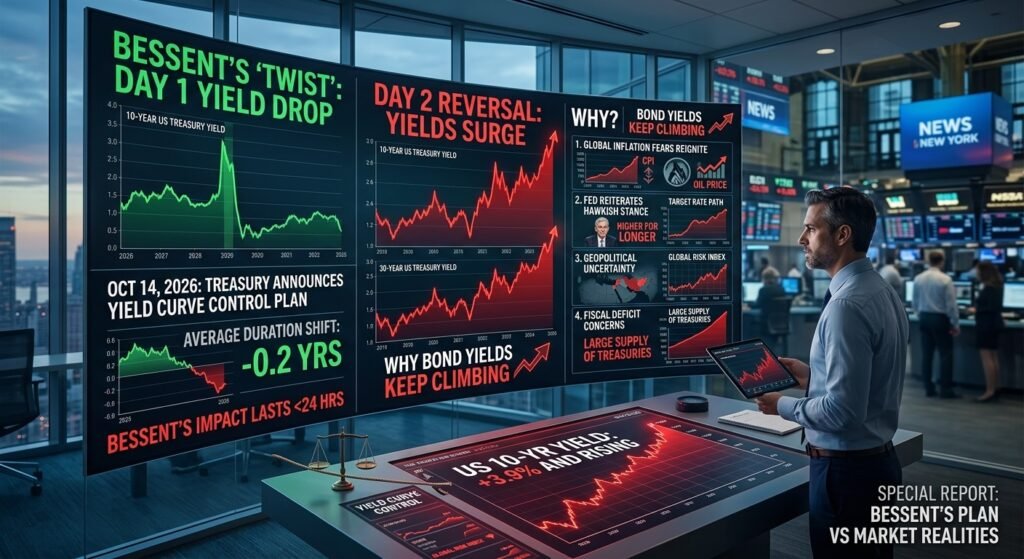
On Thursday, Bessent announced a plan to buy back a significant amount of long-term US government debt, funding the move by selling more short-dated securities instead. He described the strategy as “what I would call a Treasury twist,” a direct nod to the Federal Reserve’s well-known 1960s program that attempted to reshape the yield curve by targeting specific maturities. Bessent argued current long-term yields are out of step with what he called “equilibrium” levels.
The market’s initial reaction was exactly what Bessent wanted: long-bond yields dropped sharply on Wednesday, the day the plan was announced. But that relief didn’t last. Yields climbed right back up within days, with the closely watched 10-year Treasury yield ending the week at 4.73% — near its highest level since Bessent took office.
Bigger Forces at Play
The quick reversal suggests Bessent’s push to lower borrowing costs, particularly with November’s midterm elections approaching, is running into pressures well beyond his control. Chief among them: record debt levels, not just in the US — where one measure of total debt surpassed $40 trillion this week — but across developed economies globally.
Corporate bond issuance has also surged, driven heavily by the ongoing AI investment boom, adding further competition for capital in bond markets. Inflation has picked up since President Trump’s war with Iran disrupted global energy markets, and continued uncertainty over Federal Reserve Chair Kevin Warsh’s policy approach has added another layer of investor unease.
“Every route to lasting relief for the long end runs through something the administration doesn’t want,” said Matt King, founder of Satori Insights. According to King, meaningfully lower long-term yields would likely require some combination of a smaller US budget deficit, a decline in the stock market, or reduced AI-related investment — none of which are outcomes the administration is actively pursuing.
Not Everyone Agrees Yields Are a Problem
Some market participants push back on the idea that anything was out of equilibrium to begin with. “I think we are back to normal interest rates, 4% to 5% is normal,” said Ed Yardeni, the economist who coined the term “bond vigilantes,” speaking roughly an hour before Bessent’s announcement. Separately, JPMorgan’s rates strategy desk noted this week that broader bond market functioning has “improved notably this year,” despite the Treasury’s stated concern about liquidity.
Bessent’s approach to shaping yields hasn’t been limited to Treasuries either. It extends to major so-called hyperscalers — companies pouring enormous sums into AI infrastructure and taking on debt to fund it. Alphabet, for example, sold bonds with maturities stretching up to 40 years earlier this month. Bessent has argued that kind of investment will eventually pay off through faster, non-inflationary economic growth, but acknowledged it’s currently “causing a short-term competition for capital.” His advice to corporate finance chiefs: consider issuing more five-year “belly” debt instead of longer maturities.
Is There a ‘Bessent Put’?
The scale of these interventions has sparked debate over whether markets are now operating under something resembling a “Bessent put” — an echo of the old belief that former Fed Chair Alan Greenspan would always step in to rescue falling stock markets. Chris Turner, global head of markets at ING Groep, was among those using the phrase this week, though many analysts remain skeptical Bessent actually has the tools to replicate that kind of influence specifically over bond yields.
Addressing the climb in yields directly, Bessent suggested investors are working off “bad information,” claiming he has “asymmetric” access to a clearer picture of the underlying fiscal situation. “There’s been a lot of misinformation in terms of what’s going on with the deficit,” he said, adding that he intends to refocus public attention on the administration’s fiscal-consolidation efforts.
What Bessent Says Comes Next
Looking ahead, Bessent said he and White House budget chief Russ Vought will examine both revenue and spending options in the coming days, floating ideas like cracking down on fraud and reducing federal transfers to states. It’s a strategy reminiscent of the Elon Musk-led Department of Government Efficiency’s earlier cost-cutting push last year, which ultimately fell short of its own stated savings targets.
Some analysts remain doubtful anything meaningful will emerge from this latest effort. “We are skeptical the administration can realistically do anything at this point on the deficit that would be material,” wrote Sarah Bianchi, chief strategist at Evercore ISI. Beyond the Treasury’s own interest bill — now running well above $1 trillion annually — Social Security, Medicare, and Medicaid remain the primary drivers of a fiscal deficit projected around 6% of GDP this year. Bianchi described any near-term overhaul of those entitlement programs as “a non-starter,” a dynamic she said would only become more difficult if Democrats win control of even one chamber of Congress in November.
A Quiet Rift With the Fed?
What does fall clearly within Bessent’s authority is how the Treasury manages debt issuance and buybacks. This week’s move followed a separate tweak just two weeks earlier to the Treasury’s forward guidance on issuance, a change analysts say opened the door to potential cuts in sales of the longest-dated, highest-yielding securities.
These tactics bear a notable resemblance to the debt-issuance approach used by former Treasury Secretary Janet Yellen — an approach Bessent had previously criticized. They also hint at a subtle divergence between Bessent and Fed Chair Kevin Warsh. Rather than describing yields as out of balance, Warsh has come close to endorsing their rise, stating on July 29 that while the Fed hasn’t tightened policy in response to higher inflation, “markets have done quite a bit” on their own, adding that “market prices will continue to respond in the direction and magnitude they see fit.”
Warsh faces his own high-stakes communications moment Friday, delivering a speech at the Kansas City Fed’s annual Jackson Hole symposium. Investors will be watching closely to see whether he can repair some credibility after a poorly received press conference last month, during which he struggled to clearly explain the Fed’s rationale for holding rates steady, avoided signaling any near-term rate hikes, and suggested the central bank’s inflation target itself could be revisited come January.
“Warsh would really flip the script if he actually explained how they’re going to provide metrics, how he’s using the information, and there’s a game plan for the next three to six months,” said George Goncalves, head of US macro strategy at MUFG. “At least provide markets with what to look out for.”
The Bigger Structural Question
Warsh has also floated interest in reshaping the Fed’s balance sheet, which currently holds roughly $4.54 trillion in Treasuries, along with vague references to a new “Fed-Treasury accord” — though he hasn’t detailed specifics. The original 1951 accord dramatically limited the Fed’s role in the bond market and effectively ended yield-curve control as a policy tool. Ironically, some analysts argue that genuinely lowering borrowing costs today might require moving in the opposite direction from that original accord.
Rebecca Patterson, a veteran of JPMorgan and Bridgewater Associates now serving as a senior fellow at the Council on Foreign Relations, was blunt about the limits of Bessent’s current approach: “Buybacks are more signal than substance,” she said, arguing that even larger buyback programs wouldn’t meaningfully shift market dynamics. In her view, “the more effective — and sustainable — policy approach is through Fed quantitative easing” — a tool Bessent himself once dismissively referred to as a “perpetual dosing regimen” before taking office, and one Warsh has long opposed and criticized dating back to his own time on the Fed board in the early 2010s.
Who’s Really Setting the Yield Curve?
Absent a genuine shift in approach from either Bessent or Warsh, it’s ultimately investors themselves who continue to set the direction of the yield curve. “The economy has been resilient and there is a global competition for capital,” said Priya Misra, a portfolio manager at JPMorgan Asset Management. “It makes sense that rates have been moving higher.”
For now, that leaves Bessent in a difficult position: publicly signaling confidence that yields are out of equilibrium and correctable, while the market’s response so far suggests the underlying pressures — mounting global debt, AI-driven corporate borrowing, inflation risk, and genuine uncertainty over Fed policy — are proving considerably harder to talk down than a single buyback announcement can address.
Frequently Asked Questions
Q: What is Bessent’s “Treasury twist”? It’s a plan to buy back long-term US government debt while selling more short-term securities to fund the purchases, aimed at pushing long-term yields lower — a strategy named after the Federal Reserve’s similar 1960s “Operation Twist” program.
Q: Did Bessent’s plan actually lower bond yields? Only briefly. Long-bond yields dropped sharply the day the plan was announced, but climbed back up within days, with the 10-year Treasury yield closing the week at 4.73%, near its highest level since Bessent took office.
Q: Why are bond yields rising despite the Treasury’s intervention? Analysts point to several factors, including record US and global debt levels, a surge in AI-driven corporate bond issuance, rising inflation tied to the Iran conflict’s impact on energy prices, and uncertainty over Federal Reserve Chair Kevin Warsh’s policy direction.
Q: What is Kevin Warsh’s role in this story? As Federal Reserve Chair, Warsh has taken a notably different stance from Bessent, suggesting current yield levels reflect legitimate market pricing rather than dysfunction. His upcoming speech at the Jackson Hole symposium is expected to be closely watched for further policy signals.
Q: Could the Federal Reserve help bring yields down instead? Some analysts, including Rebecca Patterson of the Council on Foreign Relations, argue that Fed quantitative easing (large-scale bond purchases) would be a more effective and sustainable way to lower yields than Treasury buybacks alone, though this remains a tool Warsh has historically opposed.