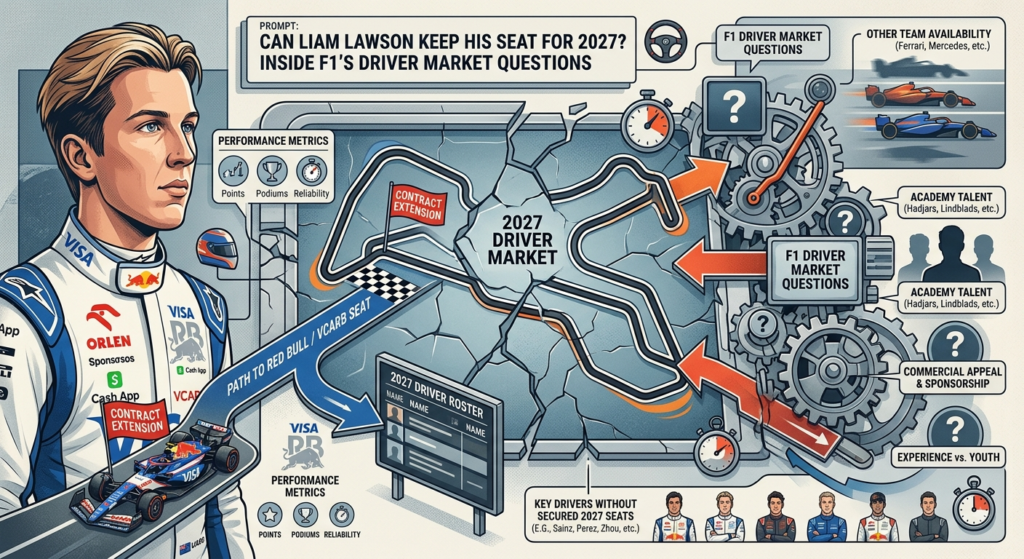
Liam Lawson leads F1’s midfield in 2026, but his 2027 Racing Bulls seat isn’t guaranteed. Here’s why form alone may not be enough to save his spot on the grid.
Liam Lawson has quietly built one of the more solid seasons on the current Formula 1 grid. Driving for Racing Bulls, the New Zealander sits ahead of every rival outside the sport’s top four constructor teams — a “best of the rest” standing that looks entirely appropriate given the car underneath him and the experience he carries into every race weekend.
Racing Bulls have fielded roughly the fifth-fastest package on the grid this season on average pace, and with Lawson considerably more seasoned than his teammate, finishing as the leading midfield driver is less a surprise and more the expected result. On paper, it’s exactly the kind of campaign that should reassure a driver about his future.
But a strong championship position only tells part of the story. Lawson’s real challenge for 2027 isn’t this year’s results sheet — it’s the shadow of his own recent history, paired with just how good the driver in the other Racing Bulls car has turned out to be.
That teammate, rookie Arvid Lindblad, is already running Lawson remarkably close. Lindblad trails by 20 points in the standings, but that gap flatters Lawson somewhat. On raw pace, there’s barely anything separating the two drivers, with the team describing them as two genuinely quick competitors who are extremely tightly matched. Break qualifying down head-to-head, and Lawson edges it narrowly — yet on average lap time, Lindblad is actually marginally faster. For a driver in his rookie season, that’s a striking signal, and precisely the kind of form that keeps an established driver’s seat under scrutiny rather than secure.
There’s precedent for concern, too. Isack Hadjar outperformed Lawson across last season, which is exactly why Red Bull promoted Hadjar into the senior team for 2026 rather than giving Lawson another look. Lawson is also still working to shake off the impression left by a difficult start to 2025, when two rocky races alongside Max Verstappen led Red Bull to demote him back to Racing Bulls just two rounds into the season. Once back at the junior team, Hadjar then comfortably got the better of him.
Racing Bulls’ stated purpose is developing drivers who can eventually step up to Red Bull’s senior team — not simply retaining a lineup out of habit. Whether Lawson still fits that development pathway under the sport’s new leadership is genuinely unclear. With Christian Horner and Helmut Marko no longer running the operation, and new team boss Laurent Mekies alongside incoming junior programme chief Gwen Lagrue now shaping driver decisions, how they view Lawson’s long-term future remains an open question heading into the 2027 driver market — one that may not fully resolve until Verstappen himself decides whether he’s staying at Red Bull at all.
Frequently Asked Questions
1. Is Liam Lawson guaranteed to keep his F1 seat for 2027?
No. Despite a strong 2026 season, Lawson’s seat isn’t confirmed. His long-term place depends on how Red Bull’s new leadership views his development potential compared to teammate Arvid Lindblad and other junior prospects.
2. How is Lawson performing compared to his Racing Bulls teammate?
Lawson leads the qualifying head-to-head narrowly, but rookie Arvid Lindblad is actually marginally quicker on average lap time — an unusually strong showing for a first-year driver and a genuine threat to Lawson’s status as team leader.
3. Why did Red Bull demote Lawson in 2025?
Lawson struggled during two races alongside Max Verstappen at the start of 2025, prompting Red Bull to send him back to Racing Bulls and promote Yuki Tsunoda in his place.
4. Why did Red Bull pick Isack Hadjar over Lawson for 2026?
Hadjar outperformed Lawson throughout the 2025 season at Racing Bulls, which led Red Bull to promote him to the senior team ahead of Lawson for the 2026 campaign.
5. Who is making the decisions about Lawson’s future at Red Bull?
Team principal Laurent Mekies and incoming junior driver programme head Gwen Lagrue are now shaping these calls, replacing the previous leadership of Christian Horner and Helmut Marko.
6. Does Max Verstappen’s future affect Lawson’s chances for 2027?
Yes. Much of the driver market, including Lawson’s situation, remains on hold until it’s clear whether Verstappen will stay at Red Bull, since his decision could reshape seat availability across the grid.