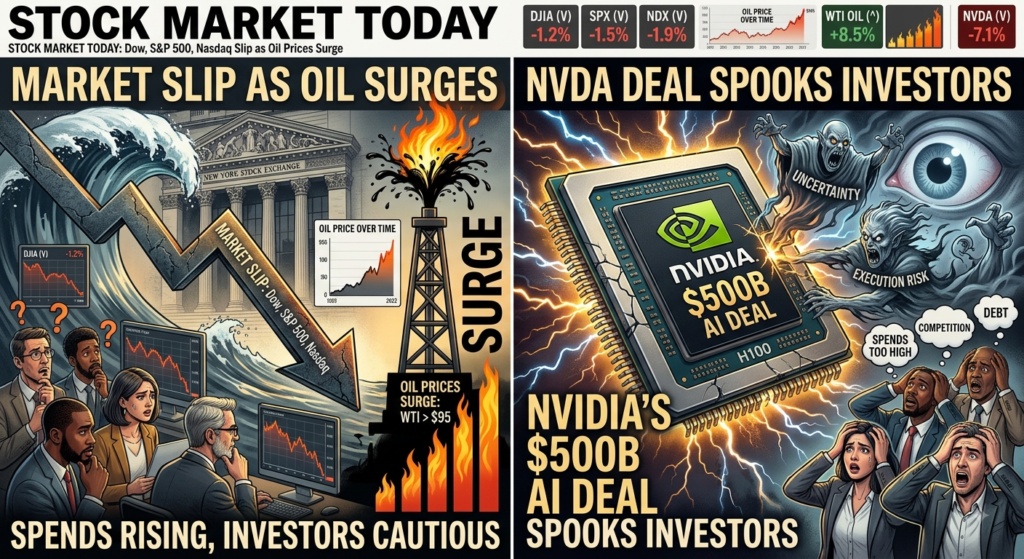
Wall Street edged lower as oil prices jumped on Middle East tensions and Nvidia fell nearly 3% on a $500B AI funding report. Here’s what moved markets today.
Wall Street closed out Monday’s session in the red, though the losses were modest by any measure. The S&P 500 slipped roughly 0.06%, ending near 7,753 and still sitting close to record territory. The Dow Jones Industrial Average shed about 61 points, or 0.11%, to close near 53,976, pulling back slightly from its all-time high. The Nasdaq Composite, weighed down by tech, fell the hardest of the three, dropping around 0.3% to settle near 26,605.
The main pressure came from energy markets. Brent crude pushed above $87 a barrel as talks between Iran and Oman over reopening the Strait of Hormuz failed to produce a breakthrough. Tehran has continued resisting direct negotiations with Washington until a list of conditions is met, and that uncertainty has been enough to keep a bid under oil prices for days. Higher energy costs matter to equity investors right now for a specific reason: they threaten to reignite inflation just as the market had started pricing in a possible Federal Reserve rate cut following a softer-than-expected jobs report. A rally in crude complicates that picture, and bond markets reacted accordingly — the 10-year Treasury yield ticked up to 4.71%, and government bonds across Asia-Pacific followed Treasuries lower into Tuesday trading.
Energy stocks were the one sector actually thriving in this environment. The S&P 500’s energy segment jumped more than 4% as names like Exxon Mobil rose alongside crude prices, while the rest of the market mostly treaded water or slipped — more than half of U.S. listed stocks were in negative territory during the session.
Nvidia was the session’s most-watched decliner, falling close to 3% after the Financial Times reported the chipmaker is working with Apollo Global Management and Blackstone to assemble a $500 billion AI infrastructure funding package. On paper, a mega-deal like that should read as bullish confirmation of AI demand. Instead, investors seemed to focus on the flip side: the sheer scale of capital now required to keep the AI buildout running is starting to raise questions about how sustainable that spending pace really is. Nvidia wasn’t alone — Intel dropped roughly 4-5% after announcing a dilutive $15 billion common stock offering to fund its own AI and manufacturing ambitions, and Apple also slipped alongside the broader chip and tech complex.
Not everything in tech struggled. Meta Platforms managed to close higher after investors digested Mark Zuckerberg’s latest AI strategy comments and the debut of a new AI model from the company. Gold also caught a bid, climbing over 1% to trade above $4,390 an ounce, as some investors rotated toward traditional safe havens amid the mixed signals from oil, rates, and tech.
Zooming out, this pullback comes on the heels of a strong run. Stocks notched solid gains the prior Friday after weak labor data cooled expectations of near-term Fed tightening, and the S&P 500 had recently broken out of a multi-month trading range between roughly 7,250 and 7,600. Market breadth has stayed healthy too, with about 72% of S&P 500 stocks trading above their 200-day moving averages — a sign that, Monday’s dip aside, the broader uptrend hasn’t been seriously challenged yet.
The bigger question heading into the rest of the week is whether oil’s climb keeps building. Traders are watching upcoming US inflation data closely, since a hotter-than-expected CPI print combined with elevated energy prices could push the Fed toward a more hawkish stance than markets currently expect. For now, Monday’s losses look more like a pause than a reversal — but with geopolitical risk around the Strait of Hormuz still unresolved and AI-related capital spending under fresh scrutiny, volatility could pick up quickly in either direction.
Frequently Asked Questions
1. Why did the stock market fall today?
Rising oil prices — driven by stalled talks over reopening the Strait of Hormuz — reignited inflation concerns, while Nvidia’s near-3% drop on a report of a $500 billion AI funding partnership added pressure on tech stocks.
2. Why did Nvidia stock pull back?
Nvidia fell after the Financial Times reported it’s working with Apollo Global and Blackstone on a $500 billion AI infrastructure funding package. Rather than reassuring investors, the size of the deal raised concerns about how capital-intensive the AI buildout has become.
3. How much did the Dow, S&P 500, and Nasdaq lose?
The S&P 500 slipped about 0.06%, the Dow fell roughly 0.11%, and the Nasdaq dropped about 0.3% — modest declines that followed a strong winning stretch for all three indexes.
4. Why are oil prices rising right now?
Brent crude climbed above $87 a barrel after Iran and Oman failed to reach a deal to reopen the Strait of Hormuz, with Iran continuing to resist direct US negotiations, keeping supply-disruption risk elevated.
5. Which stocks gained despite the market pullback?
Energy stocks led the market, rising alongside crude prices, with Exxon Mobil among the gainers. Meta Platforms also closed higher after unveiling new AI initiatives, and gold rose as investors sought safer assets.
6. Is the stock market still in an uptrend despite today’s losses?
Yes, broadly. The S&P 500 recently broke out of a months-long trading range near record highs, and about 72% of S&P 500 stocks remain above their 200-day moving average — suggesting the pullback is a pause rather than a trend reversal, though upcoming inflation data could change that.