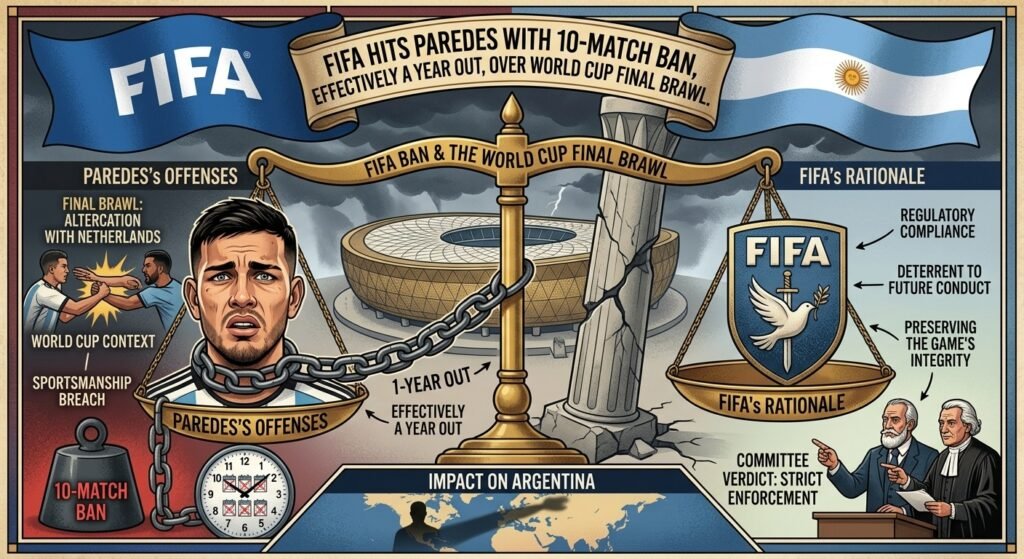
FIFA has banned Argentina’s Leandro Paredes for 10 matches, along with two teammates and the head coach’s assistant, following a post-final scuffle with Spain players after the 2026 World Cup final.
FIFA has handed down some of the most severe World Cup-related sanctions in years, banning three Argentina players following a physical altercation with Spain players that erupted moments after the final whistle of the 2026 World Cup final. Leading the punishments is a 10-match suspension for midfielder Leandro Paredes — a ban so significant it effectively keeps him out of the national team for a full year.
What Triggered the Scuffle
The incident unfolded in the immediate aftermath of Argentina’s World Cup final defeat to Spain on July 19 in East Rutherford, New Jersey. In the chaos following the final whistle, Paredes was seen grabbing Spain’s Eric García by the throat and shoving Gavi to the ground, sparking a broader physical confrontation between players and coaching staff from both sides on the field.
The Punishments Handed Down
FIFA’s disciplinary committee announced the sanctions Friday from Geneva. Paredes received the harshest penalty: a 10-match suspension along with a $90,000 fine. Argentina defender Nahuel Molina was banned for seven matches and fined the same $90,000, while midfielder Thiago Almada received a one-match ban and a $30,000 fine.
The punishment wasn’t limited to players. Argentina assistant coach Roberto Ayala was also hit with a three-match ban and a $30,000 fine for his role in the post-match confrontation. On Spain’s side, Gavi received a one-match suspension of his own, which will apply to Spain’s upcoming Nations League match against England at Wembley on September 26.
Why Paredes’s Ban Is Historically Significant
Because national teams play a relatively limited number of matches compared to club sides, a 10-match suspension carries far more real-world weight than it might in domestic league play. With FIFA’s international match calendar running through June 2027, Paredes’s ban is effectively a full year away from representing Argentina — even though all of the affected matches are likely to be friendlies, since Argentina currently has no competitive fixtures scheduled during that window.
The severity of the sanction places Paredes in rare company. FIFA and outside observers have compared the ban directly to the punishment handed to Uruguay’s Luis Suárez in 2014, when he was banned from all football activity for four months — including with his new club Barcelona — plus an additional eight competitive matches for Uruguay, after biting Italy’s Giorgio Chiellini during a World Cup group-stage match in Brazil. Paredes’s 10-match ban also matches the sanction given to Croatia’s Josip Šimunić in 2013, who was banned after using a megaphone to lead fans in chants tied to the country’s pro-Nazi wartime regime following a World Cup qualifying playoff win.
Broader Sanctions Against the Argentine Federation
Beyond the individual player and coaching bans, the Argentine Football Association (AFA) itself was fined $110,000 for a range of incidents throughout the tournament. Those incidents reportedly included players displaying a political banner referencing the Falkland Islands following Argentina’s semifinal win over England, along with instances of discriminatory chanting from Argentine fans during the tournament. The Falklands banner had previously drawn public criticism from UK politicians, including Liberal Democrat leader Ed Davey, who had called at the time for the involved players to face suspension.
As part of the sanctions, FIFA also ordered the AFA to spend $100,000 on anti-racism projects. For context on the financial scale involved, Argentina received $34 million in prize money from FIFA for its participation in the tournament.
What Happens Next
The Argentine Football Association has confirmed it plans to challenge the more severe sanctions. In an official statement, the federation said its legal department would formally request the grounds behind FIFA’s rulings in order to file appeals with the governing body’s internal appeal committee, while reserving the option to escalate the matter further to the Court of Arbitration for Sport (CAS) as a final avenue if needed.
Given the scale of Paredes’s ban and its effective one-year impact on his international career, an appeal seems highly likely to move forward, though any final outcome will take time to work through FIFA’s internal process before potentially reaching CAS.
Frequently Asked Questions
Q: Why was Leandro Paredes banned by FIFA? Paredes was banned for grabbing Spain’s Eric García by the throat and pushing Gavi to the ground during a post-match scuffle that broke out immediately after the 2026 World Cup final.
Q: How long is Paredes’s suspension? He received a 10-match ban, which, given FIFA’s international match calendar through June 2027, effectively amounts to a one-year absence from the Argentina national team.
Q: Which other Argentina players and staff were sanctioned? Defender Nahuel Molina received a seven-match ban, midfielder Thiago Almada received a one-match ban, and assistant coach Roberto Ayala was given a three-match ban, all accompanied by fines.
Q: Was anyone from Spain punished as well? Yes. Spain’s Gavi received a one-match ban, which will apply to Spain’s Nations League match against England on September 26.
Q: Can Argentina appeal these sanctions? Yes. The Argentine Football Association has confirmed it plans to formally request the grounds for FIFA’s rulings and pursue an appeal through FIFA’s internal appeal committee, with the option to escalate to the Court of Arbitration for Sport if necessary.