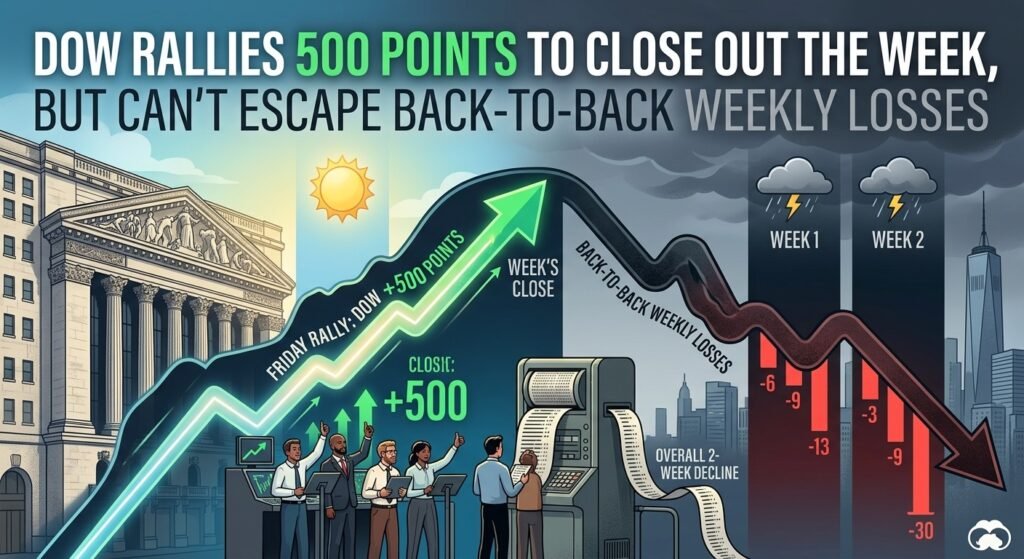
The Dow surged more than 500 points Friday, clawing back much of Thursday’s steep sell-off, but all three major indexes still closed the week lower as rising Treasury yields and Iran tensions kept pressure on stocks.
Wall Street ended the week on a strong note Friday, with the Dow Jones Industrial Average rallying more than 500 points, but the bounce wasn’t enough to erase a rough week overall. All three major indexes closed lower for the second consecutive week, as rising Treasury yields and escalating tension with Iran continued weighing on investor sentiment.
Friday’s Rally, by the Numbers
The Dow closed up 517.80 points, or roughly 1%, finishing at 53,277.01. The S&P 500 and Nasdaq Composite each gained about 0.4% on the day, recovering a meaningful chunk of Thursday’s sharp losses, though not quite enough to turn the week positive.
Despite Friday’s strength, the weekly totals told a more difficult story. The S&P 500 fell 1.4% for the week, snapping a three-week winning streak. The Nasdaq dropped 2%, also ending its own three-week run of gains. The Dow slipped 0.9% on the week, marking its second consecutive weekly decline and, by some measures, its steepest weekly drop since mid-March.
What Drove the Rebound
A few specific catalysts helped fuel Friday’s bounce. S&P Global’s flash August composite PMI reading came in at 56.0, a 52-month high, with services sector activity significantly exceeding expectations — a reading strong enough to encourage investors to buy back into stocks after Thursday’s steep sell-off.
Financial stocks provided some of the biggest support Friday, with JPMorgan Chase and Goldman Sachs climbing 1.2% and 2.3% respectively, helping push the S&P 500’s banking index up 1.1% on the day. Healthcare names also helped lift the Dow, with Merck and Johnson & Johnson among the standout performers; Moderna shares jumped more than 9%, while Merck added over 2%.
Crypto-linked stocks had a particularly strong session, riding Bitcoin’s continued climb toward its highest level since late May. Robinhood shares surged nearly 14%, while Coinbase gained around 8-9%, and bitcoin-holding firm Strategy rose more than 7%.
Why the Week Was Still a Loser Overall
Despite Friday’s gains, the broader forces that dragged markets lower earlier in the week haven’t gone away. Long-dated Treasury yields kept climbing throughout the week, with the 30-year Treasury yield touching its highest level since 2007 at one point, before settling around 5.273% by Friday. The 10-year yield rose more than 3 basis points on Friday alone, to 4.734%.
The Treasury Department’s plan to increase purchases of longer-term debt — initially targeting at least $4 billion in buybacks of 10-, 20-, and 30-year securities — had briefly eased some of this pressure earlier in the week, but that relief proved short-lived, according to Leo Kelly, founder and CEO of Verdence Capital Advisors. Kelly said equities could see further losses heading into the fall, potentially even sliding toward correction territory, if Treasury yields continue climbing and tensions in the Middle East persist.
The Iran Factor
Renewed tension between the US and Iran added another layer of pressure throughout the week. Treasury Secretary Scott Bessent stated that the US would impose what he called “the toughest sanctions in history” on Iran, suggesting the move could reduce the need for further major military action, though it did little to fully calm investor nerves. The prolonged standoff has kept oil prices elevated, even though crude ticked slightly lower on Friday specifically.
Higher energy prices remain a genuine concern for markets, since they risk adding to inflationary pressure and complicating the Federal Reserve’s policy path. Investors are now looking ahead to Federal Reserve Chair Kevin Warsh’s upcoming speech at the Jackson Hole symposium for further clues on the central bank’s interest rate trajectory.
Tech Stocks Had a Rough Week
Technology was one of the hardest-hit sectors over the past five trading days, shedding more than 3% on the week and putting the S&P 500’s tech sector on track to finish in the red. Amkor Technology and Credo Technology were among the biggest laggards, falling nearly 15% and 11%, respectively, over the five-day stretch. Meta Platforms also weighed on the sector, down almost 7% over the same period.
Not every tech name struggled, though. Tesla stood out with a more than 5% gain on Friday alone, buoyed by positive developments in its Robotaxi business that helped restore some investor confidence, following the company’s participation in the first National AV Safety Forum held by the National Highway Traffic Safety Administration.
Wall Street Still Sees Room to Run
Despite the choppy week, at least one major bank remains firmly bullish on stocks longer-term. UBS Global Wealth Management raised its year-end target for the S&P 500 to 8,100, citing expectations for stronger corporate earnings growth in the months ahead — a signal that, even amid short-term volatility tied to yields and geopolitics, institutional confidence in the broader market’s trajectory hasn’t wavered significantly.
What to Watch Next Week
With markets heading into a new week still digesting elevated Treasury yields and an unresolved Iran standoff, investor attention is likely to center on two key events: Federal Reserve Chair Kevin Warsh’s remarks at Jackson Hole, and any further developments on the sanctions front with Iran. Both have the potential to meaningfully shift market direction, particularly given how closely stocks have been tracking bond yield movements over the past several weeks.
Frequently Asked Questions
Q: How much did the Dow gain on Friday? The Dow closed up 517.80 points, or roughly 1%, finishing at 53,277.01.
Q: Did the stock market have a good week overall? No. Despite Friday’s rally, all three major indexes posted weekly losses — the S&P 500 fell 1.4%, the Nasdaq dropped 2%, and the Dow slipped 0.9%, marking its second consecutive weekly decline.
Q: Why are Treasury yields affecting the stock market? Rising Treasury yields, including the 30-year yield touching its highest level since 2007, have raised concerns about borrowing costs and inflation, pressuring stocks even as the Treasury Department has tried to ease the increase through expanded debt buybacks.
Q: How is the Iran situation affecting markets? Ongoing tension between the US and Iran, including new sanctions announced by Treasury Secretary Scott Bessent, has kept oil prices elevated, adding to inflation concerns and weighing on broader investor sentiment.
Q: Which stocks performed best on Friday? Financial stocks like JPMorgan Chase and Goldman Sachs led gains, alongside a strong rally in crypto-linked names like Robinhood and Coinbase, while Tesla jumped more than 5% on positive Robotaxi business news.