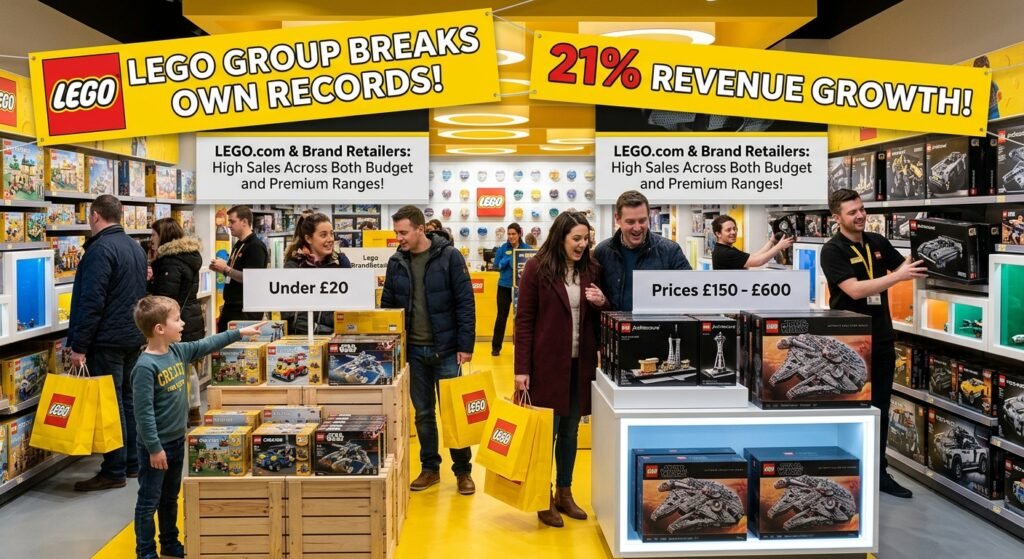
Lego posted record first-half 2026 revenue of $6.54 billion, up 21% year-over-year, with CEO Niels Christiansen crediting strength at both the value and high-end pricing tiers.
Lego just delivered its strongest first half ever, once again. The Danish toy giant reported record revenue for the first six months of 2026, extending a multi-year streak of record-breaking results that shows little sign of slowing down.
The Numbers Behind the Record
Lego posted first-half revenue of 41.9 billion Danish kroner, roughly $6.54 billion, marking a 21% jump compared to the same period last year. Operating profit climbed even faster, rising 22% year-over-year to 10.9 billion Danish kroner, or approximately $1.7 billion. The company launched more than 330 new products during the period, continuing its pattern of consistently expanding its catalog year after year.
Strength Across the Pricing Spectrum
Speaking with CNBC, CEO Niels Christiansen highlighted something notable about where this growth is coming from: Lego is seeing strong performance at both ends of its pricing range simultaneously. That means the company’s more affordable, entry-level sets are performing well alongside its premium, higher-priced collector and adult-focused lines — a combination that suggests broad-based demand rather than growth concentrated in just one customer segment.
What’s Driving the Growth
A big part of Lego’s momentum this year has come from major cultural and sports tie-ins. World Cup-themed sets have been a standout performer, including an officially licensed replica of the FIFA World Cup trophy, capitalizing on this summer’s global tournament excitement. The company’s Formula 1 partnership has continued to draw in new customers as well, building on momentum from previous years.
Lego also scored a significant pop-culture win with sets tied to “KPop Demon Hunters,” the Netflix animated hit that’s become a genuine cultural phenomenon, with the company specifically citing “consumer excitement” around the franchise as a meaningful driver of new customer interest.
Beyond entertainment tie-ins, the company has continued rolling out new technology-driven products. Its Smart Play platform, launched this year, brings sensor-equipped bricks capable of reacting to movement, sound, and light into physical sets — technology that had previously been featured in the company’s Star Wars and Pokémon ranges. Lego’s long-awaited Pokémon partnership has also officially launched this year, giving the brand access to one of the most valuable entertainment franchises in the world.
Steady Gateways Into the Brand
Alongside these newer, headline-grabbing launches, some of Lego’s more established product lines have continued quietly pulling their weight. The company’s botanical range — plants, flower bouquets, and succulents — remains a reliable draw for both existing fans and newcomers to brick-building. Its ongoing collaboration with Epic Games, which brings Lego into the digital space and imports elements from Fortnite into physical sets, has also continued to serve as an entry point for new customers discovering the brand.
According to the company, these “gateway” products tend to follow a consistent pattern: they draw in casual or first-time buyers, who then discover the broader appeal of building as both a creative outlet and a way to de-stress and focus, eventually turning into more engaged, long-term customers across Lego’s wider catalog.
A Continuation of Multi-Year Momentum
This latest report extends a genuinely remarkable growth streak. Lego’s first-half 2025 revenue had already set a record at the time, posting a 12% increase to 34.6 billion Danish kroner. This year’s 21% growth rate represents a meaningful acceleration on top of that already-strong prior performance, and follows a record full-year 2025 in which the company achieved double-digit growth in both revenue and operating profit, significantly outperforming the broader toy market and expanding its market share in the process.
What This Means for Lego’s Position in the Toy Industry
Lego’s continued outperformance comes at a time when the broader toy industry has faced a genuinely mixed and often challenging environment, including shifting consumer spending patterns and ongoing uncertainty tied to global tariff policy. Against that backdrop, Lego’s ability to post accelerating double-digit growth, while simultaneously expanding its product catalog across sports, entertainment, technology, and evergreen categories like botanicals, underscores just how dominant the company’s position within the global toy market has become.
With strong performance across both budget-conscious and premium price points, alongside a steady stream of high-profile licensing partnerships still rolling out, Lego appears well-positioned to carry this momentum into the back half of 2026.
Frequently Asked Questions
Q: How much revenue did Lego report for the first half of 2026? Lego reported record first-half revenue of 41.9 billion Danish kroner, approximately $6.54 billion, marking a 21% increase compared to the same period in 2025.
Q: What did Lego’s CEO say about the company’s pricing strategy? CEO Niels Christiansen told CNBC that Lego is seeing strong sales performance at both the high end and value end of its pricing range, indicating broad-based demand across different customer segments.
Q: What products drove Lego’s growth this year? Key drivers included World Cup-themed sets, the company’s Formula 1 partnership, “KPop Demon Hunters” licensed sets, its new Smart Play sensor technology platform, and its newly launched Pokémon partnership.
Q: How does this compare to Lego’s first-half 2025 results? Lego’s first-half 2025 revenue was 34.6 billion Danish kroner, up 12% year-over-year at the time. This year’s 21% growth rate represents a significant acceleration on top of that already-record performance.
Q: How many new products did Lego launch in the first half of 2026? The company launched more than 330 new products during the first six months of 2026, continuing its pattern of consistently expanding its product catalog.