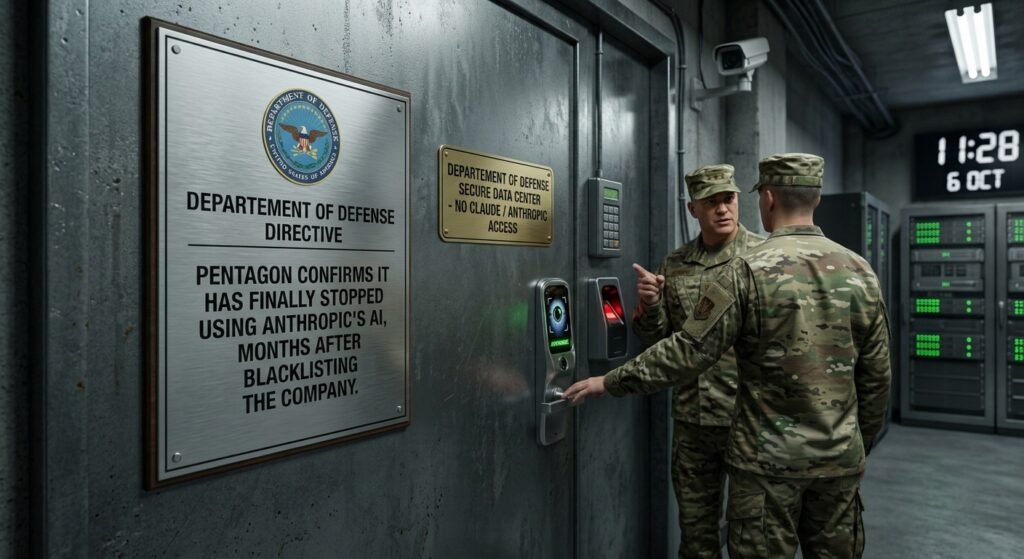
The Department of Defense has officially ceased using Anthropic’s Claude AI tools, a defense official told the BBC, months after designating the company a national security “supply chain risk” over a dispute on military AI use.
The US Department of Defense has confirmed it has officially stopped using Anthropic’s AI tools, a department official told the BBC, closing out a monthslong saga that began with a dramatic standoff over how far the Pentagon could push the company’s Claude models into military operations.
A Deadline That Took Months to Actually Stick
A Pentagon spokesperson told the BBC the department “has ceased the use of Anthropic products,” though the timeline leading up to that statement has been genuinely messy. Defense Secretary Pete Hegseth first designated Anthropic a national security “supply chain risk” back in February, a label typically reserved for companies based in countries considered adversarial to the United States, and announced the Pentagon would stop using Anthropic’s tools entirely by late August.
That deadline came and went without a clean break. Multiple people familiar with AI use inside the defense department told the BBC that Claude, including Anthropic’s newer Mythos models, continued to be used by Pentagon employees “throughout the whole period of the controversy,” well past the August cutoff. One source said recent private demonstrations of Maven, the Pentagon’s primary intelligence-organizing platform operated by Palantir, had also continued to include Claude as recently as the past few weeks.
AI policy expert Lauren Kahn told the BBC that this kind of delay isn’t unusual once a tool becomes deeply embedded in an organization’s workflow: integrated systems, she said, “can be painful to remove,” and aren’t simply “plug and play” replacements.
How the Standoff Began
The root of the dispute traces back to a disagreement over how Anthropic’s technology could be used in military contexts. The Pentagon pushed for Anthropic to agree to unconditional military use of its Claude models, including removing certain safety guardrails to allow greater flexibility. Anthropic refused, citing specific concerns about mass surveillance and the use of its technology in fully autonomous weapons systems.
When Anthropic held firm, Hegseth escalated the dispute dramatically, designating the company a formal national security supply chain risk and giving federal agencies, including the Department of Defense, a six-month phase-out period to stop using Anthropic’s products. President Trump personally weighed in at the time as well, publicly telling the government to “immediately” stop using Anthropic’s technology and criticizing the company’s leadership in blunt terms.
Anthropic has pushed back against the designation through the courts, describing the move as “unprecedented and unlawful.” In August, a federal judge ruled in Anthropic’s favor on a related legal challenge, finding that the Pentagon’s blacklisting constituted unlawful retaliation against the company.
Reports of Continued Use During Sensitive Operations
Adding another layer to the controversy, reports have surfaced suggesting that even after Anthropic was labeled a security risk and given a phase-out deadline, the company’s Claude model was reportedly still used in connection with some military operations involving Iran until relatively recently, further complicating the narrative around just how quickly and cleanly the Pentagon has actually been able to step away from Anthropic’s technology.
Who’s Filling the Gap
With Anthropic now officially out of the picture at the Pentagon, other major AI labs have moved in to fill the void. OpenAI announced a deal with the Defense Department shortly after Trump’s original ban announcement, agreeing to provide its own technology for use on classified networks. According to people familiar with AI use inside the defense department, OpenAI’s tools have become more widely adopted across some military departments in recent months.
Elon Musk’s company xAI has also been cleared for use on classified networks as part of the broader shuffle away from Anthropic, though it remains an open question how comparable these alternative tools will prove to be in terms of usefulness and security compared to what Anthropic had previously provided.
A Historic First Now Undone
Anthropic’s relationship with the US government carried real historical significance before this falling-out. According to the BBC, the company had been used by the US government and military since 2024, and was the first advanced AI company to have its tools deployed within government agencies handling classified work, a genuinely pioneering role in the relationship between frontier AI labs and national security infrastructure.
Anthropic had previously held a $200 million contract with the Defense Department, and the company has publicly maintained that its technology was serving the Pentagon’s own stated interests responsibly, including, according to earlier reporting, offering the Pentagon the ability to use its AI systems specifically for missile defense applications, even as the broader standoff over autonomous weapons and surveillance use continued unresolved.
A Surprisingly Warm Moment With the White House, Even Amid the Standoff
Despite the ongoing friction with the Pentagon specifically, Anthropic’s relationship with the broader Trump administration appears to be thawing elsewhere. Trump met with Anthropic CEO Dario Amodei twice at the White House just last week. Following one of those meetings, Amodei told reporters he still held concerns about the risks posed by AI, saying “how we address those risks is still under discussion,” while adding that “if we work with the president, we can win safely.” Trump, standing alongside Amodei at the time, praised him directly, calling him “great” and “fantastic.”
That warmer public dynamic stands in genuine contrast to the Pentagon’s continued hardline stance, highlighting something of a split-track relationship between Anthropic and different parts of the federal government, cordial and collaborative at the White House level, while remaining formally severed at the Defense Department.
What This Means Going Forward
With the Pentagon now confirming the transition away from Anthropic is complete, at least officially, the broader episode leaves behind a notable case study in how quickly, or not, deeply embedded AI tools can actually be removed from sensitive government operations once a political and security dispute escalates. It also raises a bigger question for the AI industry more broadly: as frontier AI companies increasingly negotiate the terms under which their technology can be used by militaries and governments, Anthropic’s standoff with the Pentagon may serve as an early, closely watched test case for how much leverage AI developers can realistically exercise over their own safety red lines, even when facing the full weight of a government contract and the threat of being formally blacklisted.
Frequently Asked Questions
Q: Has the Pentagon actually stopped using Anthropic’s AI tools? Yes, according to an official statement given to the BBC. However, multiple sources told the BBC that Claude tools continued to be used by Pentagon employees well past the original August 2026 deadline the department had set for phasing them out.
Q: Why did the Pentagon blacklist Anthropic in the first place? The dispute began when the Pentagon demanded Anthropic agree to unconditional military use of its Claude models, including removing certain safety restrictions. Anthropic refused, citing concerns about mass surveillance and fully autonomous weapons systems, leading Defense Secretary Pete Hegseth to designate the company a national security “supply chain risk.”
Q: Which AI companies are the Pentagon using instead of Anthropic? OpenAI has reportedly become more widely adopted across some military departments, and Elon Musk’s company xAI has also been cleared for use on classified networks as part of the shift away from Anthropic.
Q: Did Anthropic challenge the Pentagon’s decision legally? Yes. Anthropic has described the blacklisting as “unprecedented and unlawful,” and in August, a federal judge ruled in the company’s favor, finding that the designation constituted unlawful retaliation.
Q: Is Anthropic’s relationship with the rest of the Trump administration also strained? Not entirely. Despite the Pentagon dispute, President Trump met with Anthropic CEO Dario Amodei twice at the White House just last week and publicly praised him, suggesting a more cordial dynamic at the White House level even as the Defense Department relationship remained formally severed.