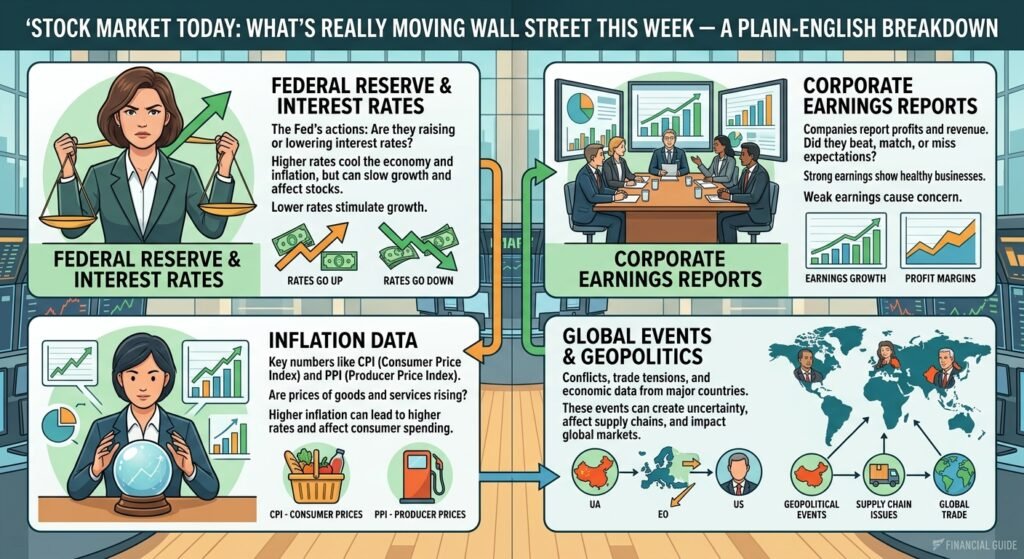
Confused about why the Dow, S&P 500, and Nasdaq keep moving in different directions? Here’s a simple, no-jargon breakdown of what’s driving the stock market this week — chip stocks, bond yields, and new Iran sanctions.
If you’ve glanced at financial headlines this week and felt lost — Dow up, Nasdaq down, bond yields, chip stocks, Iran sanctions — you’re not alone. The stock market right now is being pulled in several different directions at once, and understanding why doesn’t require a finance degree. Here’s what’s actually happening, explained simply.
The Big Picture: A Market Pulling in Two Directions
Right now, there’s a real split happening in the stock market. The Dow Jones Industrial Average, which tracks 30 large, well-established companies, has actually been having a strong month — on track for its fifth straight positive month. Meanwhile, the Nasdaq, which is heavily weighted toward technology and chip companies, has been struggling, on pace for its first positive month in three, but only barely.
This isn’t random. It reflects a genuine divide in what investors are worried about: technology and chip stocks specifically are under pressure, while more traditional, stable sectors are holding up fine or even thriving.
Why Are Chip Stocks Falling?
One of the clearest patterns this week has been a sell-off in semiconductor (computer chip) companies. Micron Technology dropped nearly 6% in a single session, while AMD and Broadcom each fell more than 2-3%. The ETF that tracks the whole chip sector, called the iShares Semiconductor ETF, slid 2.7% on Monday alone. Memory chip makers got hit especially hard — Sandisk, Seagate Technology, and Western Digital all fell 5% or more.
In simple terms: Investors have grown nervous that companies are spending enormous amounts of money building AI infrastructure — data centers, chips, servers — without yet proving that spending will pay off in real profits. When that nervousness spikes, chip stocks (which power all of this AI buildout) tend to get sold off first, since they’re viewed as the most directly tied to that risk.
Why Are Bond Yields Such a Big Deal Right Now?
You’ve probably seen the phrase “Treasury yields” or “bond yields” mentioned constantly in market news lately. Here’s what that actually means and why it matters so much.
When the US government needs to borrow money, it sells bonds (basically IOUs) to investors. The “yield” is essentially the interest rate the government pays to borrow that money. When yields rise, it means investors are demanding more interest to lend the government money — often because they’re worried about inflation, or because there’s simply a lot of competition for their money elsewhere.
Why this affects stocks: When bond yields rise, investors can earn a decent, relatively safe return just by holding government bonds. That makes riskier investments, like stocks — especially fast-growing tech stocks — comparatively less attractive. So when yields climb, stocks, and tech stocks in particular, often fall.
This week, the US Treasury actually tried to help by announcing it would buy back more long-term government debt, which initially pushed yields down and gave stocks a boost. But that relief didn’t last — yields climbed right back up within days, showing just how much pressure remains in the bond market from things like heavy government borrowing and a surge in AI-related corporate debt.
The Iran Factor: Why Foreign Policy Is Moving Stock Prices
This week also brought a fresh geopolitical twist. Treasury Secretary Scott Bessent announced a new round of sanctions against Iran, calling the effort “Operation Economic Outcast.” Around the same time, President Trump made comments about applying more economic pressure on Iran and even threatened Oman over the Strait of Hormuz, a critical waterway for global oil shipments.
Why this matters for your portfolio, even if you don’t own oil stocks: Tension in the Middle East tends to push oil prices higher, since traders worry that supply through key shipping routes like the Strait of Hormuz could get disrupted. Higher oil prices mean higher costs for businesses and consumers, which feeds into inflation fears — and as we just covered, inflation fears push bond yields up, which then pressures stocks. It’s a chain reaction: geopolitics → oil prices → inflation worries → bond yields → stock prices.
What About Individual Company News?
Not everything moving the market this week has been about big-picture economic forces. Some of it comes down to individual company earnings reports:
- Walmart stock fell more than 9% after the retail giant reported strong overall earnings but warned that US sales growth is slowing, with customers making “trade-offs” due to high gas prices — a signal that everyday consumers are feeling financial pressure.
- Ross Stores, the discount retailer, saw its stock jump 7% after beating earnings expectations and raising its full-year outlook, showing that budget-focused retailers may actually be benefiting as shoppers look for deals.
- Strategy, a company known for holding large amounts of Bitcoin, has been one of the better-performing stocks lately, rising alongside Bitcoin’s own sharp price increase this month.
This mix shows an important lesson: even during weeks when “the market” seems to be moving as one, individual companies can tell very different stories depending on their specific business and customer base.
A Quick Explainer: What Do the Dow, S&P 500, and Nasdaq Actually Measure?
If you’ve ever wondered what these three names actually track, here’s the simple version:
- The Dow Jones Industrial Average tracks 30 large, well-known American companies across various industries — think of it as a snapshot of “big, established corporate America.”
- The S&P 500 tracks 500 major US companies and is generally considered the best overall measure of the US stock market as a whole.
- The Nasdaq Composite tracks thousands of companies, but it’s especially known for being heavy on technology stocks, which is why it tends to swing more dramatically when tech sentiment shifts.
When these three indexes move in different directions, like they have this week, it’s usually a sign that one specific sector (in this case, tech and chips) is facing pressure that isn’t affecting the broader economy equally.
Gold and Bitcoin: The “Safety” and “Risk” Signals
Two other assets worth watching alongside stocks right now: gold and Bitcoin.
Gold has been climbing to multi-month highs, recently touching levels near $4,700 an ounce, extending a five-week winning streak — its longest since October of last year. Investors often buy gold when they’re nervous about inflation or economic uncertainty, since it’s traditionally viewed as a stable “safe haven” asset.
Bitcoin, meanwhile, has done the opposite of what you might expect during an uncertain week — it’s surged sharply, climbing above $79,000-80,000 after a powerful multi-day rally. This shows that Bitcoin isn’t always moving in the same direction as traditional “risk-off” assets like gold; this month, it’s behaved more like a high-growth, high-risk asset benefiting from the same loosened financial conditions that have periodically lifted stocks too.
The Bottom Line
This week’s market action boils down to a tug-of-war between a handful of forces: nervousness about AI spending weighing on chip stocks, rising bond yields making stocks less attractive by comparison, fresh geopolitical tension with Iran pushing oil and inflation worries higher, and a mixed bag of individual company earnings adding further noise on top of all of it. None of these forces exist in isolation — they’re all connected, feeding into and amplifying each other, which is exactly why the market has felt so choppy and directionless this week rather than moving cleanly in one direction.
Frequently Asked Questions
Q: Why do rising bond yields hurt the stock market? When bond yields rise, investors can earn solid returns from relatively safe government bonds, making riskier investments like stocks less attractive by comparison. This is especially true for growth-focused tech stocks, which tend to be more sensitive to yield changes than stable, established companies.
Q: Why are chip stocks falling even though AI is supposed to be booming? Investors have grown increasingly cautious about whether the massive spending on AI infrastructure will actually generate profits fast enough to justify current valuations, leading to sell-offs in chip stocks even amid continued strong AI demand.
Q: How does the Iran situation affect the US stock market? Rising tension in the Middle East tends to push oil prices higher due to concerns about disrupted shipping through routes like the Strait of Hormuz. Higher oil prices contribute to inflation concerns, which in turn push bond yields higher and pressure stock prices.
Q: What’s the difference between the Dow, S&P 500, and Nasdaq? The Dow tracks 30 large established companies, the S&P 500 tracks 500 major companies across the broader economy, and the Nasdaq is heavily weighted toward technology stocks, making it more volatile during periods of tech-specific uncertainty.
Q: Should I be worried about my investments based on this week’s volatility? This response isn’t financial advice, but it’s worth noting that short-term market swings driven by shifting narratives (like chip stock sentiment or bond yields) are a normal part of investing. Long-term investors typically focus less on week-to-week noise and more on their overall strategy and time horizon.