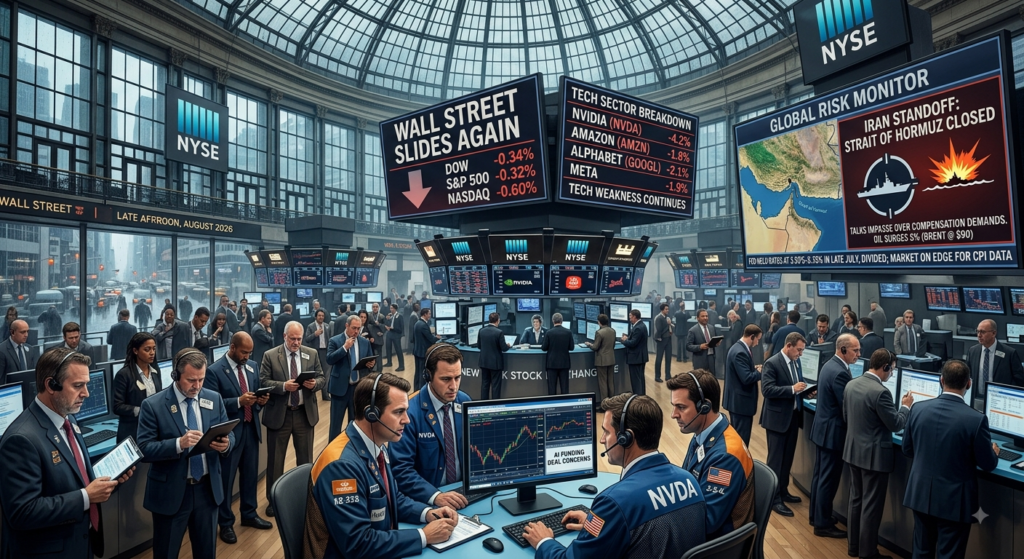
The S&P 500 and Nasdaq posted back-to-back losses Tuesday as heavyweight tech stocks dragged markets lower and renewed doubts over a US-Iran resolution pushed oil prices higher.
Wall Street closed lower for a second straight session Tuesday, as a pullback in major technology stocks combined with growing uncertainty over the Strait of Hormuz standoff to keep investors in a defensive mood heading into a pivotal stretch of inflation data.
How the Major Indexes Performed
Trading was choppy throughout the day, with heavyweight tech names weighing most heavily on both the S&P 500 and Nasdaq Composite. The technology sector itself was mixed rather than uniformly negative — Nvidia actually gained about 1.2% on the day, while Microsoft and Apple slipped 0.8% and 1%, respectively, illustrating just how split investor sentiment has become even within the same sector.
Despite the tech drag, industrial stocks helped offset some of the broader weakness, keeping the overall market decline relatively contained rather than turning into a sharper sell-off. Advancing issues actually outnumbered decliners on both the NYSE and Nasdaq, a detail that suggests the pullback was more concentrated in specific large-cap names than reflective of broad-based selling across the market.
Iran Uncertainty Keeps Oil Prices Elevated
Much of Tuesday’s cautious tone traces back to conflicting signals coming out of the ongoing Strait of Hormuz negotiations. Investors spent the session digesting a report suggesting the US and Iran were nearing “some sort of an arrangement,” with Pakistan’s defence minister telling Bloomberg News that recent signals pointed toward a possible peace agreement, shortly after Qatar’s foreign ministry indicated that Iran-Oman talks over Hormuz shipping had reached an advanced stage.
That cautious optimism didn’t last long. Later in the session, Iran’s newly appointed secretary of its Supreme National Security Council stated that the Strait of Hormuz would remain closed as long as the US doesn’t change its approach and accept Iran’s conditions for ending the conflict — a comment that reinforced investor skepticism about how close a genuine resolution actually is.
Brent crude futures held near one-week highs amid the choppy back-and-forth, while the S&P 500’s energy sector climbed 1.1% on the day, benefiting from the same uncertainty weighing on broader risk sentiment. “As has been the case for months, it’s just really hard to come to an agreement that works for everyone,” said Ross Mayfield, investment strategy analyst at Baird in Louisville, Kentucky. “Oil is a little higher, pricing in more uncertainty around that. The market has obviously gyrated around this conflict at times, but it hasn’t been the big headwind that a lot of people imagined it might be.”
What Else Moved Markets
Beyond the Iran headlines, a handful of individual stock stories added to Tuesday’s mixed picture. Amazon and Alphabet both slipped as part of the broader tech pullback. Hims & Hers Health dropped 5.5% after posting a wider-than-expected second-quarter loss, while LNG company Venture Global fell about 5% following second-quarter revenue that came in slightly below estimates.
Intel remained a focal point after increasing its previously announced $15 billion common stock offering to $20 billion, as the chipmaker seeks additional capital to fund its AI computing infrastructure buildout. The offering was priced at $95 a share, a discount of more than 2.5% to Monday’s closing price, and Intel shares fell 4% on Monday as investors weighed concerns about potential dilution from the larger raise.
On a more encouraging note for the broader economy, the NFIB Small Business Optimism Index climbed to 99.8, its best reading since August 2025 and above its 52-year historical average. The report’s labor market components stood out in particular, with a net 20% of small business owners saying they plan to create new jobs over the next three years — the highest level since October 2022. “Although uncertainty is currently elevated, Main Street anticipates that business conditions will continue to improve,” said NFIB chief economist Bill Dunkelberg.
All Eyes on This Week’s Inflation Data
With Tuesday’s session behind them, investors are now bracing for a critical stretch of economic data. Both the consumer price index (CPI) and producer price index (PPI) reports are due out over the next two days, and markets widely expect these readings to play a decisive role in shaping expectations for the Federal Reserve’s next policy move.
Fed Chair Kevin Warsh’s approach to interest rate guidance has become a particular focus for traders, with the CME FedWatch Tool showing markets nearly evenly split on whether the central bank will move to raise rates in September or opt to hold steady instead. That split underscores just how much weight this week’s inflation figures are likely to carry in tipping sentiment one direction or the other.
The Bigger Picture
Tuesday’s back-to-back decline captures a market currently being pulled in several directions at once: renewed skepticism about a near-term Iran resolution keeping energy markets on edge, ongoing divergence within the tech sector as investors reassess AI-related capital spending, and a Federal Reserve policy path that remains genuinely uncertain heading into this week’s inflation reports. Until more clarity emerges on any of these fronts, choppy, headline-driven trading like Tuesday’s session may continue to define the market’s near-term mood.
Frequently Asked Questions
Q: Why did the S&P 500 fall for a second straight day? The decline was driven primarily by weakness in heavyweight technology stocks like Microsoft and Apple, combined with renewed investor uncertainty over whether the US and Iran are actually close to resolving the Strait of Hormuz standoff.
Q: Is a US-Iran deal on the Strait of Hormuz close? Signals remain mixed. While some officials suggested an arrangement may be near, Iran’s Supreme National Security Council stated the strait would remain closed unless the US changes its approach and accepts Iran’s conditions, keeping the outcome genuinely uncertain.
Q: Why did oil prices rise despite hopes for an Iran deal? Oil prices climbed as traders priced in continued uncertainty following Iran’s comments casting doubt on a near-term resolution, pushing Brent crude futures near one-week highs even amid earlier optimistic signals.
Q: What economic data are investors watching this week? Consumer price index (CPI) and producer price index (PPI) inflation reports are due over the following two days and are expected to heavily influence expectations for the Federal Reserve’s interest rate decision in September.
Q: Why did Intel stock fall this week? Intel shares dropped after the company increased its common stock offering from $15 billion to $20 billion to fund its AI infrastructure buildout, with the larger offering priced at a discount that raised investor concerns about shareholder dilution.