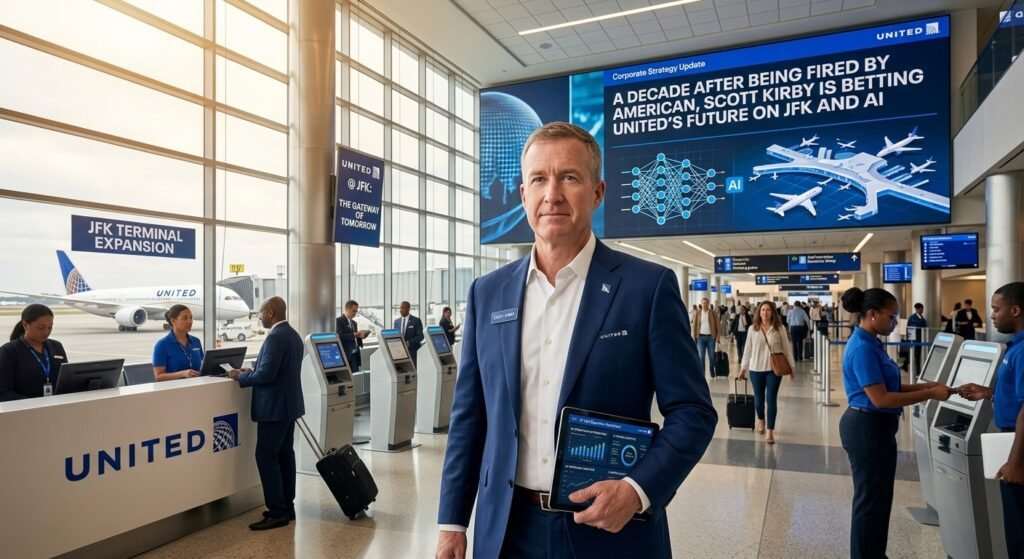
United Airlines CEO Scott Kirby, fired from American Airlines a decade ago, tells CNBC he’s focused on returning to JFK and preparing the airline for how AI will reshape the industry, even after two rebuffed merger attempts.
Ten years after being fired as president of American Airlines, Scott Kirby now runs United, the second-most profitable airline in the United States. In a recent conversation with CNBC, Kirby made clear he’s not interested in looking backward. “Everyone thinks I do, but no, I don’t,” he said, when asked whether revenge factors into his approach these days. Instead, his focus is squarely on two very different fronts shaping United’s next decade: winning back a foothold at New York’s JFK airport, and preparing the airline for how artificial intelligence will change the way it operates.
Moving Past the Merger Chapter
Kirby’s tenure at United hasn’t been short on ambition. Over the past couple of years, he pursued merger discussions with both of his largest domestic rivals — first reportedly approaching Delta CEO Ed Bastian about a potential combination, and more recently making a public overture toward American Airlines, the very company that fired him a decade ago.
Neither attempt panned out. American publicly rejected the idea outright, with CEO Robert Isom calling the concept “bad for customers, bad for the industry” and confirming American wasn’t interested in engaging on any deal. Kirby acknowledged the rejection left him without a viable partner, telling reporters at the time that a merger “requires support from everyone… we don’t have that, clearly, so we can’t get it done without them.” Delta’s own president, Peter Carter, has similarly downplayed the likelihood of major consolidation, framing the company’s strategy instead around international partnerships and joint ventures.
With that chapter now largely behind him, Kirby has been clear that acquiring a smaller carrier isn’t on the table either. His focus has shifted instead toward organic growth — expanding United’s own network and capabilities rather than chasing further deals.
The Push to Return to JFK
One of the clearest priorities Kirby has articulated is getting United back into New York’s JFK airport, a market the airline has been notably absent from in recent years after shifting its New York operations to Newark. “JFK is important to us. One way or another, we need to be back in JFK,” Kirby has said, framing it as a matter of when, not if, even without a clear timeline or specific plan yet in place for how that return might happen.
The push for JFK fits into a broader pattern that’s defined much of Kirby’s leadership: an aggressive, high-visibility approach to network expansion, particularly on long-haul international routes. United has consistently emphasized its international route map as a core driver of customer loyalty and premium credit card sign-ups, often rolling out new destination announcements with considerable fanfare. That strategy has also put United in increasingly direct competition with Delta over lucrative long-haul markets, including the trans-Pacific routes that have traditionally been a United stronghold but where Delta has recently begun pushing harder for market share.
Betting Big on AI’s Role in Aviation
Beyond network expansion, Kirby has been increasingly vocal about artificial intelligence as a central piece of United’s future strategy — both for improving the airline’s internal operations and for making the actual travel experience smoother for passengers. He’s described AI tools as a way to tackle one of aviation’s most persistent challenges: reliability, given how susceptible airlines are to weather disruptions, congested airports, and a wide range of operational variables that are notoriously difficult to manage at scale.
In earlier remarks about United’s tech transformation, Kirby offered a concrete example of what this looks like in practice: the airline has used AI to analyze decades of historical data on how storms have affected operations at Denver International Airport, helping identify which routes stay open and how to best sequence aircraft during disruptions — insights Kirby says could make operations dramatically more efficient at every airport United serves, not just Denver. He’s been candid, however, that outside constraints remain a real obstacle; the FAA’s systems, he’s noted, currently aren’t modernized enough to ingest and act on that kind of data, even though United can still capture internal benefits from the analysis regardless.
Kirby has gone further still, suggesting that within United’s network operating center — what he describes as the “brains of the airline” — AI may eventually be capable of outperforming human decision-making across nearly every function handled there, given the sheer scale and complexity of data involved in coordinating a global airline’s operations in real time.
A CEO Known for Speaking His Mind
Kirby has built a reputation as the most outspoken CEO among major US airlines, a trait that shapes how his own team operates around him. According to Kirby, his staff has learned to stop briefing him too far in advance on upcoming route announcements or marketing campaigns, specifically because they’re concerned he’ll reveal the details publicly before the official rollout — a dynamic Kirby himself acknowledges is a fair characterization.
That same directness has shaped how he’s talked publicly about the failed merger attempts, choosing to discuss the rejections openly rather than quietly moving on, an approach that stands out compared to how most corporate leaders typically handle a rebuffed acquisition attempt.
What’s Next for United
With merger ambitions set aside for now, Kirby’s stated priorities — re-establishing a presence at JFK and building out AI capabilities across both operations and customer experience — represent a shift toward organic growth and technological investment as the primary levers for keeping United ahead of Delta and American in the years ahead. Given United’s current position as the second-most profitable carrier in the US, and Delta’s continued push into markets United has traditionally dominated, how effectively Kirby executes on both fronts is likely to shape the competitive balance among America’s largest airlines for years to come.
Frequently Asked Questions
Q: Why was Scott Kirby fired from American Airlines? The CNBC report doesn’t detail the specific reasons behind his departure, only confirming that Kirby was fired as president of American Airlines a decade ago, before later becoming CEO of United in 2020.
Q: Did United successfully merge with American Airlines or Delta? No. Kirby pursued merger discussions with both carriers, but American publicly rejected the idea, and Delta reportedly considered a similar proposal without moving forward, leaving both attempts unsuccessful.
Q: Is United planning to acquire a smaller airline instead? No. Kirby has said he remains uninterested in acquiring a smaller carrier, focusing instead on organic growth strategies like network expansion and AI investment.
Q: Why does United want to return to JFK airport? United has largely operated out of Newark in the New York market in recent years. Kirby has described returning to JFK as an important priority, though he hasn’t detailed a specific timeline or plan for how that might happen.
Q: How is United using AI in its operations? United has used AI to analyze historical weather and operational data, such as decades of storm data at Denver International Airport, to improve route sequencing and airport efficiency, with plans to potentially expand this approach across its broader operations.