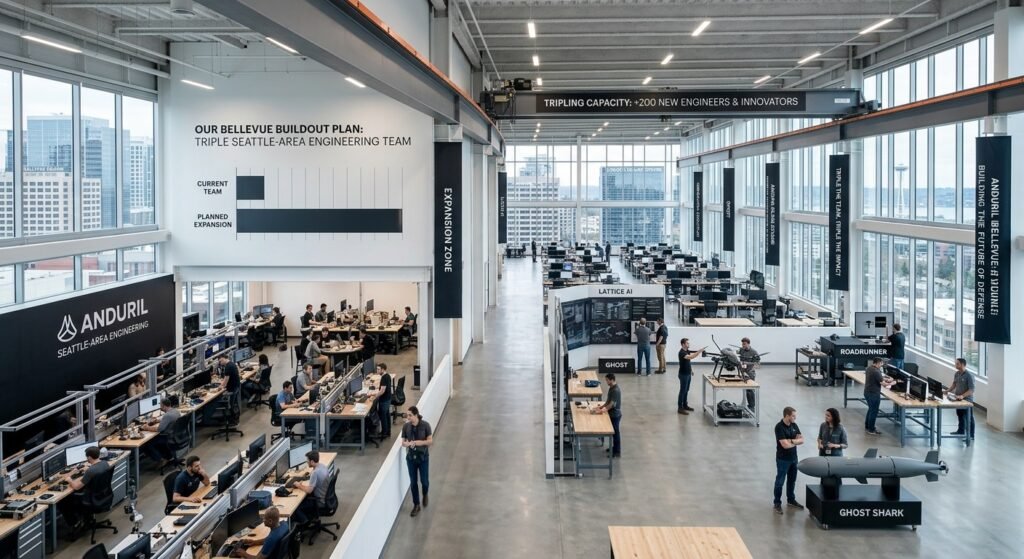
GeekWire toured Anduril’s unmarked Bellevue office, where senior VP Tom Keane says the company’s regional engineering workforce could grow from 560 to 1,000 employees within the next two years.
There’s no sign on the door, no name in the building directory, and nothing in the lobby to indicate what’s happening inside. But behind that unmarked entrance in downtown Bellevue, Washington, Anduril Industries is quietly building some of the most advanced AI-driven military hardware in development today — and preparing to nearly double its regional engineering headcount in the process.
A Rapidly Growing Regional Footprint
Anduril, the Costa Mesa, California-based defense technology company that recently closed a $5 billion funding round at a $61 billion valuation — and is reportedly now targeting a $100 billion valuation — has been steadily building out a substantial presence in the greater Seattle region. That footprint currently includes modern offices in downtown Bellevue and Seattle, along with a multi-acre military testing facility near Carnation, Washington.
Tom Keane, the company’s senior vice president overseeing its connected warfare division and a former Microsoft cloud executive, didn’t hold back when discussing the region’s growth potential. “I could absolutely see a world where we get to 1,000 people here in terms of engineers,” he said. Asked how quickly that milestone might be reached, Keane replied plainly: “It’s sort of almost as fast as you can hire people,” adding that hitting that number within the next two years is a realistic timeline.
Anduril currently employs 560 people across its Bellevue and downtown Seattle offices — up dramatically from just 30 employees four years ago, when Keane himself joined the company after interviewing with 62 other firms in search of a challenge in edge computing. With more than 110 open positions currently listed in Washington state and a newly leased third floor coming online in downtown Seattle, that regional expansion shows no signs of slowing.
What’s Actually Being Built Inside
Step past the unmarked entrance, and the scope of what’s happening becomes immediately clear. Anduril’s Bellevue office houses autonomous drones ranging from microwave-sized units to ones as large as a ping-pong table, alongside next-generation digital night-vision goggles and military-grade edge computing hardware designed to keep soldiers connected on increasingly data-heavy modern battlefields.
The centerpiece of the company’s current work is EagleEye, a heads-up hardware and software system built for frontline warfighters. Historically, soldiers have had to carry 3 to 5 pounds of glass, electronics, fragmented radios, and thick cabling on their helmets just to access basic situational data. Anduril’s system compresses all of that down into a 115-gram — roughly four-ounce — pair of augmented reality glasses, developed in collaboration with Meta for waveguide technology, Canon for sensors, Qualcomm for custom silicon, and Oakley for ballistic protection.
During a hands-on demo, the system ran through three operational functions powered by Anduril’s core software platform, Lattice: a tactical heads-up display projecting friendly force positions and navigation data directly into a soldier’s field of view; real-time threat detection pulling alerts from external AI sensors like tower cameras or overhead drones; and a command-and-control feature allowing an operator to direct autonomous systems, such as sending a Ghost drone to a specific location and pulling up its live video feed, all controlled through a small handheld device.
Next-Generation Night Vision
Anduril’s team also previewed an upcoming digital night vision system that represents a significant leap over current military-issue equipment. Where traditional analog night vision goggles offer a narrow, roughly 40-degree field of view — often described as looking through a toilet paper roll — Anduril’s VR-style digital display expands that to 84 degrees, more than double the current standard.
Using machine learning models, the system fuses thermal imagery with low-light camera feeds in real time, making heat signatures clearly visible even in pitch-black environments. Engineers use custom robotic arms to perform precise geometric calibration on each lens before it leaves the facility, ensuring visual accuracy without inducing motion sickness in users. The system hasn’t been deployed yet but is expected to be part of a Soldier Borne Mission Command prototype delivery to the US Army next year.
Recruiting Talent Away From Big Tech
Anduril’s Seattle-area expansion is, in large part, a deliberate play for regional engineering talent — specifically distributed systems engineers, AI and machine learning specialists, and advanced optics experts, a combination Keane says is difficult to find concentrated anywhere else. The region’s proximity to major military installations, including Joint Base Lewis-McChord and Naval Base Kitsap, adds another practical advantage.
While tech giants like Microsoft, Amazon, Google, and Meta have long dominated local engineering hiring, Anduril has been actively recruiting from those same companies, pitching a faster-moving, more hands-on alternative. “If you take machine learning and AI… you can look out any of these windows and see places that we can recruit from,” Keane said, gesturing toward downtown Bellevue from a conference room. “For a lot of software engineers, this is incredibly applied.”
The company received a major infusion of specialized talent roughly 18 months ago when it took over Microsoft’s IVAS (Integrated Visual Augmentation System) program, bringing on about 100 local engineers who had spent years developing augmented reality hardware for the US Army.
A Culture Built Around ‘Grit’
Anduril doesn’t pitch itself with the typical Big Tech perks playbook. Rather than remote flexibility and plush amenities, Keane describes the company’s culture around a single word: grit — a willingness to take ownership of genuinely hard engineering problems and test them directly in the field. It’s a deliberately in-office culture, partly a function of the fact that the company builds physical hardware rather than purely software products.
That philosophy extends to how the company tests its equipment. At a rural testing range in Carnation, about 20 miles east of Bellevue, Anduril has built a tactical “shoot house” for low-light operations, giving engineers a chance to iterate on code and hardware directly alongside active-duty personnel, including members of the Army’s 75th Ranger Regiment who recently tested the company’s EagleEye system on a firing range and obstacle course.
Drew Swanson, a lead architect at Anduril who spent 13 years in the military supporting special operations communications, said the appeal for engineers considering a move is straightforward. “One of the biggest things that I always hear is: ‘I want to come over there because you guys are going after really hard problems,'” he said of conversations with tech colleagues around Seattle.
Setbacks and Continued Ambitions
The company’s regional buildout hasn’t been without setbacks. Anduril recently exited a planned maritime manufacturing hub along Seattle’s Lake Washington Ship Canal after the US Navy canceled the autonomous warship program the company had been pursuing there. Still, its broader maritime ambitions continue, with ongoing development of a subsea fleet ranging from modular survey vehicles to the school-bus-sized Dive-XL autonomous submarine.
Operating a high-profile defense company in the Seattle area has also drawn public friction. Activist groups have staged protests outside Anduril’s downtown Seattle offices, targeting the company’s autonomous weapons development and military contracts. In response, Anduril has stated it respects the right to free speech, while noting it finds it “perplexing when people choose to protest a company dedicated to supporting the very military that safeguards those rights.” Keane, for his part, said the protests haven’t affected hiring: “There’s protests at every company, frankly.”
Frequently Asked Questions
Q: How many engineers does Anduril currently employ in the Seattle area? Anduril currently employs 560 people across its Bellevue and downtown Seattle offices, up from about 30 employees four years ago.
Q: How large could Anduril’s Seattle-area workforce eventually grow? Senior vice president Tom Keane said he could see the regional engineering team growing to 1,000 people, potentially within the next two years, depending on hiring pace.
Q: What is EagleEye? EagleEye is Anduril’s augmented reality hardware and software system for soldiers, weighing just 115 grams and offering a tactical heads-up display, real-time threat detection, and command-and-control capabilities for directing autonomous systems.
Q: Why did Anduril exit its Seattle shipyard facility? Anduril vacated its planned maritime manufacturing hub along the Lake Washington Ship Canal after the US Navy canceled the autonomous warship program the company had been developing there.
Q: What is Anduril’s current valuation? Anduril closed a $5 billion funding round earlier this year at a $61 billion valuation and is reportedly now targeting a valuation of $100 billion.