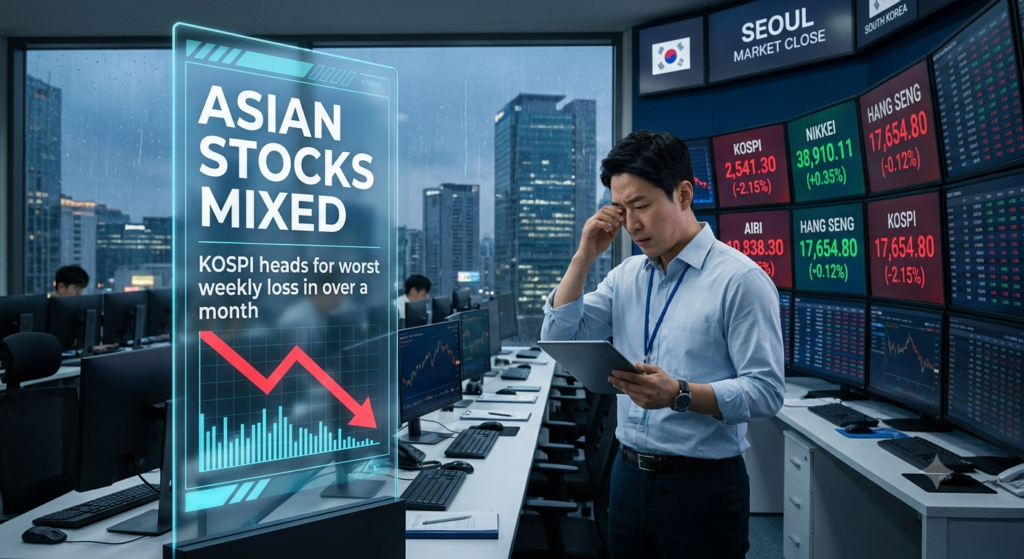
South Korea’s KOSPI is on pace for its worst weekly performance in more than a month as investors continue pulling back from AI-linked chipmakers, while Japan’s Nikkei stays on track for weekly gains.
Asian equity markets showed a mixed picture on Friday, with South Korea’s KOSPI leading the region lower and heading toward its worst weekly performance in over a month, even as Japan’s Nikkei 225 held onto a modest weekly gain despite a daily dip.
KOSPI’s Rough Stretch Continues
The KOSPI fell about 1.2% on the day, pushing the index down more than 6% for the week and putting it on track for a seventh straight weekly decline. The benchmark has now closed lower in eight of its last ten trading sessions, as investors continue trimming positions in AI-related chipmakers following their explosive rally in the first half of the year.
South Korea’s two largest chip names told very different stories within that broader trend. SK Hynix dropped more than 4%, extending a difficult week for the stock, while Samsung Electronics managed to claw back some ground, rebounding nearly 1% after taking heavier losses earlier in the week. LG Innotek also slipped roughly 1%, adding to the pressure across the sector.
What’s Driving the Chip Sector Pullback
Much of the weakness ties back to underwhelming reactions to recent earnings from several major US semiconductor companies. Those results have reinforced growing investor concern that near-term corporate earnings may not be able to keep pace with the sky-high valuations that AI-related stocks have commanded, even as companies continue pouring money into AI infrastructure.
This pullback follows a period of extraordinary volatility for South Korean equities more broadly. The KOSPI experienced one of its steepest monthly corrections on record in recent weeks, at one point wiping out roughly $2.18 trillion in market value over a short stretch, largely driven by leveraged investors unwinding bets on chipmakers that had previously ridden the AI investment wave to outsized gains.
Japan Holds Up Comparatively Better
Japan’s market fared somewhat better than South Korea’s this week. The Nikkei 225 dipped about 1% on the day, but the index remained on pace for a roughly 1% weekly gain, showing more resilience than its South Korean counterpart. The broader TOPIX index was little changed on the day, suggesting the selling pressure was more concentrated in specific AI and semiconductor-linked names rather than spreading evenly across the Japanese market.
Some Offsetting Support for South Korean Markets
Despite the ongoing chip-sector weakness, there have been a few bright spots helping to cushion the broader decline. South Korea recently reported a record current account surplus of $49.73 billion for June, driven by strong semiconductor export performance, which has helped reinforce confidence in the country’s underlying export outlook even as domestic stock valuations come under pressure.
Easing geopolitical tension has also provided some support to broader risk sentiment. Reports of progress toward an interim transit arrangement between Iran and Oman over Strait of Hormuz shipping have helped calm some investor concerns about potential disruptions to global oil supply, indirectly supporting risk appetite across Asian markets this week.
A Volatile Few Weeks for South Korean Stocks
Even with this week’s decline, some major institutions remain constructive on South Korean equities over the longer term. Following a sharp correction earlier in the summer, Morgan Stanley recently upgraded South Korean stocks to “Overweight,” pointing to what it sees as an attractive entry point following the recent wave of leveraged position unwinding. The bank has set a long-term KOSPI target of 9,000 points, favoring sectors like industrials, defense, and financials as key pillars for a more stable recovery going forward.
What to Watch Next
With the KOSPI now on track for its seventh consecutive weekly decline, investors will be watching closely for signs of stabilization in chip stocks, along with any fresh signals from upcoming US corporate earnings that could either ease or intensify concerns about AI-related valuations. Broader macro developments, including progress on Middle East tensions and upcoming US economic data, are also likely to continue shaping sentiment across the region in the days ahead.
Frequently Asked Questions
Q: Why is the KOSPI having its worst week in over a month? The decline is being driven mainly by continued selling in AI-linked chipmakers like SK Hynix and Samsung Electronics, as investors react to disappointing earnings reactions from major US semiconductor companies and reassess elevated AI valuations.
Q: How much has the KOSPI fallen this week? The index is down more than 6% for the week and on track for its seventh consecutive weekly decline, having closed lower in eight of its last ten trading sessions.
Q: Is Japan’s stock market also falling? Japan’s Nikkei 225 dipped about 1% on the day but remained on pace for a roughly 1% weekly gain, showing more resilience than South Korea’s market this week.
Q: What is helping offset the losses in South Korea? A record current account surplus driven by strong semiconductor exports, along with easing tensions over the Strait of Hormuz, have helped provide some support to broader risk sentiment.
Q: Are analysts still bullish on South Korean stocks long-term? Yes. Morgan Stanley recently upgraded South Korean equities to “Overweight” following the recent correction, setting a long-term KOSPI target of 9,000 points and favoring sectors like industrials, defense, and finance.