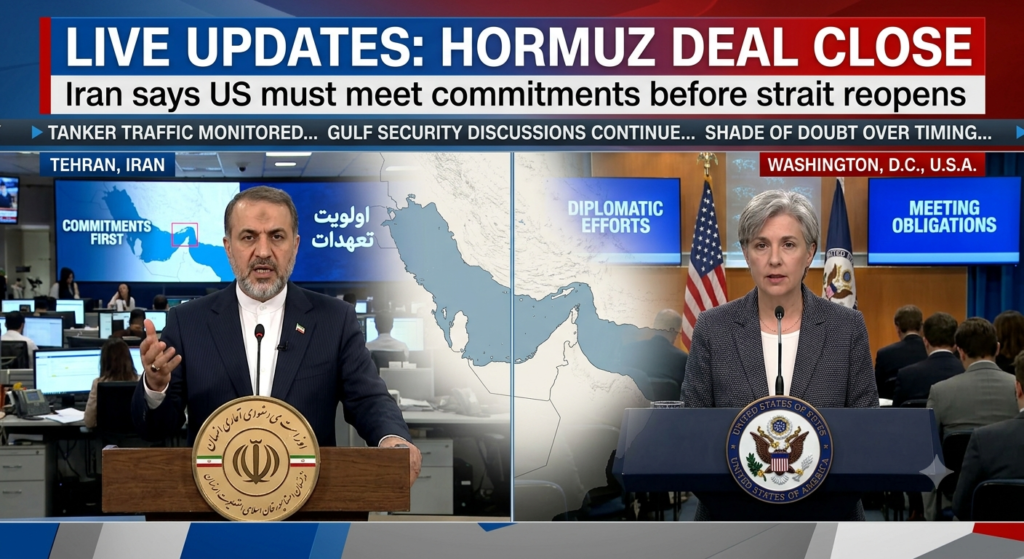
Iran says its proposed shipping agreement with Oman over the Strait of Hormuz is nearly finalized, but insists the waterway won’t fully reopen until the US lifts its naval blockade and honors prior commitments.
Iran says it’s on the verge of finalizing a shipping framework with Oman for the Strait of Hormuz, but Tehran is drawing a hard line: the strategic waterway won’t fully reopen to traffic until Washington follows through on commitments Iran believes it has failed to meet. The standoff highlights just how fragile the current de-escalation effort remains, even as both sides signal genuine progress.
Where the Iran-Oman Deal Stands
Iran’s Deputy Foreign Minister Kazem Gharibabadi said this week that an understanding between Tehran and Muscat over Hormuz shipping routes is close to being finalized. According to Iranian officials, the two sides have already agreed on the coordinates for a new navigation route through the strait and are now working out the final details of how the waterway would be jointly managed.
Gharibabadi explained that Iran had pushed for changes to existing shipping routes, arguing the old paths no longer reflected what he described as the difficult security conditions currently threatening the country. Iran’s foreign ministry has been careful to stress that this agreement, even once finalized, would not automatically mean the strait reopens to full commercial traffic — that step, Tehran insists, depends on the United States.
Iran’s Central Demand: End the Blockade First
Iranian officials have repeatedly tied any full reopening of the Strait of Hormuz to the US ending what they describe as its naval blockade of Iranian ports. Iran’s foreign ministry said the underlying factors making the strait insecure “still exist on the part of the United States,” pointing specifically to the blockade along with what it called other aggressive actions targeting Iranian interests.
That blockade has had a real, measurable impact — US officials say it has already redirected 48 vessels away from Iranian ports since being reinstated last month. Iranian lawmakers have also drafted legislation to formally regulate traffic through the strait, including restrictions on certain vessels and penalties for violators, signaling that Tehran intends to keep tight control over the waterway even under a new arrangement.
Speaking bluntly on the matter, a senior Iranian official pushed back on what he characterized as US pressure tactics, criticizing what he called bullying, broken promises, and misleading narratives used as leverage in negotiations. His message to Washington was direct: acknowledge the facts and follow through on commitments, rather than continuing with what he dismissed as theatrics.
The US Position
For its part, the US has signaled openness to a temporary arrangement, but with specific conditions attached. A US official stated that any temporary shipping routes agreed to would come “without any impediments” — meaning no special approvals, permissions, tolls, or charges — emphasizing that the Strait of Hormuz is an international waterway that no single party controls.
President Trump has publicly expressed optimism about the state of negotiations, saying “a lot of progress” has been made and suggesting an announcement could come soon. He has also pushed back on reports questioning the US’s military readiness, insisting the country has “massive amounts” of munitions available, even as senior officials say Trump has privately expressed frustration that reports of a dwindling Pentagon stockpile make the US appear weaker at the negotiating table.
Trump also said over the weekend that he called off what he described as the largest planned US military action against another country since World War II, explaining that he did so because Iran indicated a willingness to negotiate. At the same time, he’s warned Tehran that it would be hit “really hard” if a deal isn’t ultimately reached.
Tensions Spreading Beyond the Strait
The standoff over Hormuz isn’t happening in isolation. Saudi Arabia is reportedly bracing for what one Saudi official described as potential “multiple coordinated attacks” involving Iraqi militias working alongside Iran-backed Houthi rebels, raising concerns that the broader conflict could widen across the region.
Adding to those concerns, Yemen’s Houthi movement claimed responsibility for what it called a “large-scale” military operation targeting Saudi troops. A separate attack attributed to Houthi militants reportedly wounded 11 people in southern Saudi Arabia, marking one of the highest casualty tolls the kingdom has seen in this stretch of the conflict.
Why This Matters for Global Markets
The Strait of Hormuz remains one of the most closely watched flashpoints in global energy markets, given that a significant share of the world’s oil and gas exports normally pass through the waterway. Any credible signal of a deal — even a partial or temporary one — tends to move oil prices and broader market sentiment, which is part of why officials on both sides are being so precise in how they characterize the state of negotiations.
For now, the situation remains a delicate balancing act: real diplomatic progress on the technical details of a shipping route, paired with a much harder political standoff over which side needs to make the first move. Until that deeper disagreement is resolved, full normalization of traffic through the strait appears unlikely, even if a narrower, temporary arrangement is announced in the near term.
Frequently Asked Questions
Q: Has Iran finalized a deal with Oman over the Strait of Hormuz? Not yet. Iran says the framework is close to being finalized, with both sides having already agreed on a navigation route, but final details of joint management are still being worked out.
Q: Will the Strait of Hormuz fully reopen once the Iran-Oman deal is signed? No. Iran has explicitly stated that any Iran-Oman agreement would not automatically reopen the strait to full traffic — Tehran says that depends on the US lifting its naval blockade and honoring prior commitments.
Q: Is the US negotiating directly with Iran? Iran has publicly denied engaging in direct negotiations with the United States, even as reports suggest the US, Iran, and Oman are closely coordinating on a potential interim shipping agreement.
Q: What has the naval blockade done to shipping near Iran? US officials say the blockade has already redirected 48 vessels away from Iranian ports since being reinstated last month.
Q: Is the conflict at risk of spreading beyond Iran and the US? Yes. Saudi Arabia says it is bracing for potential coordinated attacks involving Iraqi militias and Iran-backed Houthi rebels, and Yemen’s Houthi movement has already claimed a major operation against Saudi troops.