Bitcoin miners are racing into AI data centers, but Wall Street’s enthusiasm is cooling fast. Here’s why the once-electric trade is losing steam in 2026.
Not long ago, a single announcement was enough to send a bitcoin mining stock soaring. A hyperscaler contract, a new gigawatt of committed capacity, a lease agreement with a cloud provider — any of these could add double-digit percentage points to a miner’s share price in a single trading session. That reaction has been fading through 2026, and the shift says a lot about where investors think this industry actually stands.
The bitcoin mining sector spent the last two years reinventing itself. Squeezed by thin margins, a shrinking block reward, and a bitcoin price that hasn’t cooperated, miners such as IREN, Core Scientific, TeraWulf, Hut 8, Riot Platforms, and Cipher started marketing their real estate differently. Instead of selling themselves as bitcoin-hashing operations, they began pitching what they actually own: cheap, already-secured power, industrial land, and data center shells that can, with enough capital, be retrofitted for AI and high-performance computing workloads. IREN closed a $3 billion convertible note deal in May to fund that transformation. Hut 8’s contracted AI portfolio has climbed past $26 billion. TeraWulf signed a 20-year AI infrastructure lease with Anthropic and has said it intends to exit bitcoin mining altogether. Across the sector, miners have inked more than $65 billion worth of AI and HPC agreements with the likes of Microsoft and Google.
For a while, the market treated this as one of the cleanest stories in crypto-adjacent equities: volatile bitcoin miners rebranding into something Wall Street already understood — data center landlords with long-term, investment-grade tenants. Mining stocks decoupled from bitcoin’s price entirely. Earlier this year, a basket of mining equities climbed 56% while bitcoin itself fell 17%, a split that would have been unthinkable a few years back, when miner shares functioned as a leveraged bet on the coin itself.
That momentum has run into a wall. A review of 25 AI and HPC infrastructure deals announced between mid-2024 and August 2026 found that the average stock move on announcement day has shrunk from roughly 24% for the earliest deals to about 10% for the most recent ones, even as the dollar value of the contracts kept growing. Median gains have roughly halved over the same stretch. Investors, in other words, have stopped treating every new AI headline as automatically bullish — they’re asking harder questions about execution instead.
Those questions have teeth. VanEck estimates the industry is staring down a roughly $50 billion near-term funding gap, with long-term capital needs that could stretch past $221 billion. Only around a quarter of leased AI and HPC capacity has actually been energized and delivered so far, which means a lot of these headline contracts are still promises rather than revenue. Building AI-grade infrastructure isn’t the same job as running ASIC racks — it demands far higher power density, industrial cooling, uptime guarantees, and networking that most mining sites weren’t originally built for. Miners are covering that gap by selling bitcoin reserves, taking on debt, and issuing new shares, and the dilution is starting to show up in valuations.
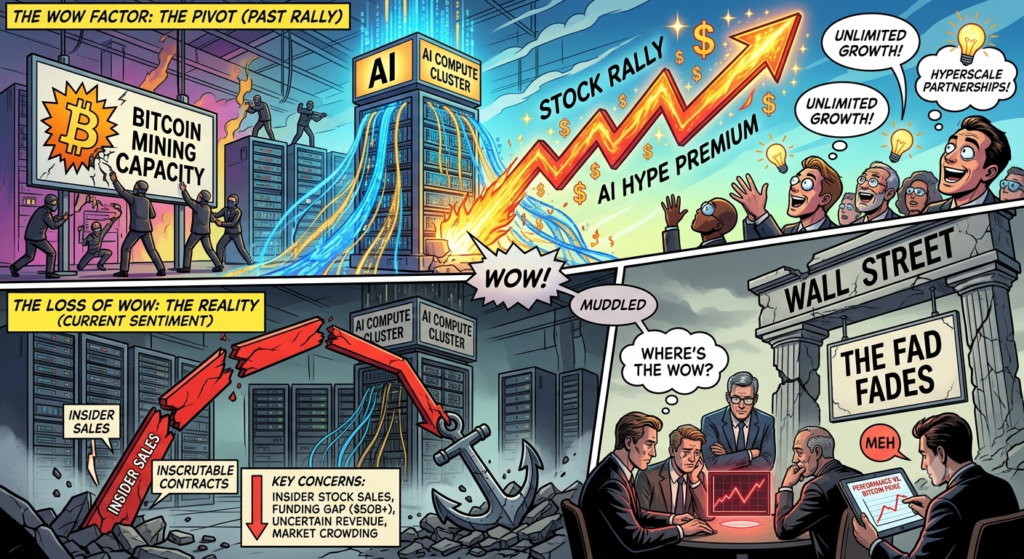
The pullback has been sharp. Research firm 10x Research found mining equities down roughly 20% as AI and semiconductor enthusiasm cooled, noting that these stocks now track chip-sector benchmarks more closely than they track bitcoin. A tracked index of AI infrastructure names spanning miners, cloud providers, and power suppliers dropped 16% in a single month. Individual names have taken it harder: TeraWulf shares fell more than 30% and IREN dropped roughly 25% in one recent stretch, even as bitcoin itself proved comparatively resilient. Layer on rising competition from neocloud giants like CoreWeave and Nebius — which are sitting on tens of billions in backlog — and insider stock sales at several mining companies that have drawn extra scrutiny now that the AI trade has turned choppy, and it’s clear why the “wow factor” has worn off.
None of this means the pivot has failed. CoreWeave, the clearest proof of concept, is worth roughly $40 billion after starting life as a bitcoin miner. Companies with grid-connected power and delivered, tenant-backed capacity are still being framed by analysts, including Morgan Stanley, as well positioned for the AI buildout. But the market has moved from rewarding the announcement to demanding the delivery. For bitcoin miners chasing a second act as AI infrastructure companies, the easy applause is over — what’s left is the harder job of actually building, financing, and energizing the capacity they’ve promised.
FAQs
1. Why are bitcoin miners pivoting to AI infrastructure? Bitcoin mining margins have been squeezed by falling rewards and volatile prices, while miners already own two things AI data centers need most: cheap, secured power and industrial land. Converting that infrastructure for AI and high-performance computing gives them a more stable, contract-backed revenue stream.
2. Which bitcoin miners have made the biggest AI moves? IREN, Hut 8, Core Scientific, TeraWulf, Riot Platforms, and Cipher are among the most active. IREN raised $3 billion in convertible notes for its transition, Hut 8’s contracted AI portfolio has topped $26 billion, and TeraWulf signed a 20-year AI lease with Anthropic while moving to exit bitcoin mining entirely.
3. Why has Wall Street’s reaction to these deals cooled off? Analysis of AI and HPC deal announcements shows the average stock price reaction has dropped from about 24% in the earliest deals to roughly 10% more recently, even as deal sizes grew. Investors are shifting focus from contract headlines to whether miners can actually finance and build the capacity they’ve promised.
4. How big is the funding challenge facing these miners? VanEck estimates a near-term funding gap of roughly $50 billion across the sector, with long-term capital needs as high as $221 billion. Only about a quarter of leased AI and HPC capacity had actually been delivered as of mid-2026.
5. Has the AI pivot hurt or helped bitcoin mining stocks? It’s done both. Mining equities decoupled from bitcoin’s price and outperformed sharply earlier in 2026, but many have since fallen roughly 20% or more as AI and semiconductor sentiment cooled, with some individual stocks dropping over 25-30% in weeks.
6. Is the bitcoin miner AI pivot a viable long-term strategy? It can be, but success now depends on execution rather than announcements. Miners with grid-connected power, investment-grade hyperscaler tenants, and delivered (not just leased) capacity are seen as better positioned, while those that miss construction milestones or rely heavily on debt and equity dilution face a tougher path.