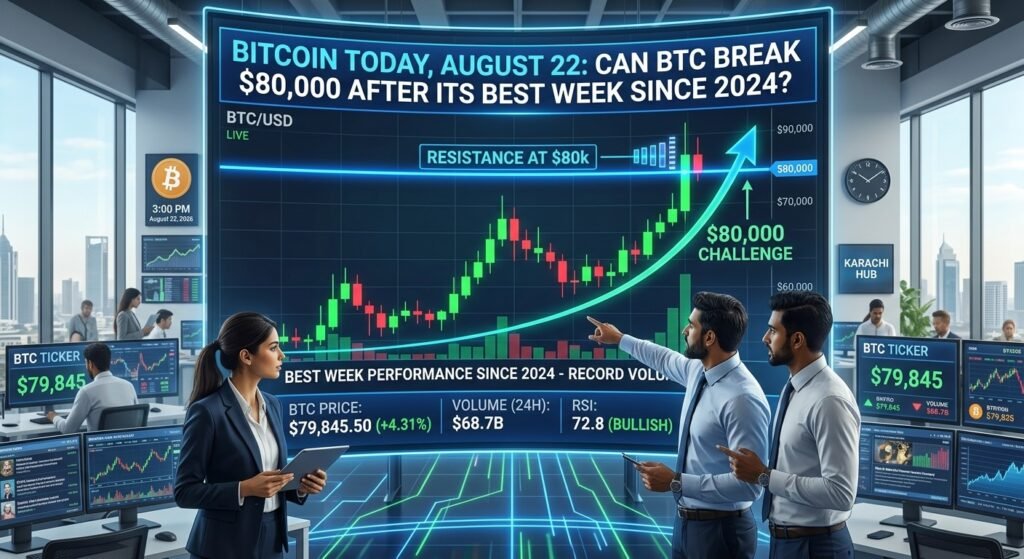
Bitcoin is trading near $77,000 after a historic 22% weekly surge, with $80,000 now the key level to watch. Here’s today’s price outlook and which coins are leading the rally.
Bitcoin just had one of its best weeks in years. After starting the week around $62,800, BTC has surged as high as $78,335, posting a roughly 22% weekly gain — its strongest week since 2024. Now, heading into the weekend, all eyes are on one number: $80,000, the level analysts say will determine whether this rally has real staying power.
Bitcoin’s Current Price and This Week’s Rally
Bitcoin is currently trading around $77,000–$77,600, after briefly testing above $80,000 overnight before pulling back. To put this move in context: BTC cleared $69,000 on Wednesday, pushed above $72,000 on Thursday, and touched levels above $78,000 on Friday — a genuinely explosive four-day stretch after months of sideways, low-volatility trading between roughly $63,000 and $66,000.
Bitcoin’s market cap now sits around $1.33–1.5 trillion, comfortably ahead of Ethereum’s roughly $233–290 billion. Despite the sharp rebound, it’s worth noting Bitcoin remains well below its all-time high of $126,198, reached in October of last year, and below its 2026 high of $94,820 hit back in January.
What’s Driving the Rally
Two forces have combined to produce this move. First, the US Treasury announced plans to at least double its purchases of longer-dated government bonds, which pushed long-term yields lower and weakened the dollar — a classic setup for risk assets like Bitcoin to rally. Second, that initial move triggered a massive short squeeze: more than $3-4 billion in bearish crypto positions have been liquidated over the past two days alone, with Thursday’s liquidation total setting a record dating back to 2021.
Crucially, this isn’t purely a squeeze story. Spot Bitcoin ETFs pulled in $606 million on August 20 alone, up from $517 million the day before — the second straight day of accelerating inflows, each larger than the last. Ether ETFs added another $221 million on the same day, with XRP and Solana funds also drawing fresh inflows. As CoinShares’ head of research James Butterfill put it, “The rally is primarily a macro story rather than a crypto specific one… Bitcoin remains acutely sensitive to shifts in liquidity expectations and real yields, and it has responded accordingly.” That combination — genuine institutional buying layered on top of forced short covering — is why some analysts see this as more than just a temporary squeeze bounce.
Today’s Bitcoin Price Prediction: Is $80,000 Within Reach?
The bullish case: Bitcoin has already reclaimed its 20-, 50-, 100-, and 200-day moving averages and cleared the major $71,500 resistance zone, a genuinely significant technical shift. The near-term target sits around $80,000, with $82,500–$85,000 as a stretch goal if momentum continues. On Deribit’s options market, the $80,000 call has been the most heavily traded strike since spring, with open interest above $1.6 billion at that level — a sign traders are actively positioning for a breakout.
The bearish case: RSI readings are deeply overbought across nearly every timeframe right now, which historically increases the odds of at least a short-term pullback. Analysts flag $71,500–$73,000 as a realistic retracement zone even within a broader uptrend, with $71,500 as the key support level that keeps the bullish case intact. Weekend liquidity is also thinner than usual, which tends to produce sharper, more volatile price swings in either direction.
What could confirm the next move: According to Butterfill, a decisive push through $80,000 will likely require confirmation that Federal Reserve policy is shifting away from further tightening — something that could emerge from next week’s Jackson Hole symposium. Before then, today’s US flash PMI readings could move yields and the dollar, which would ripple directly into Bitcoin’s price action.
The Honest Risk Behind This Rally
It’s worth being clear-eyed about one thing: liquidation-driven rallies can produce enormous price moves without necessarily reflecting durable new demand. A trader who gets forcibly stopped out of a short position is a one-time buyer, not a long-term holder. With roughly $3-4 billion in shorts already wiped out, that particular fuel source is largely spent — meaning the rally’s next leg, if there is one, will need to come from fresh spot demand rather than continued short covering. The strong, accelerating ETF inflow numbers are the best evidence right now that real demand is showing up alongside the squeeze, but it’s a dynamic worth watching closely rather than assuming will continue automatically.
Which Coins Are Leading Today’s Rally
XRP has been the standout performer of the week, surging as much as 12–14.6% in a single session to trade around $1.41–$1.45, breaking out of a long descending technical structure above its 20, 50, 100, and 200-day moving averages in one strong move. The rally has been reinforced by fresh institutional activity — Ripple is backing a new institutional credit fund that will lend its RLUSD stablecoin to fintech and payments companies on the XRP Ledger. Resistance sits around $1.43–$1.50, with RSI near 83 suggesting a short pullback or retest is likely before any further push higher. The $1.30–$1.34 zone is the key support to watch.
Ethereum also outperformed Bitcoin on a percentage basis, climbing roughly 3–8% to trade between $2,395 and $2,515, an unusual dynamic in a Bitcoin-led risk-on session that points to demand from funds that had previously been underweight the second-largest cryptocurrency.
Solana gained a more modest 5–7%, trading around $92–$94, aided partly by the network activating its first reduction in block confirmation times since launch. The 200-day moving average near $89 is now acting as a key support floor.
Which Coin Suddenly Turned Bearish
Not every token joined the celebration. MANTRA plunged 18% to a record low of $0.004126 after its blockchain network halted block production entirely, following what the project later confirmed was an exploit targeting a vulnerability in software used by the chain — a sharp reminder that individual project risk can move in the completely opposite direction of a broad market rally.
The Bottom Line
Bitcoin is riding its strongest weekly performance since 2024, powered by a rare combination of genuine institutional ETF demand and a historic short squeeze. Today’s session centers on whether BTC can push decisively through $80,000 or needs to cool off first with a retracement toward $71,500–$73,000. With Fed policy signals from next week’s Jackson Hole symposium looming as the next major catalyst, and today’s PMI data capable of moving markets in the meantime, this is a moment worth watching closely rather than assuming the rally continues in a straight line.
This is not financial advice. Crypto markets are highly volatile, and prices can change significantly within hours. Always do your own research before making investment decisions.
Frequently Asked Questions
Q: What is Bitcoin’s price today? Bitcoin is trading around $77,000–$77,600 after briefly testing above $80,000 overnight, following a roughly 22% weekly gain that marks its best week since 2024.
Q: Will Bitcoin break $80,000 today? It’s uncertain. Analysts see $80,000 as a key psychological and technical boundary, with a decisive breakout likely requiring confirmation of a shift in Federal Reserve policy, which could come from next week’s Jackson Hole symposium rather than today’s session alone.
Q: What caused Bitcoin’s massive rally this week? The rally was driven by the US Treasury’s plan to increase purchases of long-dated government bonds, which weakened the dollar and lowered yields, combined with a historic short squeeze that liquidated $3-4 billion in bearish crypto positions.
Q: Why is XRP outperforming Bitcoin this week? XRP’s rally has been fueled by both broad market momentum and specific institutional news, including Ripple backing a new credit fund that will lend its RLUSD stablecoin on the XRP Ledger.
Q: Is this Bitcoin rally sustainable, or just a short squeeze? It’s likely a combination of both. While the initial move was heavily driven by forced short liquidations, accelerating and consistently growing spot ETF inflows over multiple consecutive days suggest genuine institutional demand is also playing a meaningful role.