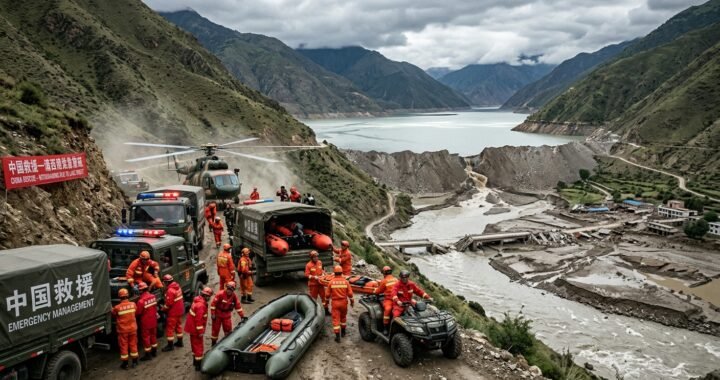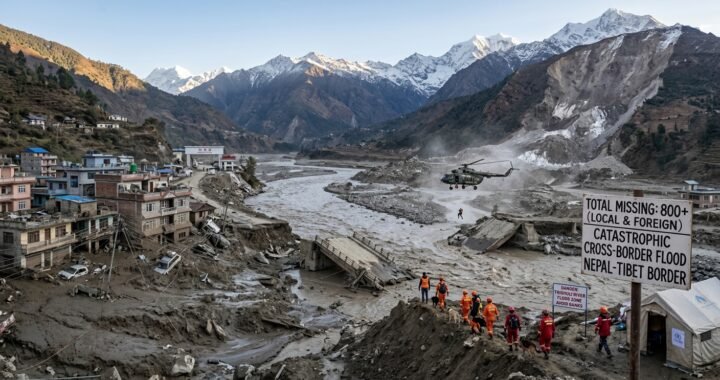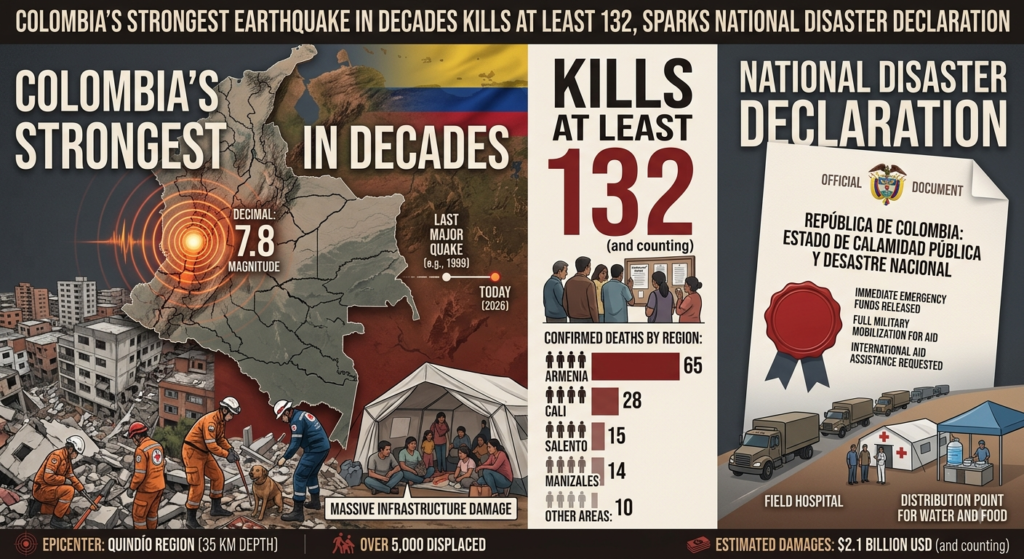
A magnitude 7.4 earthquake struck western Colombia on Monday, killing at least 132 people and injuring hundreds more, collapsing dozens of buildings across the country’s coffee-growing region.
Colombia is reeling from its most powerful earthquake in years after a magnitude 7.4 quake tore through the western part of the country on Monday morning, killing at least 132 people, injuring hundreds more, and prompting the government to declare a national disaster.
How the Earthquake Unfolded
The quake struck at 7:34 a.m. local time, with its epicenter located near the village of San José del Palmar in Chocó province, at a depth of roughly 103 kilometers (64 miles), according to Colombia’s Geological Service. Despite the depth, the tremor was powerful enough to be felt across an enormous stretch of western Colombia, and reached as far as neighboring Venezuela, Ecuador, and Panama.
Colombian authorities have described it as the strongest earthquake to hit the country in the past decade, with some reports characterizing it as the most powerful of the century so far.
Where the Damage Hit Hardest
The heaviest toll has fallen on Colombia’s Eje Cafetero, or coffee axis — a mountainous, culturally significant region recognized by UNESCO for its farming traditions and known for producing much of the country’s signature coffee exports. The area encompasses several of the hardest-hit cities, including Pereira, Manizales, Armenia, and Ibagué.
Pereira, a city of roughly 500,000 people located less than 64 kilometers from the epicenter, has reported the highest single-city death toll so far, with 60 confirmed fatalities according to the Colombian Association of Capital Cities. Cali, Colombia’s third-largest city, and the surrounding Valle del Cauca region have also been hit hard, along with Quibdó and Buenaventura. Five capital cities across the country remain under red alert as search-and-rescue operations continue.
According to the latest figures, at least 86 buildings have collapsed nationwide, and authorities have confirmed damage to 1,575 homes, 37 of which were completely destroyed. Seven regional airports have suspended operations due to infrastructure damage, including facilities in Pereira, Manizales, Quibdó, Armenia, Cartago, and Buenaventura. Hospitals, transportation systems, water infrastructure, energy networks, and telecommunications have all reported significant disruptions in the affected areas.
Even in the capital, Bogotá, the quake was felt strongly enough to shake trees and traffic lights and trigger building evacuations, though officials say the city has avoided serious structural damage so far.
A Community Spared, Thanks to Strict Building Codes
Remarkably, the village closest to the earthquake’s epicenter, San José del Palmar, reported no deaths or injuries at all, despite significant road damage in and out of the town. Local mayor León Fabio Marín Moncada credited the community’s strict seismic-resistant building regulations, put in place following previous earthquakes, for helping structures withstand the impact.
Describing the moment the quake hit, Marín Moncada said he watched glass break and heard people screaming as the ground shook. “I have 450 books and only a few were left standing on the shelves,” he told BBC Mundo, calling the experience “terrible and terrifying.” Despite the fear, his own building remained structurally intact — a stark contrast to the widespread building collapses reported elsewhere in the region.
Government Response and International Support
Colombia’s recently inaugurated President Abelardo de la Espriella, who took office just days before the disaster, has declared a national emergency and convened a crisis committee to personally oversee rescue operations. Emergency crews are continuing search-and-rescue efforts in the hardest-hit cities, working to free people believed trapped beneath collapsed buildings, with officials warning the death toll is likely to rise further as recovery work continues.
International support has begun mobilizing quickly. Leaders across the United States, South America, Europe, and the Middle East have pledged assistance for Colombia’s ongoing rescue and relief efforts. Domestically, officials in Bogotá have coordinated the deployment of 100 rescuers to the most affected cities and set up donation collection points across the capital for essential supplies including drinking water, blankets, non-perishable food, and first-aid materials.
A Region With a Painful History
This isn’t the first time the area has faced catastrophic seismic activity. The same general region was struck by a devastating earthquake in 1999 that killed nearly 1,200 people, a disaster that still looms large in the collective memory of communities in Colombia’s coffee-growing heartland.
The timing is also notable on a regional scale — Monday’s quake comes less than two months after twin earthquakes devastated northern Venezuela, killing more than 6,300 people, underscoring a difficult recent stretch of seismic activity across the broader region.
What Happens Next
With search-and-rescue operations still actively underway and damage assessments ongoing across multiple provinces, Colombian authorities are bracing for the death toll to climb further in the coming days. The scale of infrastructure damage — spanning hospitals, airports, housing, and utilities — suggests recovery efforts in the hardest-hit areas will likely stretch on for an extended period, even as emergency response continues to prioritize locating survivors still trapped in the rubble.
Frequently Asked Questions
Q: How strong was the earthquake that hit Colombia? The earthquake registered as a magnitude 7.4 (with some reports citing 7.5), making it the strongest to hit Colombia in at least a decade, according to authorities.
Q: Where was the earthquake’s epicenter? The epicenter was located near the village of San José del Palmar in Colombia’s Chocó province, at a depth of approximately 103 kilometers.
Q: Which cities were hit hardest by the earthquake? Pereira, Cali, Manizales, Quibdó, and Armenia — cities largely within Colombia’s coffee-growing Eje Cafetero region — reported the most significant damage and casualties.
Q: How many people have been killed or injured? At least 132 people have died and more than 570 others have been injured, according to the Colombian Association of Capital Cities, though officials warn these numbers are likely to rise.
Q: Has Colombia declared a state of emergency? Yes. President Abelardo de la Espriella declared a national disaster and has convened an emergency committee to personally oversee rescue and relief operations.