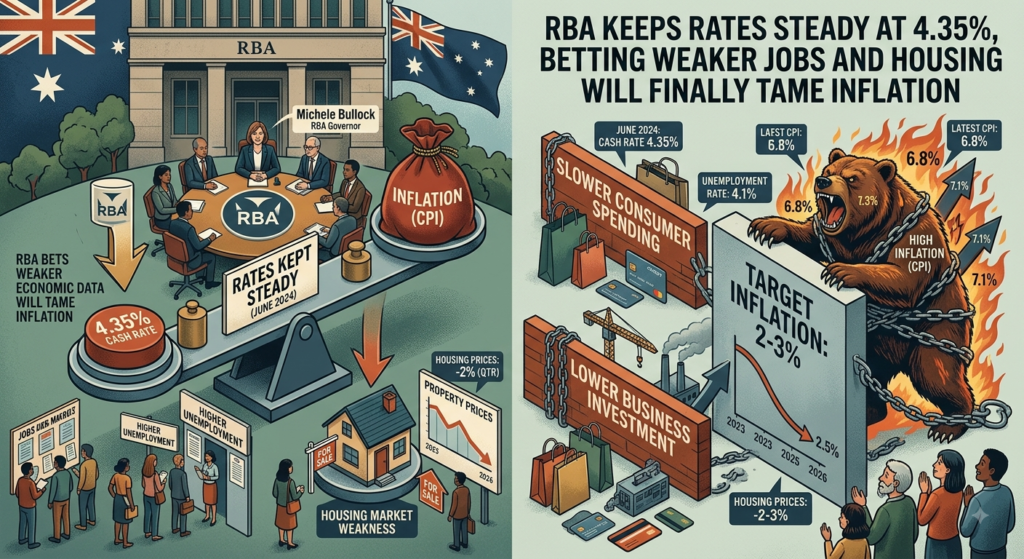
Australia’s central bank held its cash rate at 4.35% for a second straight meeting, wagering that rising unemployment and a cooling property market will bring inflation back under control.
Australia’s Reserve Bank left its key interest rate unchanged on Tuesday, holding steady at 4.35% for a second consecutive meeting in a unanimous decision that markets had widely expected. The RBA board, chaired by Governor Michele Bullock, is essentially placing a bet: that softening employment conditions and a weakening property market will do enough of the heavy lifting to finally bring inflation back within target.
A Long-Running Inflation Struggle
The hold extends a difficult stretch for Australia’s central bank, which has failed to bring inflation down to the midpoint of its 2-3% target range for roughly five years. That persistent gap has kept the RBA in a cautious, data-dependent posture, even as signs have started to emerge that price pressures may finally be easing.
The most recent Consumer Price Index data showed some encouraging movement: annual headline inflation fell for a third straight month, landing at 3.8% in June. The RBA’s preferred measure, the Trimmed Mean CPI, rose just 0.8% quarter-on-quarter in the second quarter, coming in below the 0.9% figure markets had been expecting. That softer-than-anticipated inflation report was widely seen as the key factor that shifted market expectations away from a possible rate hike and toward Tuesday’s hold decision.
Even so, core inflation hasn’t made nearly as much progress as headline figures, and remains a lingering concern for policymakers looking to fully close the gap to their target.
Why the RBA Is Choosing Patience Over Action
Rather than adjusting rates directly, the RBA appears to be counting on broader economic conditions to do some of the inflation-fighting work on its own. Several factors are feeding into that calculation: unemployment has been rising faster than the central bank had anticipated, Australia’s property market has cooled noticeably, with national property prices falling 0.7% in July — the sharpest monthly drop since December 2022 — and overall economic growth continues to slow roughly in line with the RBA’s earlier expectations from May.
Commonwealth Bank economist Belinda Allen noted that this combination of data gives the RBA room to be patient while it evaluates how earlier rate increases are working their way through the economy, though she was careful to add that this patience doesn’t mean the central bank considers its inflation fight over.
The Middle East Wildcard
One significant risk factor hanging over the RBA’s outlook has nothing to do with domestic economic data: geopolitical tension in the Middle East. Economists have repeatedly flagged that a renewed escalation in the region could push oil prices higher and encourage Australian businesses to pass increased costs on to consumers, particularly heading into the September quarter.
Adding to that pressure domestically, Australia’s temporary fuel excise discount expired on August 2, removing a source of downward pressure on local fuel prices and creating fresh upside risk for inflation in the months ahead. Some analysts have also pointed to the potential reopening of the Strait of Hormuz as a factor the RBA may be weighing when assessing whether global oil-related inflation risks are beginning to ease.
What Comes Next for Rates
Despite Tuesday’s hold, the RBA has continued signaling that it isn’t ready to fully abandon its hawkish stance. Morgan Stanley’s Australian economics team expects the central bank to keep emphasizing the “persistence of above-target inflation” and the risk that a large minimum wage increase in July, combined with a weaker Australian dollar, could continue putting upward pressure on prices even as broader demand softens. Some forecasts suggest the RBA doesn’t expect inflation to sustainably return to the midpoint of its target range until as late as 2028.
Market economists remain split on what happens from here. A recent survey found 55% of economists still expect at least one additional rate increase before the end of 2026, while other major banks — including Commonwealth Bank, NAB, ANZ, and Westpac — now expect the RBA to hold rates steady for the remainder of the year. Most major banks appear aligned on the idea that any actual rate cuts are unlikely before 2027, contingent on inflation continuing to ease in a sustained way.
The Toll on Australian Households
For everyday borrowers, the RBA’s extended tightening cycle continues to weigh heavily on household finances. Recent data shows Australian borrowers are now devoting an average of 38% of their after-tax income to mortgage payments each month, underscoring just how significant the cumulative effect of the central bank’s rate increases has been on cost-of-living pressures across the country.
What to Watch Going Forward
With Tuesday’s decision confirming another hold, attention now turns to how household spending, labor market data, and geopolitical developments evolve heading into the RBA’s next policy meeting. Commonwealth Bank expects the central bank to revise its inflation forecasts lower and lift its unemployment projection when updated numbers are released, a combination that could shape whether the RBA signals more openness to eventual rate cuts, or continues emphasizing patience and vigilance in the months ahead.
Frequently Asked Questions
Q: What interest rate did the RBA set on Tuesday? The RBA held its cash rate steady at 4.35% for the second consecutive meeting, matching what markets had widely expected.
Q: Why didn’t the RBA cut or raise rates? The central bank is betting that rising unemployment and a cooling property market will help bring inflation down on their own, without needing further rate hikes, while remaining cautious about cutting too soon given persistently elevated inflation.
Q: Is inflation in Australia improving? Yes, to some extent. Headline inflation fell to 3.8% in June, marking a third consecutive monthly decline, though core (underlying) inflation has made slower progress and remains a concern for policymakers.
Q: Could the RBA still raise rates again in 2026? It’s possible. A recent survey found 55% of economists still expect at least one further rate increase this year, while major banks like Commonwealth Bank, NAB, ANZ, and Westpac currently expect rates to remain on hold for the rest of 2026.
Q: When might the RBA start cutting interest rates? Most current forecasts suggest a first rate cut is unlikely before 2027, contingent on inflation continuing to ease in a sustained, consistent way.