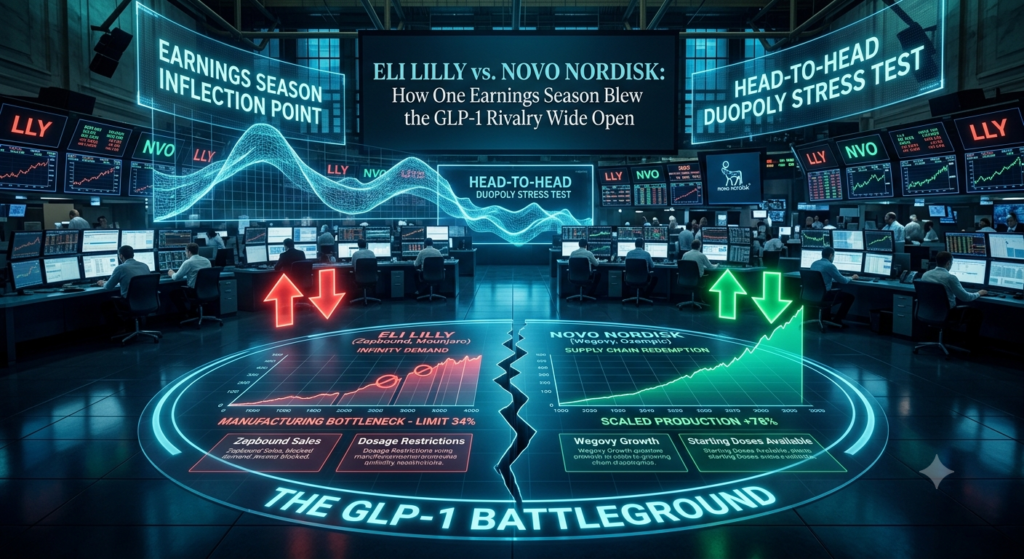
Eli Lilly and Novo Nordisk both beat earnings estimates, but investors reacted in opposite ways. Here’s why the gap between the two obesity-drug giants keeps growing.
For a while, the obesity drug race looked like a genuine two-horse contest. Eli Lilly and Novo Nordisk were trading blows quarter after quarter, each one racking up blockbuster sales off the back of the GLP-1 boom. That narrative just took a serious hit. This week’s earnings reports didn’t just show one company doing better than the other — they revealed two companies heading in fundamentally different directions, and Wall Street noticed immediately.
Both companies technically beat expectations. Both raised their full-year guidance. On paper, that should read as a win for both sides. Instead, investors sent Lilly’s stock climbing while punishing Novo’s shares the very next day. That split reaction says more about where each company is headed than the headline numbers ever could.
The Numbers Behind the Divide
Lilly’s second-quarter performance was, in a word, dominant. The company posted a sharp jump in U.S. revenue, driven by relentless demand for its diabetes and weight-loss drugs, Mounjaro and Zepbound. Worldwide sales volume for its GLP-1 products surged, even as the company let realized prices slide — a deliberate trade-off that appears to be paying off by pulling in more patients at a lower per-unit cost. Off the back of that momentum, Lilly raised its full-year revenue guidance for the second time this year, now projecting between $85 billion and $87 billion.
Novo Nordisk’s quarter wasn’t actually bad by most conventional measures — sales grew and operating profit came in well above analyst expectations. But the details told a more complicated story. The company’s newly launched oral version of Wegovy underperformed relative to expectations, a setback for a product Novo had been counting on to help it claw back market share. Novo also nudged its full-year outlook, but the range it’s now guiding toward spans anywhere from flat growth to a mid-single-digit decline — a far cry from the confident upward trajectory Lilly is riding.
Put simply: Lilly is compounding its lead. Novo is playing defense.
Market Share Tells the Real Story
Perhaps the clearest signal of how far apart these two companies have drifted shows up in U.S. market share numbers. According to Lilly’s own earnings presentation, the company now commands roughly 61% of the U.S. obesity and diabetes drug market, compared to Novo’s just under 39%. A year or two ago, that split was far tighter. Now it’s approaching a two-to-one advantage in Lilly’s favor.
Analysts have taken notice of what this means beyond the current quarter. One closely watched note from a BMO Capital Markets analyst pointed out that while Novo’s guidance bump was expected, the bigger question — its long-term pipeline and path to sustainable growth — remains murky. That kind of uncertainty tends to weigh far more heavily on a stock than a single quarter’s results.
Why Novo Is Struggling to Keep Pace
Novo’s challenges aren’t just about a single underwhelming product launch. The company has reportedly been restructuring internally, including notable workforce reductions, as it works to control costs while its growth engine sputters. It has also pre-announced steep price cuts on two of its flagship products, Wegovy and Ozempic, set to take effect in 2027 — a move that should help protect sales volume but will almost certainly squeeze future profit margins.
Meanwhile, Novo is still counting on international expansion of its oral Wegovy pill and new Medicare coverage provisions to help stabilize its numbers in the back half of the year. Both of those catalysts remain unproven, which is likely part of why investors reacted so cautiously to the company’s report.
Lilly’s Expanding Arsenal
Lilly, on the other hand, isn’t resting on Mounjaro and Zepbound alone. The company’s own oral obesity pill entered the market this quarter for the first time, and while its early sales came in slightly below analyst projections, prescription trends have reportedly been accelerating fast — nearly doubling within a matter of weeks. Executives have also pointed to the oral pill as additive rather than cannibalizing existing injectable sales, suggesting Lilly sees this as a way to expand the overall pool of patients rather than just shifting existing ones between products.
Beyond that, Lilly continues advancing its pipeline further, including a next-generation obesity treatment currently working through the approval process. If it succeeds, it could extend Lilly’s lead even further into the back half of the decade.
What This Means for the Broader Market
The stakes here go well beyond bragging rights between two pharmaceutical companies. Analysts expect the global obesity drug market to exceed $100 billion in value within the next several years, as GLP-1 treatments continue to expand from a niche category into mainstream, long-term care for millions of patients worldwide. Whoever leads that market isn’t just winning a single earnings season — they’re positioning themselves to define an entire category of medicine for years to come.
For now, that race has a clear frontrunner. But healthcare markets have a way of shifting quickly, especially with new drug approvals, pricing changes, and international expansion all still in motion. Novo Nordisk has the resources and the scientific track record to mount a comeback — the question is whether its pipeline can deliver one before the gap becomes too wide to close.
Tags: Eli Lilly, Novo Nordisk, GLP-1 drugs, Mounjaro, Zepbound, Wegovy, Ozempic, obesity drug market, pharma earnings, weight loss drugs 2026
FAQs
1. Why is the gap between Eli Lilly and Novo Nordisk widening? Lilly has posted stronger sales growth, raised guidance twice this year, and now holds a significantly larger share of the U.S. obesity and diabetes drug market, while Novo’s oral Wegovy pill has underperformed expectations.
2. Did Novo Nordisk actually have a bad quarter? Not exactly. Novo beat profit estimates and raised its outlook, but its future guidance range includes the possibility of a sales decline, and its stock still fell after the report due to concerns about its long-term growth path.
3. What is driving Eli Lilly’s growth? Strong demand for Mounjaro and Zepbound, aggressive volume growth despite lower prices, and the recent launch of its oral obesity pill are all contributing to Lilly’s expanding lead.
4. How big is the U.S. market share gap between the two companies? As of the most recent quarter, Lilly held roughly 61% of the U.S. obesity and diabetes drug market compared to Novo’s approximately 39%.
5. Is Novo Nordisk cutting prices on its drugs? Yes. Novo has pre-announced significant price cuts on Wegovy and Ozempic set to take effect in 2027, a move aimed at protecting sales volume even as it pressures future profit margins.
6. How big could the obesity drug market become? Some analysts project the global obesity drug market could surpass $100 billion in value by the early 2030s, making the current competition especially high-stakes for both companies.