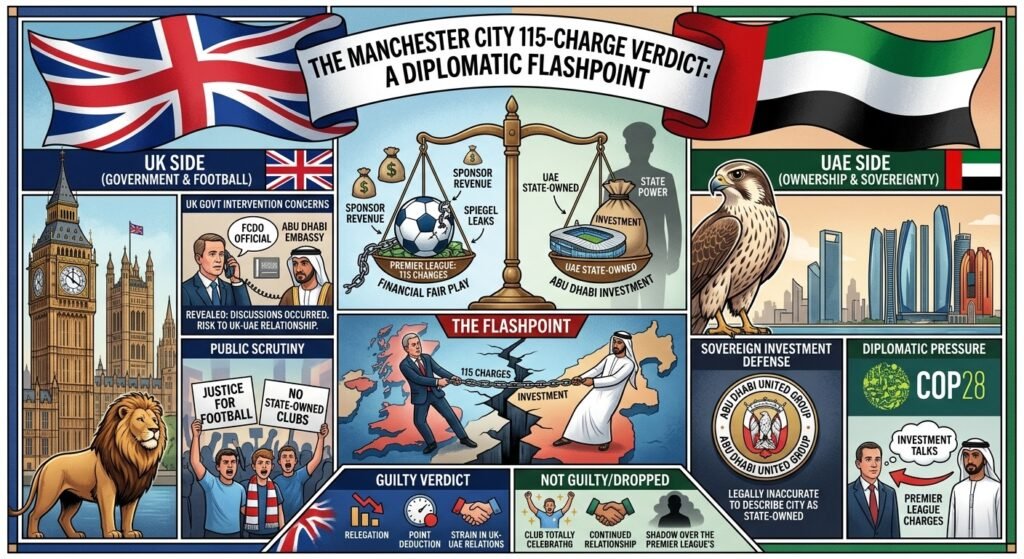
The looming verdict in Manchester City’s 115-charge Premier League case has moved beyond football, with the UAE reportedly raising the case in talks with UK officials amid concerns over Abu Dhabi’s broader investment in Britain.
What began as a football finance dispute has quietly evolved into something with genuine diplomatic weight. As a panel of three judges prepares to rule on Manchester City’s long-running 115-charge case, the outcome is reportedly being discussed at a government level between the United Arab Emirates and the United Kingdom — a sign of just how far this case has extended beyond the pitch.
What the Case Is Actually About
Manchester City has been under investigation since 2023, when the Premier League formally charged the club with 115 alleged breaches of its financial rules, following a four-year inquiry that grew out of the 2018 “Football Leaks” document disclosures. The charges relate to how City accounted for sponsorship income, along with other financial disclosures made to the league over roughly a decade.
After months of hearings inside London’s International Dispute Resolution Centre, a three-judge panel is now weighing a verdict that carries serious potential consequences. If found guilty, City could face significant fines, the stripping of Premier League titles, or even relegation from England’s top division — a set of outcomes that would be virtually unprecedented for a club of City’s stature.
Why the UAE Is Involved at All
Manchester City has been owned by Abu Dhabi royalty since 2008, when Sheikh Mansour bin Zayed Al Nahyan — a senior member of Abu Dhabi’s ruling family and the UAE’s vice-president and deputy prime minister — took control of the club. Since then, City has become one of English football’s most dominant forces, winning multiple Premier League titles and a Champions League crown, while roughly a third of the club’s sponsorship revenue reportedly comes from UAE-linked entities.
According to Bloomberg, the UAE has raised the Man City case, and its potential fallout, directly in discussions with the British government. The concern isn’t really about football at all — it’s about the broader relationship between the two countries, and specifically about protecting the flow of Emirati investment into the UK.
The UK’s Delicate Position
British officials reportedly find themselves in an uncomfortable spot. The UK government has been working to repair a relationship with the UAE that had grown strained in recent years, and officials are said to be wary of getting entangled in what is, at its core, a sports governance dispute. At the same time, UK officials are privately concerned that a guilty verdict against City could have knock-on effects for Abu Dhabi’s wider investment presence in Britain.
A UK government spokesperson has publicly emphasized that the UK and UAE maintain a “deep and long-standing bilateral relationship,” with deepening cooperation on trade, defense, and security described as a top government priority. Ed Lister, joint chair of the UK-UAE Business Council, has framed the situation as something that needs to be understood within the broader context of a relationship that has, at times, deteriorated between the two nations.
Rival Clubs Are Watching Closely, and Warily
The political dimension of this case hasn’t gone unnoticed among Manchester City’s Premier League rivals. According to reporting from British outlets, some competing clubs privately fear that political pressure tied to the UK-UAE relationship could ultimately influence how the charges are resolved, or even result in some charges being dropped or softened as part of a broader effort to avoid diplomatic friction.
Not everyone agrees this concern is well-founded, however. Some legal commentators covering the case closely have explicitly pushed back on the idea of government interference, noting there’s no clear evidence any UK government body has actually intervened in the proceedings, and characterizing suggestions of a “rigged” outcome as unfounded speculation rather than a demonstrated pattern.
A Case With Real Legal Complexity, Independent of Politics
Beyond the geopolitical backdrop, the case itself carries significant legal weight purely on its own terms. Legal analysts have noted the unusually long timeline involved — roughly four years from initial charge to an eventual verdict, on top of the original four-year investigation — and have pointed out a structural tension in how the process works: the Premier League itself, which is effectively acting as prosecutor in the case, is an organization owned collectively by its member clubs, including Manchester City.
City has also shown a willingness to challenge the Premier League’s rules directly through separate legal action. In a related dispute over the league’s Associated Party Transaction (APT) rules — which govern sponsorship deals between clubs and companies linked to their owners — an independent panel previously ruled that key elements of the league’s rules were unlawful, handing City a partial legal victory in a separate but related fight over commercial regulation. That dispute was ultimately settled between the two sides, but it illustrated City’s broader strategy of contesting Premier League governance through formal legal channels rather than simply accepting sanctions.
What’s at Stake Beyond Manchester City
The eventual verdict carries implications well beyond one club’s fate in English football. A guilty finding with severe sanctions could set a significant precedent for how the Premier League enforces financial rules against its most powerful clubs, particularly those backed by sovereign wealth. A lighter outcome, or one perceived as influenced by political considerations, could equally draw scrutiny and criticism from rival clubs, fans, and governance experts watching how English football’s regulatory system holds up under genuine pressure.
For the UK government, the case represents an unusually direct collision between domestic sports governance and international diplomacy — a reminder that in an era of sovereign wealth-backed sports ownership, decisions made inside a sporting tribunal can carry consequences that extend well beyond the touchline.
Frequently Asked Questions
Q: What are the 115 charges against Manchester City? The charges relate to alleged breaches of Premier League financial rules, primarily concerning how the club accounted for sponsorship income and other financial disclosures made to the league over roughly a decade, following a four-year Premier League investigation.
Q: What could happen to Manchester City if found guilty? Potential consequences reportedly include significant fines, the stripping of previously won Premier League titles, or even relegation from the Premier League to a lower division.
Q: Why is the UAE involved in discussions about a football case? Manchester City is owned by Sheikh Mansour bin Zayed Al Nahyan, a senior member of Abu Dhabi’s ruling family. The UAE has reportedly raised the case in talks with UK officials due to concerns about its potential impact on the broader UK-UAE relationship and Emirati investment in Britain.
Q: Has the UK government actually intervened in the case? There’s no clear public evidence that any UK government body has directly intervened in the legal proceedings. Some legal commentators have specifically pushed back on speculation of government interference, describing it as unfounded.
Q: Has Manchester City won any related legal disputes with the Premier League? Yes. In a separate case concerning the league’s Associated Party Transaction rules, an independent panel ruled that key elements of the rules were unlawful, resulting in a partial legal victory for City before the dispute was ultimately settled.