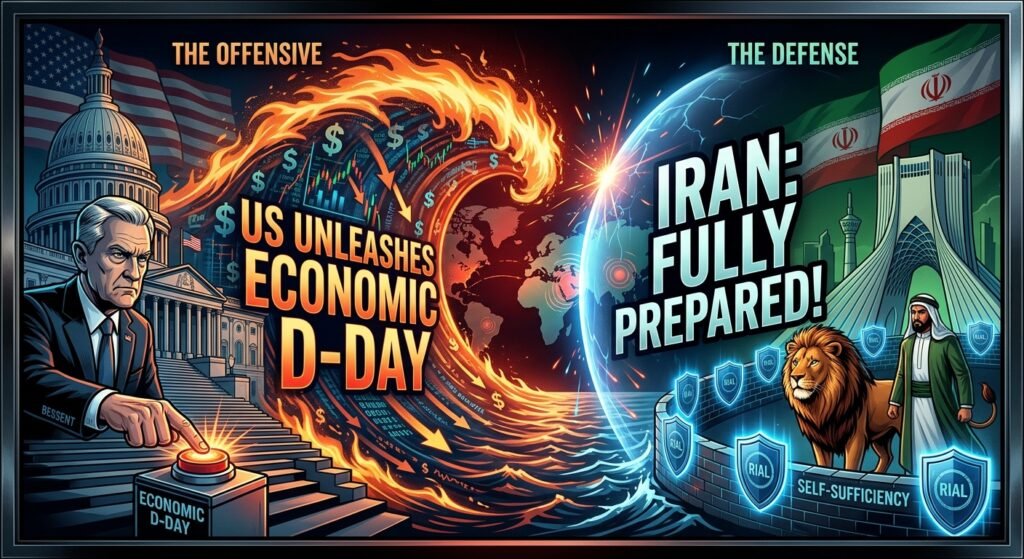
Iran’s economy minister says Tehran has a two-year plan ready to counter sweeping new US sanctions, as Treasury Secretary Scott Bessent warns countries trading with Iran risk being cut off from the dollar system.
Iran says it saw this coming, and it’s ready. As the United States rolled out a sweeping new round of economic sanctions this week, Tehran responded with defiance rather than concern, with senior officials insisting the country has spent two years preparing for exactly this moment.
What the US Actually Announced
US Treasury Secretary Scott Bessent unveiled the new measures Monday, framing them as part of what he’s dubbed an “economic D-Day” against Iran’s government. Notably, Bessent stopped short of deploying the most severe sanctions available, instead warning that countries continuing to trade with Iran risk being pushed out of the dollar-based global financial system entirely.
The Treasury Department confirmed new sanctions targeting 60 individuals, entities, and vessels. Conspicuously absent from that list, however, were any of the Chinese financial institutions widely suspected of helping facilitate Iran’s oil trade — a detail that’s drawn attention given how central China’s role has become in keeping Iranian oil exports moving despite years of sanctions pressure. Bessent declined to name which countries would ultimately be targeted or specify when penalties might take effect, saying instead that he intended to give them time to comply with the new directive. He separately indicated the public should expect a further sanctions announcement targeting an unspecified financial institution before the end of this week.
Iran’s Defiant Response
Iranian Economy Minister Ali Madanizadeh wasted no time responding, telling state television plainly: “We are fully prepared for the US sanctions.” He framed the sanctions in sharply adversarial terms, describing them as an attempted “economic terrorist attack,” while insisting Iran has its own tools to respond in kind. “Our defense is no longer so defensive; the enemies should wait for an attack,” he said, adding elsewhere that Tehran has been anticipating this exact scenario for a long time: “The government has a two-year plan and is fully prepared, and has been prepared, for these developments.”
Madanizadeh went further still, predicting the sanctions would ultimately amount to “another defeat” for Washington. “They have done everything they could to test the determination of the Iranian people and the country’s officials, but they have failed every time. It seems they wished to suffer yet another defeat,” he said.
Iran’s top negotiator, Mohammad Bagher Ghalibaf, added his own pushback, arguing that the US isn’t actually in a strong enough economic position to successfully restrict Iran’s relationships with other countries. Madanizadeh separately claimed that neither China nor Russia had “accepted” the new US measures, predicting other nations would resist the pressure campaign as well.
A Central Bank Governor Urges Honesty at Home
Not every voice inside Iran’s government struck a purely combative tone. Central Bank Governor Abdolnaser Hemmati took a somewhat more measured approach, telling an audience at Tehran’s Entrepreneurs’ Assembly that Iran’s leadership needs to be candid with its own citizens about the economic difficulties ahead. “I believe we must speak honestly with the people,” Hemmati said. “We are meeting the people’s basic needs. If our exports are cut off, we have made preparations for that as well.” He compared the current pressure campaign to the “maximum pressure” strategy Trump pursued during his first term in office, expressing confidence that this round of sanctions would ultimately fail to force Iranian capitulation, just as previous rounds had.
The Toll on Iran’s Currency
Despite the defiant public messaging, real economic strain is visible. Iran’s rial dropped to roughly 2.02 million to the US dollar as trading opened on informal currency markets this week — a stark, tangible sign of the pressure the country’s economy continues to face, regardless of how officials characterize their level of preparedness.
Trump’s Own Warnings
President Trump has been amplifying the pressure campaign in his own public remarks. As a prior memorandum of understanding between the two countries expired Monday, Trump called on Tehran to raise the “white flag of surrender,” while stressing he was in no rush to bring the conflict to a close. Just days earlier, he had echoed Bessent’s tone directly, warning that Iran would be hit hard economically if it didn’t change course.
Since the start of Trump’s second term in February 2025, the US Treasury’s Office of Foreign Assets Control has sanctioned more than 1,000 Iran-related individuals, vessels, and aircraft, according to the agency’s own figures released in May — underscoring just how extensive the broader sanctions campaign against Iran has already become, even before this week’s newest additions.
Regional Diplomacy Continues Alongside the Pressure
Even as economic tensions escalate, diplomatic activity around Iran hasn’t stopped entirely. Pakistan’s army chief, Field Marshal Asim Munir, met with Iranian officials this week, described by Pakistan’s Interior Minister Mohsin Naqvi as a “very positive and productive meeting” with Iranian President Masoud Pezeshkian. During that meeting, Iranian security chief Mohsen Rezaei told Munir that the US “must change its behavior and take concrete steps toward fulfilling the conditions of the memorandum of understanding.”
Separately, Oman’s foreign minister, Sayyid Badr al-Busaidi, is set to visit Tehran this week to discuss the Strait of Hormuz and other regional developments, continuing Oman’s role as a key intermediary in the broader standoff over shipping through the strait.
A War With No Clear End in Sight
Nearly six months have now passed since the US and Israel first launched strikes on Iran, and while neither side has carried out major attacks in recent weeks, the underlying conflict shows little sign of moving toward a genuine diplomatic resolution. In the meantime, the US continues working, both directly and through regional allies, to curb ongoing Iranian attacks on shipping vessels in the Gulf and, more recently, in the Red Sea as well.
Analysts caution that this latest round of sanctions, however sweeping, is unlikely to fundamentally change Iran’s behavior. Iran already ranks among the most heavily sanctioned countries in the world, having weathered decades of layered US and international economic penalties that have clearly damaged its economy without ultimately shifting its leadership’s core positions.
What Happens Next
With Bessent promising further sanctions announcements before the end of the week, and Iran continuing to publicly project confidence in its ability to weather the pressure, the standoff appears likely to intensify rather than ease in the near term. Whether ongoing regional diplomacy — including Oman’s continued mediation efforts — can create any meaningful opening for de-escalation remains to be seen, even as both Washington and Tehran show no immediate signs of backing down from their current positions.
Frequently Asked Questions
Q: What did the US announce regarding Iran sanctions? Treasury Secretary Scott Bessent unveiled new sanctions on 60 individuals, entities, and vessels, part of what he’s calling an “economic D-Day,” while warning that countries continuing to trade with Iran risk being cut off from the dollar-based financial system.
Q: How has Iran responded to the new sanctions? Iranian officials, including Economy Minister Ali Madanizadeh, have said the country is “fully prepared” for the sanctions, citing a two-year preparation plan and predicting the measures will ultimately fail, similar to previous sanctions campaigns.
Q: Did the sanctions target Chinese financial institutions? No. Despite widespread suspicion that Chinese financial institutions help facilitate Iran’s oil trade, none were included in the initial list of 60 sanctioned individuals, entities, and vessels announced this week.
Q: How has the sanctions announcement affected Iran’s currency? Iran’s rial dropped to approximately 2.02 million to the US dollar on informal currency markets as trading opened this week, reflecting real economic pressure despite official statements of preparedness.
Q: Is there still diplomatic engagement happening between Iran and other countries? Yes. Pakistan’s army chief met with Iranian officials this week in what was described as a positive meeting, and Oman’s foreign minister is scheduled to visit Tehran to discuss the Strait of Hormuz and broader regional developments.