While China’s humanoid robots grab headlines boxing and sprinting at showcase events, a far bigger, quieter industrial transformation is already reshaping factories and raising hard questions about the country’s workforce.
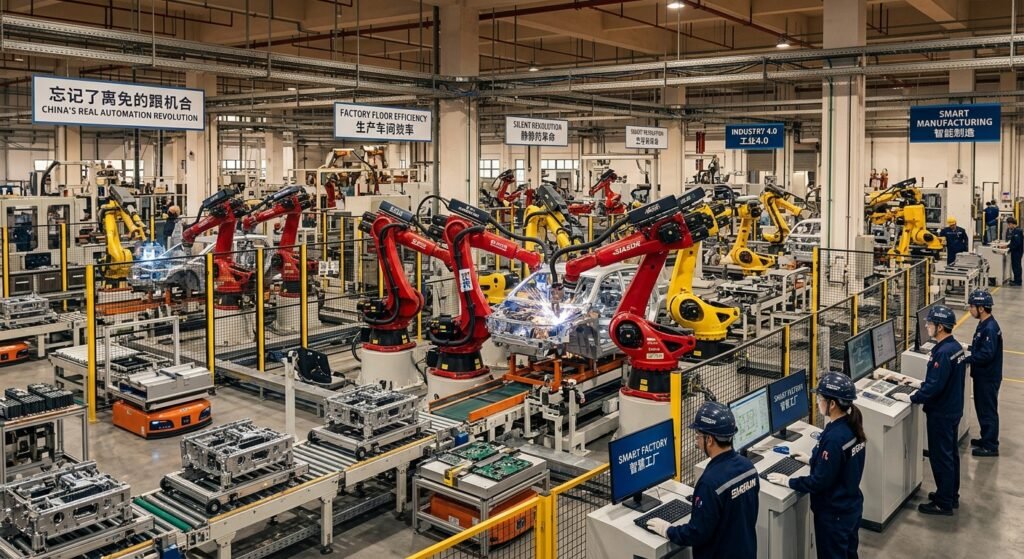
China’s humanoid robots have become impossible to ignore. Over the weekend, the country hosted the second edition of its World Humanoid Games, where machines boxed, sprinted, and marched in front of cameras. But according to BBC reporting from inside Chinese industrial sites, the far more consequential transformation isn’t happening on a showcase stage at all — it’s unfolding quietly, inside factories and classrooms, in machines that don’t look human, dance, or leap, but simply weld, paint, lift, and assemble around the clock without breaks or benefits.
Beyond the Spectacle
The image most people associate with China’s robotics push — humanoid machines performing acrobatics or competing in staged athletic events — represents only the visible surface of a much larger shift. The BBC’s on-the-ground reporting from industrial sites paints a different picture: functional, purpose-built industrial robots that have already become deeply embedded in everyday manufacturing, far removed from the flashy demonstrations that tend to dominate international headlines.
The scale of this quieter transformation is already staggering. China now manufactures more than half of the world’s industrial robots, and it’s actively exporting that capacity globally, positioning the country not just as a robotics showcase but as the literal supplier of automation infrastructure to the rest of the world.
An Economic Transformation on the Scale of China’s Last Big Shift
Observers describe this robotics push as carrying implications on par with China’s last major economic transformation — the kind of sweeping shift that reshaped the country’s role in the global economy once before. This time, the visible signs of change extend well beyond factory floors: gleaming solar grids, streets made quieter by widespread electric vehicle adoption, and machines now capable of outrunning elite human athletes all point to a country moving through a genuinely comprehensive industrial shift, not an isolated automation trend limited to one sector.
The Uncomfortable Questions Nobody Has Clear Answers To
What remains far less clear, according to the reporting, is what this transformation actually means for the millions of workers whose jobs sit directly in automation’s path. China occupies a uniquely central position at the intersection of global manufacturing, trade, and technological innovation, which makes the human cost of this shift both especially significant and especially difficult to measure — particularly within a political system that maintains tight control over the flow of information.
That opacity creates a genuine reporting challenge: it’s difficult to gauge how workers whose livelihoods are threatened by automation actually feel about the change bearing down on them, or whether China’s manufacturing revolution will ultimately create new prosperity for these workers, or simply displace them without a clear path to what comes next.
Voices From Inside the Shift
Amid this uncertainty, some of the most telling reactions are coming from educators trying to prepare the next generation for a job market they themselves can’t fully predict. One instructor, identified only as Chen, described the difficulty of advising students navigating this rapidly shifting landscape: “My students ask me what will happen in the future. I say I don’t know. Technology is changing so fast. But we can’t just stand still and sleep here. We have to move forward to see what we are capable of doing.”
That sentiment captures the broader tension running through China’s automation push: a recognition that the pace of change has outrun anyone’s ability to fully predict its consequences, paired with an acknowledgment that standing still isn’t a realistic option either.
A Global Race With Multiple Fronts
China’s robotics and automation push doesn’t exist in isolation — it’s unfolding alongside a broader, closely watched competition over artificial intelligence more generally, with the United States and China each holding advantages in different aspects of the race. Some observers argue China currently holds the edge in one particular AI race, while the US leads in another, with either country potentially positioned to pull further ahead depending on how the technology, and the policy environment surrounding it, continues to evolve.
This broader context matters for understanding China’s humanoid robot showcases specifically. Events like the World Humanoid Games function as much as geopolitical signaling and soft power projection as they do genuine technology demonstrations, timed against a backdrop of a more assertive, more technologically confident China navigating its relationship with the US and the rest of the world.
What Comes Next
The central unresolved question hanging over this transformation isn’t really about the technology’s capability — China has clearly demonstrated it can build competitive, exportable robotics at scale. It’s about the social and economic distribution of that technology’s impact: whether widespread automation ends up genuinely lifting displaced workers into new roles and new prosperity, or whether it simply removes their jobs faster than the broader economy can absorb the resulting disruption. With limited transparency into how ordinary workers are experiencing this shift, and with the pace of deployment continuing to accelerate, that question remains genuinely open — and, for now, largely unanswered.
Frequently Asked Questions
Q: What is the “quieter” robot revolution referenced in the reporting? It refers to the widespread deployment of functional, non-humanoid industrial robots across Chinese factories — machines that weld, paint, lift, and assemble — which represent a far larger and more consequential shift than the more visible humanoid robots seen at showcase events.
Q: How significant is China’s role in global robot manufacturing? China currently manufactures more than half of the world’s industrial robots and is actively exporting that manufacturing capacity to other countries.
Q: What was the World Humanoid Games? It’s a Chinese-hosted event, now in its second edition, where humanoid robots compete in activities like boxing, sprinting, and marching, functioning largely as a public showcase of the country’s robotics capabilities.
Q: What is the biggest concern about this automation push? The central concern is the uncertain impact on China’s human workforce — specifically, whether widespread automation will create new economic opportunities for displaced workers or simply eliminate jobs faster than new ones can be created, a question made harder to assess given limited information transparency.
Q: How does China’s robotics push relate to the broader AI race? It’s viewed as one front within a larger technological competition between China and the United States, with observers suggesting each country currently holds advantages in different areas of AI and automation development.