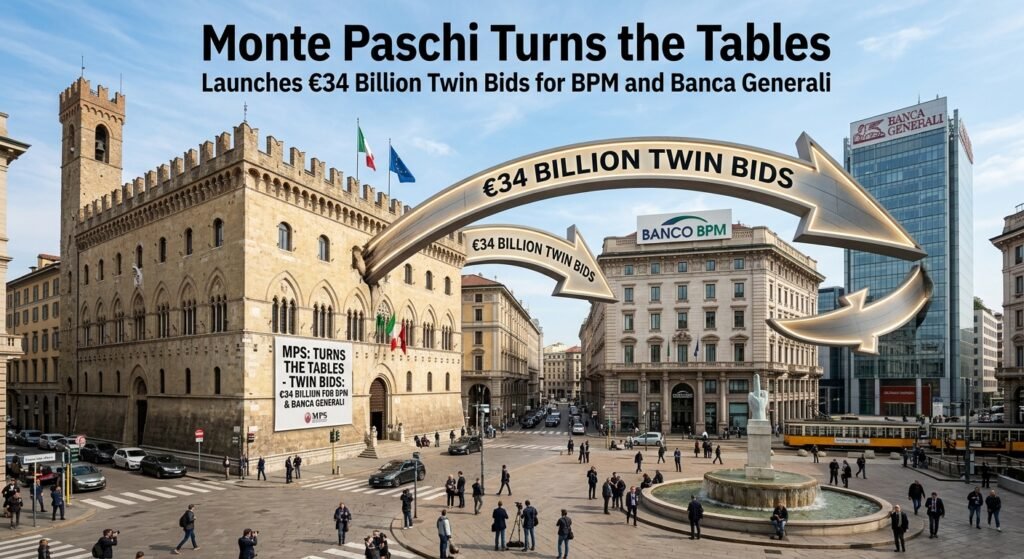
In a bold defensive move, Italy’s Monte dei Paschi has approved competing all-share offers for Banco BPM and Banca Generali worth roughly €34 billion, aiming to build a €70 billion banking group and fend off Intesa Sanpaolo’s takeover bid.
In a dramatic twist to one of Europe’s biggest ongoing banking sagas, Monte dei Paschi di Siena has flipped the script on its own takeover battle — going on the offensive with a combined €34 billion bid to acquire both Banco BPM and Banca Generali, rather than simply defending itself against a rival’s advances.
The Board’s Bold Counter-Move
Monte Paschi’s board approved the plan Thursday, backing a strategy put forward by CEO Luigi Lovaglio to launch two separate all-share exchange offers: one for Banco BPM, and another for Banca Generali. According to people familiar with the matter, the combined entity created by these deals would carry a market value of roughly €70 billion. As part of the plan, Monte Paschi would also pay out an extra dividend to shareholders, funded in part using its existing stake in insurance giant Assicurazioni Generali.
The move is widely being read as an “industrial alternative” — a way for Monte Paschi’s leadership to build a larger, more defensible banking group specifically designed to fend off an unsolicited takeover bid from Intesa Sanpaolo, Italy’s largest bank.
How This Bidding War Started
To understand Thursday’s move, it helps to trace back through several months of escalating maneuvering across Italy’s banking sector. The saga began when Banco BPM’s board unanimously approved a plan to open discussions with Monte Paschi over a potential “merger of equals,” an offer that would have created a combined group with a market capitalization of around €50 billion, positioning it as Italy’s second-largest bank.
Intesa Sanpaolo wasted little time countering. The following day, Intesa launched its own unsolicited offer for Monte Paschi worth roughly €30.6 billion (about $35.3 billion), aiming to leapfrog BPM’s proposal entirely. Intesa structured its bid carefully to address potential antitrust concerns, striking a separate arrangement with insurer Unipol Assicurazioni, which would pay between €3 billion and €3.5 billion in cash to acquire the Monte Paschi brand itself, along with roughly 635 of its branches — about half its total network — and most of the central operational functions needed to run it as a standalone bank. Under that plan, Unipol, already the largest shareholder in rival lender BPER Banca, intended to merge those assets into a new entity still operating under the Banca Monte dei Paschi name.
Intesa projected the deal would generate around €1.5 billion annually in pretax cost savings, plus roughly €1.4 billion in additional pretax revenue synergies, positioning the combined Intesa-MPS-Mediobanca group as the eurozone’s second-largest banking group by market value, trailing only Santander.
Why Monte Paschi Is Such a Valuable Target
Monte Paschi’s appeal as an acquisition target goes well beyond its standing as the world’s oldest bank. The lender, which received a state bailout in 2017 before being re-privatized in 2023, has become a genuine consolidation magnet in Italian banking after acquiring Mediobanca last year — a deal that also made Monte Paschi the largest shareholder in Assicurazioni Generali, Italy’s largest insurer.
That Generali stake in particular has become central to the entire dispute. Monte Paschi currently owns roughly 13% of Generali, one of Italy’s largest private holders of government bonds, making the outcome of this takeover battle significant well beyond the banking sector alone.
Political Stakes Add Another Layer
This isn’t purely a financial contest — it’s also become a politically sensitive one. Banco BPM’s largest shareholder is French banking giant Crédit Agricole, which owns roughly 20% of BPM. Critics have raised concerns that a BPM-MPS merger could effectively give Paris indirect influence over one of Italy’s most strategically important financial institutions, an issue that’s drawn scrutiny from figures within Prime Minister Giorgia Meloni’s nationalist government, which has taken an increasingly interventionist stance toward protecting nationally significant Italian companies from foreign control.
Credit Agricole has publicly expressed support for exploring value-creating opportunities with BPM, though the French bank has so far declined to comment specifically on Monte Paschi’s newly approved counter-bids for both BPM and Banca Generali.
What Happens to Banco BPM and Banca Generali Now
Notably, Monte Paschi’s offer for Banco BPM has not been agreed upon with BPM’s own management, adding yet another complicated layer to an already crowded contest between major shareholders and competing banking groups. Banca Generali, which is controlled by Assicurazioni Generali, is being targeted through a separate transaction entirely from the BPM offer, expanding the scope of Monte Paschi’s counter-strategy considerably. As of Thursday, Banca Generali had issued no public comment following Monte Paschi board’s approval of the offer.
Markets reacted positively to the news, with Milan’s Piazza Affari stock exchange trading higher following the board’s decision.
What Comes Next
With Monte Paschi’s board now formally backing dual offers for BPM and Banca Generali, Italy’s banking sector finds itself in the middle of what may become one of the most consequential rounds of financial consolidation the country has seen in years. The outcome will likely hinge on how Intesa Sanpaolo responds to this counter-move, whether Credit Agricole’s stake in BPM becomes a decisive factor, and how much political pressure the Meloni government ultimately exerts to keep control of these strategically important assets within Italian hands.
For now, what began as a defensive scramble by Monte Paschi to avoid being absorbed by Intesa has transformed into a genuinely ambitious offensive play — one that, if successful, would reshape the landscape of Italian banking and insurance for years to come.
Frequently Asked Questions
Q: What exactly did Monte Paschi’s board approve? The board approved a plan to launch two separate all-share exchange offers: one to acquire Banco BPM and another to acquire Banca Generali, together valued at roughly €34 billion, aiming to build a combined group worth about €70 billion.
Q: Why is Monte Paschi doing this? The move is widely seen as a defensive strategy to fend off an unsolicited €30.6 billion takeover bid from Intesa Sanpaolo, by making Monte Paschi itself larger and harder to acquire.
Q: What is Intesa Sanpaolo’s role in this story? Intesa Sanpaolo, Italy’s largest bank, launched an unsolicited takeover bid for Monte Paschi worth roughly €30.6 billion, countering an earlier proposed “merger of equals” between Monte Paschi and Banco BPM.
Q: Why does Monte Paschi’s stake in Generali matter so much? Monte Paschi owns roughly 13% of Assicurazioni Generali, Italy’s largest insurer and one of the country’s largest private holders of government bonds, making the outcome of this takeover battle significant well beyond the banking sector.
Q: Is there a political dimension to this deal? Yes. Banco BPM’s largest shareholder, Crédit Agricole of France, owns about 20% of the bank, raising concerns among some Italian officials about foreign influence over strategically important domestic financial institutions.