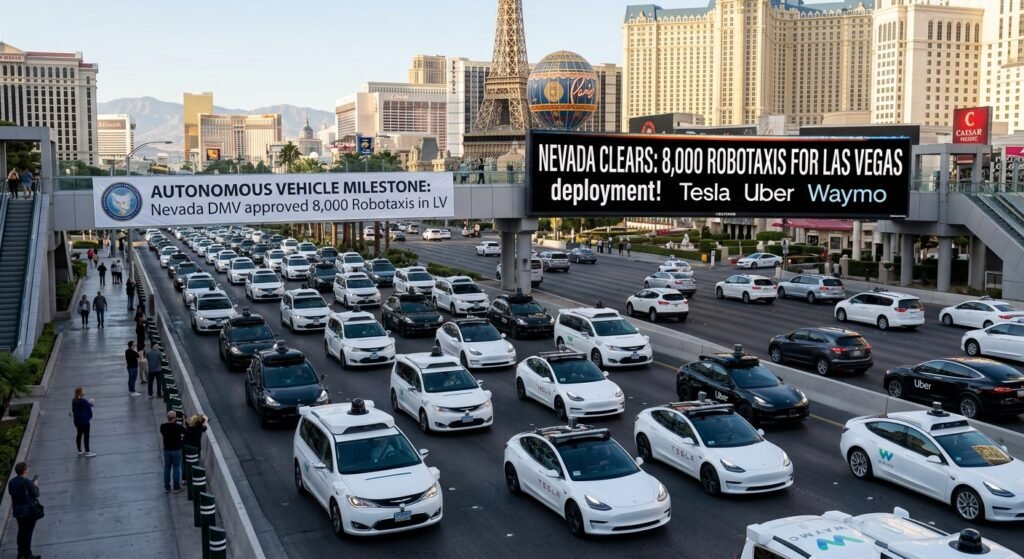
Nevada regulators have approved permits allowing Tesla, Uber, and Waymo to collectively deploy up to 8,000 self-driving robotaxis across Clark County, setting up a major autonomous vehicle showdown in Las Vegas.
Las Vegas is about to become the biggest robotaxi battleground in the country. Nevada regulators have approved permits allowing Tesla, Uber, and Waymo to collectively deploy up to 8,000 autonomous robotaxis across Clark County over the next 12 months, marking the largest coordinated self-driving vehicle rollout approved by any state to date.
Breaking Down the Numbers
The Nevada Transportation Authority unanimously approved permits allowing each company to operate a specific number of autonomous vehicles. Tesla received the largest allocation by far, with permission to deploy up to 5,000 robotaxis. Waymo was approved for up to 1,000 autonomous vehicles over the coming year, while Uber received approval for up to 1,000 additional vehicles operated through its autonomous vehicle partners, Motional and Zoox.
Even if these companies only end up deploying a fraction of their approved totals, the sheer scale of the approval signals a dramatic shift in how quickly regulators are willing to greenlight large-scale autonomous ride-hailing operations. Notably, industry observers expect Tesla itself to deploy roughly half of its approved 5,000-vehicle allotment, given real-world operational constraints.
A Sharp Reversal From Just Weeks Earlier
This approval marks a striking turnaround from where things stood only a few weeks ago. In late July, the Nevada Transportation Authority had granted Tesla an initial permit allowing just 10 robotaxis — a small fraction of the 5,000 vehicles Tesla had originally requested. That earlier approval came with tight restrictions: vehicles were confined to a specific geofenced area along the Las Vegas Strip, capped at a maximum speed of 45 mph, and barred from picking up passengers at Harry Reid International Airport, despite the airport being included in Tesla’s original application.
The jump from that limited initial approval to the current 5,000-vehicle permit represents a significant escalation in regulatory confidence, though it remains to be seen whether all of the earlier operational restrictions, like the airport pickup ban and speed cap, will carry over to the expanded rollout.
Setting the Stage for a Three-Way Robotaxi Rivalry
With all three companies now cleared to operate, Las Vegas is positioned to become a genuine proving ground where Tesla, Uber, and Waymo compete head-to-head for the same riders in the same city. Waymo had already entered fully driverless operations in Las Vegas back in early July, while Zoox — one of Uber’s autonomous vehicle partners — had separately begun offering paid driverless rides on the Strip even earlier, building on a permit that currently allows it to operate around 100 robotaxis independently of this new joint approval.
For Uber specifically, these permits mark a notable return to autonomous vehicle ambitions. The company shut down its own in-house self-driving unit following a fatal 2018 crash, and has since pursued the space primarily through partnerships with companies like Motional and Zoox rather than developing proprietary self-driving technology itself.
Nevada has been positioning itself as a testing ground for autonomous vehicles for well over a decade, having become the first state to authorize self-driving car testing back in 2011. But this latest approval represents something fundamentally different from earlier controlled pilot programs — it’s a bet on full commercial-scale deployment in one of the busiest, most tourist-heavy environments in the country, operating around the clock rather than on quiet test routes.
Not Everyone Is On Board
The approval hasn’t come without pushback. Representatives from the Livery Operators Association and local taxi companies formally opposed the permits during the hearing process, arguing that regulators are moving too far and too fast. “These applications raise two grave concerns,” said Kimberly Maxson-Rushton, a lawyer representing the Livery Operators Association, pointing specifically to concerns about oversaturating the commercial transportation industry.
That tension points to a broader question hanging over the rollout: what happens to Las Vegas’s existing workforce of human taxi and gig drivers as thousands of autonomous vehicles enter the market. Perspectives on this vary sharply depending on who’s asked — some argue the robotaxi rollout will create an entirely new category of jobs focused on maintaining, charging, and cleaning these vehicles, while others warn it could effectively eliminate a major segment of driving-based employment in the city.
What This Means for the Broader Robotaxi Industry
Nevada’s decision to approve such a large-scale, multi-company deployment is being closely watched well beyond the state’s borders. If Tesla, Uber, and Waymo can demonstrate that their technology performs reliably at this scale in a demanding, high-traffic tourist environment like the Las Vegas Strip, it could accelerate similar large-scale approvals in other states currently taking a more cautious approach to autonomous vehicle regulation. Conversely, any significant safety incidents during this expanded rollout could just as easily slow momentum industry-wide.
For now, Las Vegas finds itself at the center of one of the most ambitious real-world tests of autonomous ride-hailing technology attempted anywhere in the country, with three major companies racing to prove their systems can handle the demands of a 24/7 tourism economy at genuine commercial scale.
Frequently Asked Questions
Q: How many robotaxis were approved in Nevada total? Nevada approved permits allowing Tesla, Uber, and Waymo to collectively deploy up to 8,000 robotaxis across Clark County over the next 12 months.
Q: How many robotaxis can each company deploy? Tesla was approved for up to 5,000 vehicles, while Waymo and Uber (through partners Motional and Zoox) were each approved for up to 1,000 vehicles.
Q: Wasn’t Tesla previously limited to just 10 robotaxis in Nevada? Yes. In late July, Tesla received an initial permit limited to just 10 vehicles with significant restrictions. This new approval represents a major expansion from that earlier, much more limited permit.
Q: Is Waymo already operating in Las Vegas? Yes. Waymo began fully driverless operations in Las Vegas in early July, ahead of this broader joint approval alongside Tesla and Uber.
Q: Who opposes the robotaxi expansion in Nevada? The Livery Operators Association and local taxi companies formally opposed the permits, citing concerns about oversaturating the commercial transportation market and the potential impact on human driver jobs.