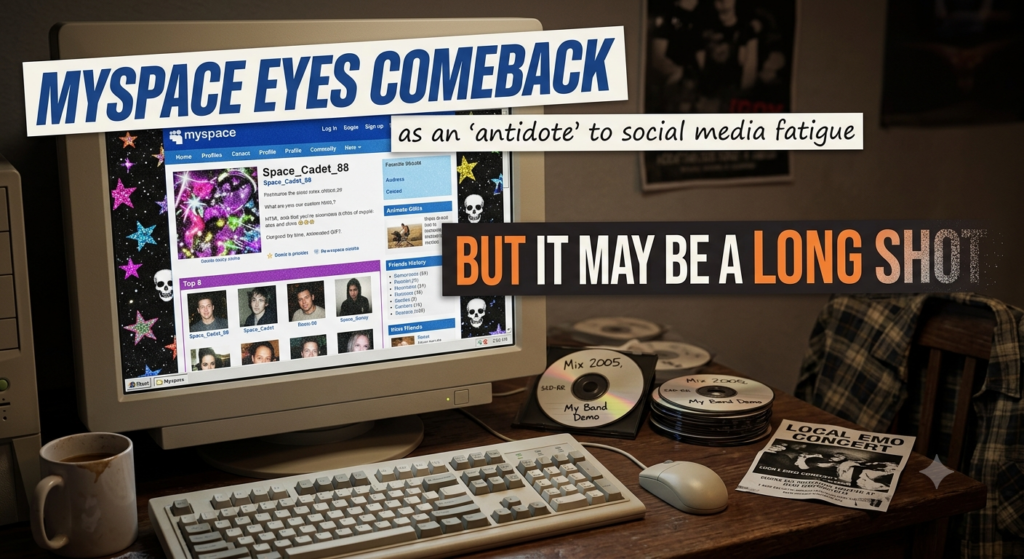
Myspace’s owners are teasing another relaunch, positioning the once-dominant platform as an escape from algorithm-driven feeds. Analysts say the nostalgia play faces steep odds in today’s crowded social landscape.
Myspace is stirring up old memories again. The platform that defined an entire era of internet culture before Facebook took over is quietly plotting a comeback, this time pitching itself not as a competitor to today’s social giants, but as a deliberate escape from them.
The Pitch: An Escape From Algorithm Fatigue
Myspace’s owners, Tim and Chris Vanderhook — who also co-founded ad-tech company Viant Technology — recently teased the relaunch during appearances in a new documentary titled “Myspace,” directed by Tommy Avalone. It’s not their first attempt at reviving the brand; a previous relaunch effort in 2013 failed to gain meaningful traction.
This time, the messaging is different. Rather than trying to out-algorithm TikTok, Instagram, or X, Myspace’s owners are framing the platform as an intentional “antidote” to the kind of scrolling fatigue many users say they feel toward today’s mainstream apps. The bet is that after two decades of increasingly algorithm-driven, attention-optimized feeds, a meaningful number of users might actually want to go back to something that feels more personal, more analog, and less engineered to keep them scrolling.
Why the Timing Might Actually Make Sense
Industry analysts note that this pitch lands very differently in 2026 than it would have even five years ago. One analyst told CNBC that excitement around Myspace’s potential relaunch reflects a broader nostalgia for a “more analog time,” when algorithms played a far smaller role in shaping what people saw and experienced online. That sentiment lines up with other recent reporting describing a “quiet revolution” among younger users, some of whom are reportedly trading heavy social media use for things like lunch dates, vinyl records, and even basic, non-smart phones — small but telling signals of algorithm burnout among a demographic raised entirely on curated feeds.
The Long Odds Ahead
Despite the timing working in its favor conceptually, analysts remain skeptical that nostalgia alone can translate into a sustainable platform. Today’s social media landscape is dominated by deeply entrenched players: Meta’s platforms reportedly serve around 3 billion users, while TikTok continues to hold significant cultural influence, particularly among younger audiences. Competing directly with that scale of reach and engagement is, by most measures, not realistic for a relaunched Myspace.
That’s not necessarily the goal, according to industry watchers. Analyst commentary suggests Myspace’s smaller-scale relaunch shouldn’t be viewed as a head-on challenge to incumbent platforms, but rather as a form of “counter-programming” — identifying specific pain points where major platforms have overreached, and building an alternative around exactly that frustration. Under this framing, success wouldn’t necessarily mean unseating Meta or TikTok, but rather carving out a smaller, loyal base of users who specifically want what current platforms have stopped offering.
A Graveyard Full of Similar Attempts
Myspace certainly isn’t the first platform to try this pitch, and history hasn’t been kind to challengers making similar promises. Alternative social networks like Ello, Peach, and Vero have all launched with genuine buzz around offering something different, only to fade into irrelevance after failing to sustain meaningful user growth beyond an initial wave of curiosity.
What sets Myspace apart from those failed attempts, analysts point out, is history and brand recognition. Rather than asking users to adopt an entirely new concept, Myspace is reintroducing something many people already have an emotional connection to — a platform millions of millennials associate with their first real experience of digital self-expression, from customizable profile pages to Top 8 friend lists.
Real Business Challenges Beyond Nostalgia
Beyond the emotional appeal, Myspace’s owners will need to solve some very practical problems if this relaunch is going to work. Analysts point to several specific hurdles: competing for advertiser dollars in a market where budgets are already concentrated around the biggest platforms, navigating an evolving regulatory landscape around data privacy and platform accountability, and appealing to a user base that has fundamentally changed since Myspace’s original heyday in the mid-2000s.
The financial stakes are also real. Reports indicate Myspace’s owners have already absorbed more than $150 million in losses tied to earlier efforts to keep the platform relevant, underscoring just how difficult — and expensive — sustaining a comeback attempt can be, even with strong brand recognition behind it.
What Success Might Actually Look Like
Rather than measuring success by user counts that rival Meta or TikTok, analysts suggest a more realistic benchmark for Myspace would be sustained engagement among a smaller but genuinely loyal community. If the platform can successfully position itself as a legitimate alternative for people specifically burned out on algorithmic feeds, rather than trying to become “the next big thing,” it may find a workable, if modest, niche.
Whether that translates into a real business remains very much an open question. As one industry analyst put it, Myspace has something none of its failed nostalgia-driven competitors ever had: an entire generation that already loved it once. Whether that’s enough to matter in a market this crowded is, for now, still unclear.
Frequently Asked Questions
Q: Who owns Myspace now? Myspace is owned by Tim and Chris Vanderhook, co-founders of the ad-tech company Viant Technology.
Q: Has Myspace tried to relaunch before? Yes. A previous relaunch attempt in 2013 failed to gain significant traction, and this new comeback effort marks a second major attempt to revive the platform.
Q: How is Myspace positioning this comeback differently? Rather than competing directly with algorithm-driven platforms like TikTok, Instagram, and X, Myspace is pitching itself as an “antidote” to feed fatigue, targeting users who are tired of algorithmic, engagement-optimized social media.
Q: Why do analysts think Myspace’s comeback faces long odds? Major platforms like Meta and TikTok are deeply entrenched, with Meta alone reportedly serving around 3 billion users. Myspace would also need to compete for limited advertiser budgets and adapt to a very different regulatory and user landscape than when it first launched.
Q: Have other nostalgia-based social platforms succeeded before? Not typically. Platforms like Ello, Peach, and Vero all launched with initial buzz but failed to sustain meaningful growth, though analysts note Myspace has stronger existing brand recognition than those earlier attempts.