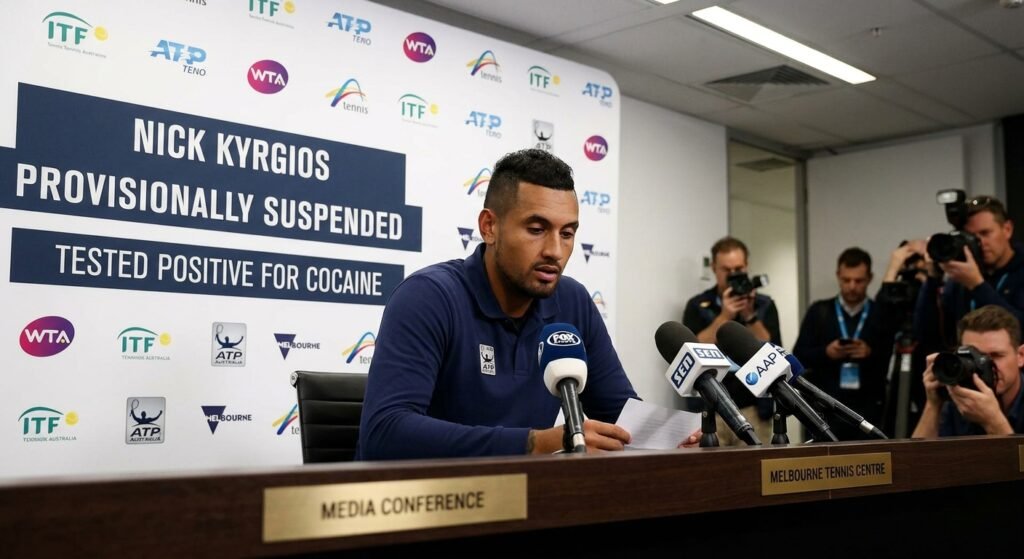
Former Wimbledon finalist Nick Kyrgios has been provisionally suspended by the ITIA after testing positive for cocaine at a tournament in Mallorca, with the Australian publicly apologizing and taking full responsibility.
Former Wimbledon finalist Nick Kyrgios has been provisionally suspended from professional tennis after testing positive for cocaine, the International Tennis Integrity Agency (ITIA) confirmed this week. The 31-year-old Australian broke the news himself in a lengthy, emotional statement on social media, acknowledging what he called a “huge mistake.”
What Happened
Kyrgios provided the sample that triggered his suspension during an ATP 250-level tournament in Mallorca, Spain, on June 22. Testing later confirmed the presence of benzoylecgonine, a metabolite of cocaine, with a World Anti-Doping Agency laboratory verifying the result on July 17 — notably, after Kyrgios had already competed at Wimbledon. A mandatory provisional suspension was formally applied on August 4.
It remains unclear whether the substance was used before or after his first-round singles match against Adam Walton on the day the sample was taken. The ITIA has confirmed it will prosecute the case, and the specific length of any eventual ban will depend on whether the tribunal determines the substance was used in or out of competition.
Kyrgios’s Public Response
Rather than waiting for the ITIA to make the situation public, Kyrgios chose to reveal the positive test himself, posting a lengthy statement on Instagram. “I recently failed a drug test in Mallorca after testing positive for cocaine. I made a huge mistake and I take full responsibility for it,” he wrote. “I’m sorry to my fans, my family, my sponsors and everyone close to me.”
He went on to offer context, without attempting to excuse the situation. “I’m not going to make excuses, but I do want to give some context about where I’ve been. The last couple of years of injuries have taken a huge toll on me, both physically and mentally,” he wrote, describing how his body has struggled to keep pace with what his mind expects, and how difficult it’s been coming to terms with being near the end of his career. “I’ve always said I didn’t choose tennis — tennis chose me. But letting go of something that has been my whole life is one of the hardest things I’ve ever had to face. At times I’ve felt helpless and alone. None of that excuses what I did.”
Kyrgios also directly addressed younger fans in his statement, saying, “Above all, I’m sorry to the kids who follow me. I know the example this sets and I’m deeply disappointed in myself.” He announced he would be stepping away from social media and public life for the next 28 days.
What the Suspension Means Right Now
While provisionally suspended, Kyrgios is barred from playing in, coaching at, or attending any events organized by the ITF, WTA, ATP, the Grand Slams, or any national tennis association. The ITIA confirmed that Kyrgios has the right to appeal the provisional suspension but has not done so as of this week.
Cocaine is classified as a banned substance during competition under World Anti-Doping Agency rules, in part because of its stimulant properties and mood-altering effects, even though it’s not a steroid and less commonly involved in tennis doping cases than other substances. Kyrgios isn’t the first high-profile player to test positive for the drug — Dan Evans failed a similar test in 2017, as did Richard Gasquet in 2009.
A Career Already Defined by Struggle in Recent Years
Kyrgios has played sparingly over the past several seasons due to a persistent series of injuries. A career-high world No. 13 and the 2022 Wimbledon runner-up, he has competed in just two Grand Slam main draws since that Wimbledon final run. His most recent appearance came as a wild card in men’s doubles at this year’s Wimbledon, where he and partner Alexander Bublik lost in the first round.
Kyrgios has been open in the past about his struggles with mental health, which he has said were compounded at times by drinking and drug use. His latest statement echoed that ongoing struggle, framing the positive test within the broader difficulty of confronting the likely end of his playing career after years of physical setbacks.
What Happens Next
With the provisional suspension in place and no appeal filed to date, Kyrgios’s case now moves toward a formal tribunal process, where the ITIA will determine whether the positive test resulted from in-competition or out-of-competition use — a distinction that will significantly influence the length of any final sanction. Until that process concludes, Kyrgios remains barred from all sanctioned tennis activity, adding fresh uncertainty to a career already shaped in recent years by injury, sporadic appearances, and open discussion of the mental toll of professional sport.
Frequently Asked Questions
Q: Why was Nick Kyrgios suspended from tennis? Kyrgios tested positive for benzoylecgonine, a metabolite of cocaine, in a sample provided at an ATP tournament in Mallorca on June 22. The result was confirmed on July 17, leading to a mandatory provisional suspension on August 4.
Q: Has Kyrgios appealed the suspension? As of this week, the ITIA confirmed that Kyrgios has the right to appeal but has not done so.
Q: What does the suspension prevent Kyrgios from doing? While provisionally suspended, he cannot play in, coach at, or attend any events organized by the ITF, WTA, ATP, the Grand Slams, or any national tennis association.
Q: How long will Kyrgios’s suspension last? The exact length has not yet been determined. The ITIA will decide the final sanction after determining whether the substance was used in-competition or out-of-competition.
Q: Has any other tennis player tested positive for cocaine before? Yes, though it remains relatively uncommon in tennis doping cases. Dan Evans tested positive for cocaine in 2017, and Richard Gasquet did so in 2009.