Stock futures held roughly flat Friday after a failed Treasury intervention sent yields climbing again, dragging the S&P 500 and Nasdaq to their worst weekly losses in weeks amid rising Iran-related tension.
US stock futures were largely directionless early Friday, a relatively calm open following a bruising Thursday session in which a brief rebound in Treasury bonds evaporated almost as quickly as it arrived, sending yields — and stocks — back in the wrong direction.
Where Futures Stood Friday Morning
S&P 500 futures traded roughly flat, while Nasdaq-100 futures ticked up about 0.2%, suggesting markets were pausing to regroup rather than extending Thursday’s losses. That pause came after a genuinely rough stretch: the S&P 500 and Nasdaq Composite fell 0.9% and 1%, respectively, on Thursday alone, leaving the S&P 500 down 1.9% for the week and the Nasdaq off 2.5% — putting both indexes on track to snap a three-week winning streak. The Dow Jones Industrial Average has fallen 1.8% week-to-date, on pace for back-to-back weekly losses.
What Triggered Thursday’s Sell-Off
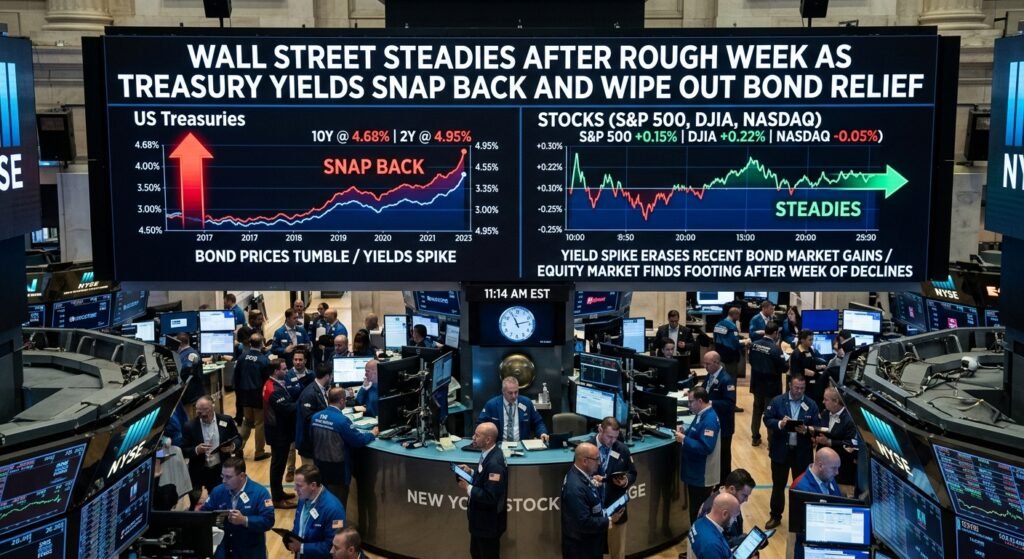
The culprit behind Thursday’s slide traces directly back to the bond market. Just a day earlier, the US Treasury had announced a plan to increase its long-term debt buybacks, an intervention that initially pushed yields lower and gave stocks a modest lift. But that relief proved short-lived. By Thursday, long-dated Treasury yields had resumed their climb, essentially wiping out the entire benefit of Wednesday’s intervention as investor concerns about persistent inflation resurfaced.
The 10-year Treasury yield rose to around 4.67%–4.70% during this stretch, while the 30-year yield pushed above 5.2%, levels that have kept equity markets on edge for much of the past week. Analysts have pointed to a combination of factors driving the move: persistent inflation risk, heavy government borrowing needs, and growing competition for capital tied to the ongoing AI infrastructure investment boom, all putting sustained upward pressure on long-term yields even as expectations for a near-term Federal Reserve rate hike have cooled.
Iran Tensions Add to the Pressure
Compounding the bond market jitters, geopolitical tension between the US and Iran resurfaced as a market driver Thursday. Treasury Secretary Scott Bessent vowed that the US would pursue what he described as “the greatest coordinated economic isolation in the history of the world” against Iran, comments that helped push oil prices higher and added another layer of uncertainty for investors already digesting the bond market’s reversal.
President Trump separately reinforced the tougher stance, vowing a major economic campaign against Iran, which helped extend a streak of gains in crude oil prices — WTI crude has now climbed for five straight sessions, adding more than 2% on Thursday alone.
Consumer Stocks Bore the Brunt
Thursday’s decline wasn’t evenly distributed across sectors. Consumer staples and consumer discretionary stocks led the market lower, reflecting growing investor sensitivity to household spending as borrowing costs stay elevated. Energy was the notable exception, outperforming thanks to the rally in oil prices.
Walmart was a particularly high-profile casualty, with shares falling more than 9% after the retail giant posted strong headline earnings but flagged slowing US sales growth, with the company noting that customers were making “trade-offs” in response to elevated gas prices — a detail that rattled investors already worried about the broader health of consumer spending.
How Asian and Global Markets Reacted
The weakness carried into Friday’s overnight session across Asia-Pacific markets, tracking Wall Street’s pullback. Japan’s Nikkei 225 fell about 0.39%, while the Topix was roughly flat. South Korea’s Kospi managed to reverse early losses to close up 0.80%, though the small-cap Kosdaq index dropped sharply, down 4.73%. Australia’s S&P/ASX 200 slipped 0.31%, while Hong Kong’s Hang Seng gained 0.72% and mainland China’s CSI 300 added 0.52% — a genuinely mixed picture reflecting how unevenly investors are digesting the combination of rising yields and Iran-related uncertainty.
The Bigger Bond Market Story
This week’s volatility fits into a broader, ongoing narrative around global bond markets. Just days earlier, US 30-year Treasury yields had climbed to around 5.324%, their highest level since 2002, while long-dated government bond yields in Japan, Germany, the UK, and France were all trading near multi-year or post-financial-crisis highs. Ed Yardeni, president of Yardeni Research and the analyst who coined the term “bond vigilantes” to describe investors who sell Treasurys specifically to push yields higher and pressure fiscal or monetary policy, has been closely watched for his read on whether this bond market pressure is a passing phase or a more structural shift investors need to prepare for.
What to Watch Going Forward
With stocks now on pace for a second consecutive weekly decline and Treasury yields showing little sign of settling into a stable range, the market’s next moves will likely hinge on two intertwined threads: whether the Treasury’s debt buyback strategy can produce a more lasting effect on yields than this week’s brief reprieve, and how the escalating rhetoric between Washington and Tehran over economic pressure on Iran continues to play out in oil markets and broader risk sentiment.
Frequently Asked Questions
Q: Why did the stock market fall on Thursday? Stocks dropped after a brief rebound in Treasury bonds — triggered by a Treasury Department announcement to increase long-term debt buybacks — reversed course, sending yields climbing again and reigniting inflation concerns among investors.
Q: How much did the major indexes fall this week? Through Thursday, the S&P 500 was down 1.9% for the week, the Nasdaq had fallen 2.5%, and the Dow Jones Industrial Average was off 1.8%, putting all three indexes on pace for weekly losses.
Q: Why are Treasury yields rising right now? Analysts point to persistent inflation risk, heavy government borrowing, and increased competition for capital tied to the ongoing AI infrastructure investment boom as key factors pushing long-term Treasury yields higher.
Q: Why did Walmart stock fall despite strong earnings? Walmart shares dropped over 9% after the company reported strong headline results but flagged slowing US sales growth, noting that customers were making spending “trade-offs” due to elevated gas prices.
Q: How is the US-Iran situation affecting markets? Renewed rhetoric from US officials about pursuing aggressive economic pressure against Iran has helped push oil prices higher for five consecutive sessions, adding another source of uncertainty for equity markets already reacting to rising bond yields.