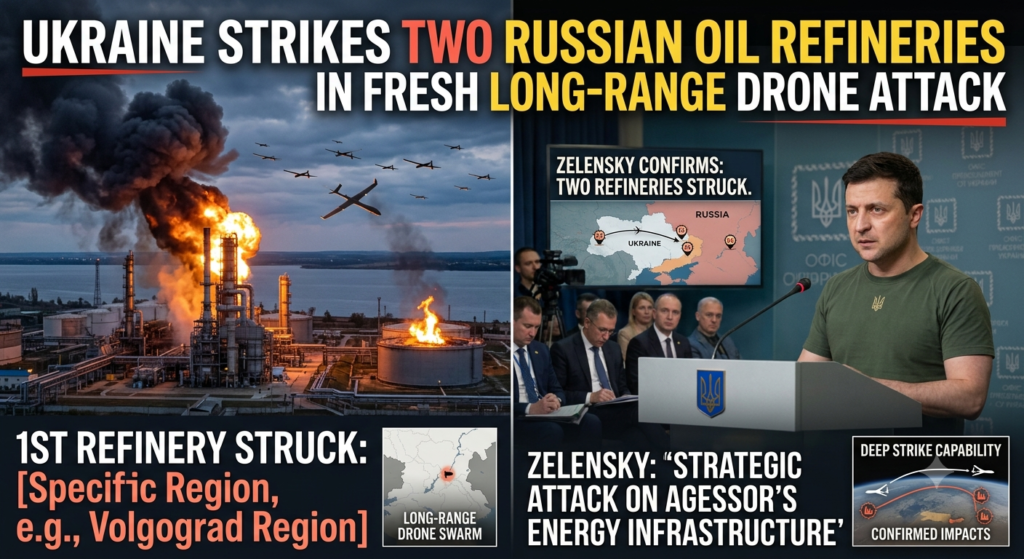
Ukrainian drones struck two Russian oil refineries overnight, including a Yaroslavl facility hit for the second night running, as Kyiv’s campaign against Russia’s energy infrastructure continues.
Ukrainian drones struck two oil refineries deep inside Russian territory overnight on August 6, President Volodymyr Zelensky confirmed, with one facility in Yaroslavl Oblast hit for the second consecutive night. The strikes are the latest chapter in Kyiv’s ongoing campaign targeting the infrastructure that keeps Russia’s war economy running.
What Happened Overnight
Videos posted online the following morning showed a large fire burning at the Slavneft-Yanos refinery in Yaroslavl, one of the largest oil refining facilities in Russia, located more than 700 kilometers (435 miles) from the Ukrainian border. Local residents shared footage of thick smoke plumes rising over the city during the attack, and the independent Russian outlet Astra used geolocation analysis of the footage to confirm the refinery had indeed caught fire.
This marked the second straight night the Yaroslavl facility had come under attack, suggesting Ukrainian forces are deliberately returning to targets to compound damage rather than striking each site only once.
Part of a Sustained Campaign
Thursday’s strikes fit into a much broader pattern that has intensified sharply over the past several months. According to Ukrainian monitoring groups, Ukrainian long-range drones have now struck all 11 of Russia’s largest oil refineries at some point during the full-scale invasion, with the final holdout — the massive Omsk refinery, roughly 2,500 kilometers from the border — hit for the first time in early July. As of that point, Ukraine’s General Staff estimated that strikes had disabled nearly 43% of Russia’s total designed refining capacity.
The campaign has hit some of Russia’s most strategically important facilities. The Moscow Oil Refinery, which once supplied around 60% of the Moscow region’s fuel needs, is expected to remain offline for repairs until early 2027 following repeated strikes. Ukrainian forces have also reached extraordinary distances into Russian territory, including a strike on the Ukhta refinery in the Komi Republic roughly 1,750 kilometers from the border — one of the longest-range attacks of the war — and a strike on a major petrochemical plant in Bashkortostan nearly 1,500 kilometers from Ukraine.
The Toll on Russia’s Fuel Supply
The sustained pressure on Russia’s refining network has triggered a genuine fuel crisis inside the country. More than 90% of Russian regions have reported some form of fuel rationing or shortages, according to official statements and local media, forcing Moscow to restrict a range of fuel exports it would normally rely on for revenue.
Zelensky has repeatedly framed the strikes as a direct and proportional response to Russia’s own attacks on Ukrainian cities, describing the campaign as a form of “long-range sanctions” aimed at facilities that sustain what he calls Russia’s war machine. Ukrainian officials argue that energy infrastructure represents a legitimate military target, both because it fuels Russian tanks, aircraft, and drones directly, and because it generates the export revenue that helps finance the broader war effort.
Russia’s Response
Russian authorities have generally acknowledged fires at targeted facilities while downplaying the scale of damage in official statements, though independent verification through satellite imagery and geolocated social media footage has consistently confirmed the attacks. Russia’s Ministry of Defense has also reported destroying large numbers of incoming Ukrainian drones during these overnight barrages, though a significant share continue to reach their targets.
Russian President Vladimir Putin acknowledged fuel shortages inside the country for the first time in recent weeks, a rare public admission of the toll these strikes are taking on domestic energy supply.
Why This Matters
Ukraine’s refinery campaign represents a significant shift in strategy — rather than relying solely on frontline military engagement, Kyiv has increasingly focused on economic pressure by targeting the revenue and fuel sources that sustain Russia’s ability to continue fighting. With strikes now reaching deep into Russian territory and hitting facilities that were previously considered out of range, the campaign shows no signs of slowing, even as it draws continued attention to the vulnerability of Russia’s sprawling energy infrastructure.
Frequently Asked Questions
Q: Which refineries did Ukraine strike on August 6? Ukrainian drones struck two Russian oil refineries overnight, including the Slavneft-Yanos refinery in Yaroslavl Oblast, which was hit for the second consecutive night.
Q: How far into Russia can Ukrainian drones reach? Ukraine’s long-range drones have struck targets as far as roughly 2,500 kilometers (1,550 miles) into Russian territory, including strikes on the Omsk and Ukhta refineries.
Q: How much of Russia’s refining capacity has been affected? As of early July, Ukrainian strikes had disabled an estimated 42.7% of Russia’s designed oil refining capacity, according to Ukraine’s General Staff.
Q: Why is Ukraine targeting Russian oil refineries? Ukrainian officials describe the refineries as legitimate military targets because they supply fuel to Russian military equipment and generate export revenue that helps finance the war.
Q: Has this campaign caused fuel shortages inside Russia? Yes. More than 90% of Russian regions have reported fuel rationing or shortages, and Russia has restricted certain fuel exports as a result of the ongoing strikes.