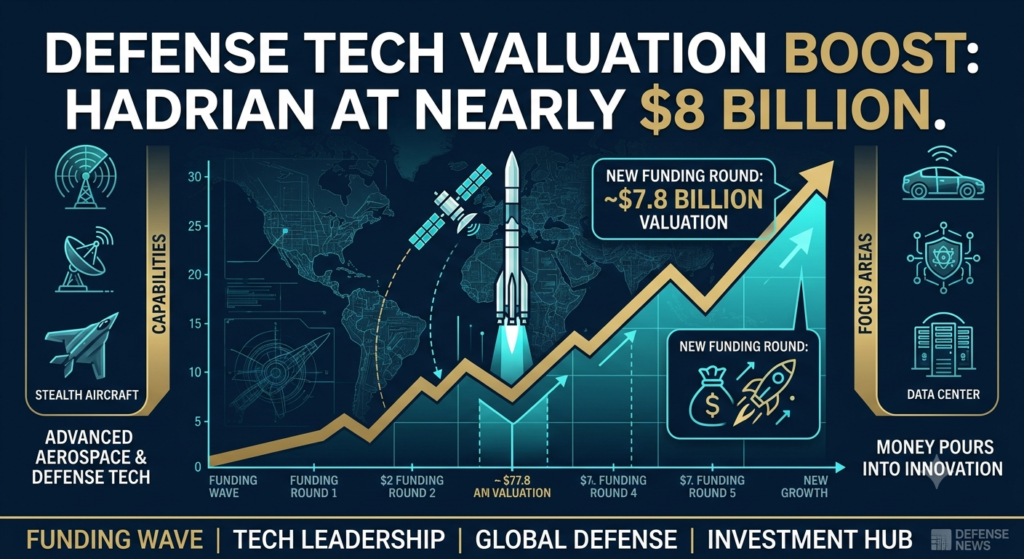
Defense manufacturing startup Hadrian closed a new funding round valuing it near $8 billion, more than quadrupling its January valuation as investors pour money into US defense tech.
Defense manufacturing startup Hadrian has closed a fresh funding round that values the company at nearly $8 billion, capping off one of the fastest valuation climbs in the current defense tech boom. The round, announced Thursday, marks more than a fourfold increase from where investors valued the company just seven months earlier in January.
Hadrian builds AI-powered, software-driven factories that manufacture precision components for aerospace, defense, and space programs — everything from rocket and satellite parts to submarine components. The company’s core technology, a platform called Opus, automates much of the traditionally manual work involved in quoting, programming, machining, and inspecting parts, aiming to cut production timelines from months down to weeks.
Who’s Backing the Round
The new funding round was led by Baillie Gifford and J.P. Morgan Strategic Investment Group, with additional participation from investors including Washington Harbor Partners. That roster adds to a growing list of major institutional names that have backed Hadrian over the past year, including T. Rowe Price, a16z, Founders Fund, Altimeter Capital, Construct Capital, D1 Capital Partners, Lux Capital, and StepStone Group.
Hadrian CEO Chris Power said the fresh capital will go toward scaling the company’s workforce and further developing the Opus platform that runs its factories. He pointed to the country’s ongoing production challenges in areas like submarine manufacturing as a key area the new investment is meant to address.
A Valuation That’s More Than Quadrupled in Months
Hadrian’s rise has been remarkably fast, even by defense tech standards. The company was valued at around $1.6 billion following a funding round in January. By June, reports surfaced that Hadrian was in talks to raise as much as $1 billion at a roughly $7.5 billion valuation — a figure the company initially disputed as inaccurate. Thursday’s close near $8 billion confirms that trajectory, and then some.
Founded in 2020, Hadrian currently operates four manufacturing plants, located in Torrance, California; Mesa, Arizona; and Cherokee, Alabama, with the newest facility built specifically to support a $2.4 billion contract with the US Navy to produce submarine components. That contract has been viewed as an important proof point for the company, offering real revenue behind what might otherwise be seen as a speculative valuation built on hype alone.
Part of a Broader Defense Tech Surge
Hadrian’s raise is just the latest in a string of massive funding rounds sweeping through the defense technology sector. Drone software maker Shield AI closed a $1.5 billion round in March at a $12.7 billion valuation, more than doubling its value from the previous year. Around the same time, autonomous ship builder Saronic — whose technology has reportedly been used in Iran — was valued at $9.25 billion in a new funding round. Anduril, one of the biggest names in the space, doubled its own valuation two months later to more than $60 billion.
Much of this enthusiasm is being fueled by the Trump administration’s push to modernize and reindustrialize the US military. The administration has proposed an unprecedented $1.5 trillion defense budget, driven by heightened geopolitical tensions and a desire to reduce US dependence on costly, slow-to-produce missile systems and other military hardware. Lawmakers had already approved an $839 billion defense spending bill for 2026, a 15% increase over prior years, with even larger increases proposed for the following year.
Why Investors Are Betting on ‘Physical AI’
Hadrian’s rapid rise reflects a broader investment theme gaining momentum in venture capital circles: what some are calling “physical AI,” where artificial intelligence is applied not to chatbots or software, but to factories, robotics, and industrial production. Combined with growing political and economic pressure to rebuild American manufacturing capacity, that theme has made companies like Hadrian especially attractive to investors racing to get exposure before valuations climb even further.
Still, some industry observers have raised concerns that the sector may be moving into bubble territory, pointing out that a small handful of companies — Anduril, Shield AI, and Saronic among them — have absorbed a disproportionate share of total defense tech investment in recent months. The counterargument from bulls in the space is that, unlike previous speculative venture cycles, this boom is backed by real, multi-year government contracts and rare bipartisan political support for reshoring defense manufacturing.
What Comes Next for Hadrian
With its valuation now approaching $8 billion, Hadrian will be under pressure to demonstrate that its factories can scale production reliably enough to justify the price tag investors are putting on the company. Execution on contracts like its Navy submarine components deal will likely serve as the clearest signal of whether Hadrian’s valuation reflects genuine operational strength — or simply the broader wave of capital currently flooding into defense tech.
Frequently Asked Questions
Q: What does Hadrian actually make? Hadrian builds AI-powered, automated factories that manufacture precision metal components for aerospace, defense, and space programs, including parts for rockets, satellites, jets, and submarines.
Q: How much is Hadrian now worth? Following its latest funding round, Hadrian is valued at nearly $8 billion, up from about $1.6 billion in January — more than a fourfold increase in roughly seven months.
Q: Who invested in Hadrian’s latest funding round? The round was led by Baillie Gifford and J.P. Morgan Strategic Investment Group, with participation from Washington Harbor Partners and other existing investors.
Q: Why is defense tech attracting so much investment right now? Growing geopolitical tensions, the Trump administration’s proposed $1.5 trillion defense budget, and a broader push to rebuild US manufacturing capacity have made defense-focused startups especially attractive to venture investors.
Q: How does Hadrian compare to other defense tech companies? Hadrian’s valuation is smaller than peers like Anduril (over $60 billion) and Shield AI ($12.7 billion), but its rapid growth trajectory places it among the fastest-rising companies in the current defense tech investment wave.