July payrolls unexpectedly fell, but S&P 500 futures rose Friday as investors bet on a Fed rate cut. Here’s what the jobs report really revealed.
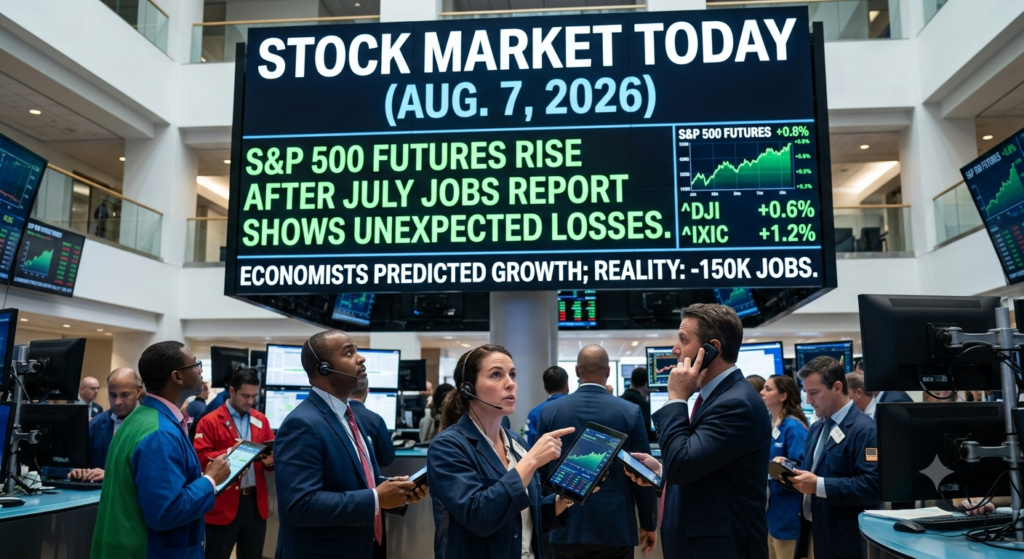
Normally, a weak jobs report sends stocks tumbling. On Friday, the opposite happened. The Bureau of Labor Statistics revealed that the U.S. economy actually lost jobs in July — a sharp miss compared to what economists were expecting — and yet S&P 500 futures ticked higher anyway. To understand why Wall Street reacted this way, it helps to look past the headline number and into what the report actually says about where the economy, and the Federal Reserve, might be headed next.
A Number Nobody Saw Coming
Heading into Friday’s release, the consensus among economists was that the U.S. economy would add somewhere between 80,000 and 95,000 jobs in July, with the unemployment rate expected to hold steady near 4.2%. Instead, nonfarm payrolls fell by 23,000 — the first outright decline in months, and a stunning gap from what forecasters had penciled in. To make matters more jarring, June’s previously reported gain was also revised sharply lower, from an initial estimate to a much smaller 20,000-job increase, effectively shaving tens of thousands of jobs off what had already been reported for the prior two months combined.
Oddly, the unemployment rate actually dipped slightly, falling to 4.1% from 4.2%. That might sound like good news buried inside a bad report, but the reason behind it tells a less encouraging story: labor force participation fell to 61.4%, its lowest level in more than five years. In other words, part of the reason unemployment ticked down wasn’t that more people found jobs — it’s that fewer people were actively looking for one.
Other details in the report reinforced the picture of a cooling labor market. The number of people on temporary layoff jumped by 153,000 to a total of 921,000. Long-term unemployment, defined as joblessness lasting 27 weeks or longer, made up roughly a quarter of all unemployed workers, even as the raw number ticked down slightly.
Why Weak News Became a Market Positive
So why did stock futures rise on data that, on its face, looks like bad news? The answer comes down to how investors are reading the Federal Reserve’s next move. A softening labor market increases the odds that the Fed will cut interest rates at its upcoming meeting, since a key part of the central bank’s mandate is supporting employment alongside controlling inflation. When economic data comes in weaker than expected, markets often interpret it as raising the likelihood of looser monetary policy, and lower interest rates tend to be a tailwind for stock prices, particularly for growth-oriented and interest-rate-sensitive sectors.
Economists have also pointed out that payroll growth has historically tended to run softer in July specifically, and some have characterized the broader labor market as being in a “slow hire, slow fire” mode — meaning companies aren’t rushing to lay off large numbers of workers, but they’re also being notably cautious about bringing on new ones. That framing suggests the weakness may reflect hiring hesitancy tied to broader economic uncertainty, rather than a sudden wave of layoffs sweeping across industries.
Earnings Season Adds Its Own Crosscurrents
The jobs report landed in the middle of an active earnings week, and individual company results were pulling markets in their own directions. Cloudflare shares surged sharply after the company posted strong results and raised its full-year outlook, reflecting continued momentum in cloud infrastructure and cybersecurity demand. Airbnb also jumped in extended trading following stronger-than-expected revenue and earnings. On the other side of the ledger, DraftKings shares slipped after falling short of revenue estimates, and Papa John’s cut its outlook and suspended its dividend as sales continued to decline — a reminder that even amid broader market optimism, individual companies are still facing very different fundamental pressures.
Thursday’s regular session had already reflected some of this tension, with the Dow, S&P 500, and Nasdaq all closing lower as investors weighed incoming jobs data against a mixed batch of earnings. That pullback followed a stretch of record-setting closes earlier in the week, suggesting the market had been due for a pause even before Friday’s data arrived.
The Bigger Economic Picture
Beyond the immediate market reaction, this jobs report adds to a broader storyline that’s been building for months: a labor market that’s gradually losing momentum without falling off a cliff. Average hourly earnings rose only modestly, and the average workweek held steady, signs that point to stability rather than acceleration in either direction. The Bureau of Labor Statistics also noted that data collection was disrupted last October due to a federal government shutdown, a reminder that comparing recent monthly figures against that stretch requires some caution.
For the Federal Reserve, this report likely reinforces a delicate balancing act. Inflation remains a consideration, but a cooling labor market gives policymakers more room to justify supporting growth through lower rates without appearing to lose focus on price stability. Markets, for their part, appear to be betting that the Fed will lean toward supporting employment in its next decision — which is ultimately why a report showing job losses was met with rising stock futures rather than a selloff.
What to Watch Next
The path forward will likely hinge on how the Fed interprets this data heading into its next policy meeting, along with whether upcoming reports show this weakness continuing or proving to be a one-month anomaly. Investors will also be watching whether corporate earnings, which have broadly outperformed expectations this season, can continue offsetting concerns about a softening labor backdrop. For now, Wall Street’s message seems clear: in the current environment, weaker economic data isn’t necessarily bad news for stocks — it may simply be read as another reason for the Fed to cut.
Tags: jobs report, stock market today, S&P 500, Federal Reserve, interest rates, nonfarm payrolls, unemployment rate, Cloudflare earnings, Airbnb earnings, stock futures
FAQs
1. How many jobs did the U.S. economy add or lose in July 2026? The economy lost 23,000 jobs in July, a sharp miss compared to economist forecasts that had expected a gain of roughly 80,000 to 95,000 jobs.
2. Why did the unemployment rate fall if jobs declined? The unemployment rate dipped to 4.1% partly because labor force participation dropped to its lowest level in more than five years, meaning fewer people were actively counted as looking for work.
3. Why did stock futures rise after a weak jobs report? Investors interpreted the weak data as increasing the likelihood that the Federal Reserve will cut interest rates at its next meeting, which is generally seen as favorable for stock prices.
4. Which companies had notable earnings moves this week? Cloudflare surged after beating earnings and raising its outlook, and Airbnb jumped on stronger-than-expected results, while DraftKings and Papa John’s both saw declines tied to weaker results or outlooks.
5. What does “slow hire, slow fire” mean in the context of this jobs report? It describes a labor market where companies aren’t laying off large numbers of workers, but are also hesitant to hire new ones, resulting in weak job growth without a spike in unemployment.
6. What should investors watch next regarding the labor market? Key things to watch include the Federal Reserve’s response at its upcoming meeting, whether future jobs reports confirm or reverse this month’s weakness, and how ongoing corporate earnings continue to influence overall market sentiment.