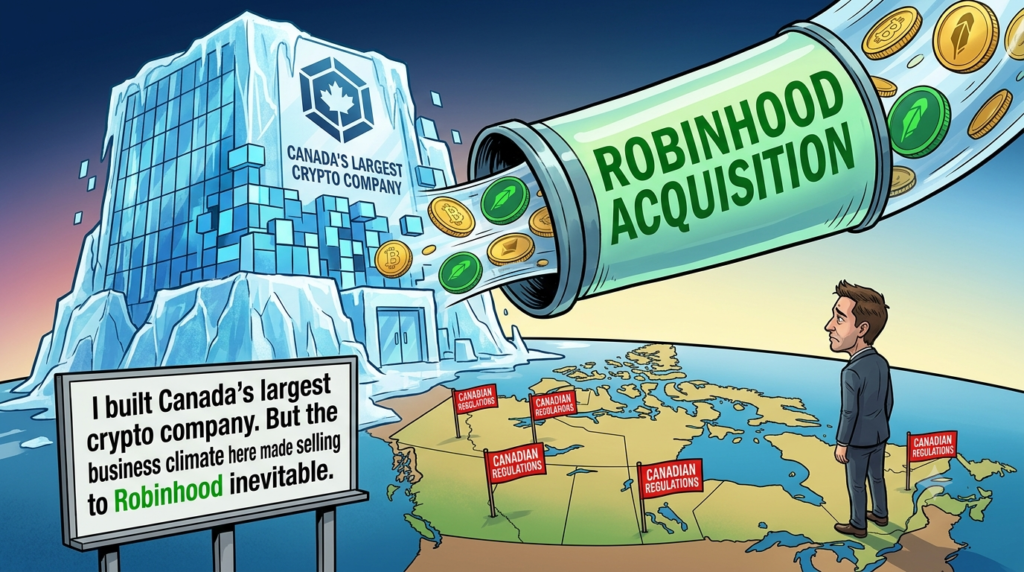
WonderFi founder Karia Samaroo says he sold Canada’s biggest crypto firm to Robinhood not by choice but because the country’s business climate left no other option. Here’s his case.
When Robinhood announced it was acquiring WonderFi, Canada’s largest crypto company, the reaction from some corners of the country wasn’t celebration — it was alarm. Prominent voices argued the government should step in and block the deal, framing WonderFi as a homegrown asset too important to lose to an American buyer. The company’s founder sees it very differently, and his explanation says less about one acquisition and more about a much bigger problem he believes Canada refuses to fix.
The Deal Everyone’s Talking About
Karia Samaroo built WonderFi from the ground up starting in 2021, eventually consolidating what had been a fragmented Canadian crypto market into a single, trusted national brand. That wasn’t a small achievement. WonderFi had to earn user trust in a market still reeling from the collapse of Quadriga, Canada’s most notorious crypto exchange failure, and it survived the fallout of FTX’s implosion despite FTX being an early investor in the company. By 2023, WonderFi had become the dominant player in Canadian crypto.
Then came the offer from Robinhood, which saw WonderFi as its foothold into the Canadian market. The acquisition, valued at roughly C$250 million, gave WonderFi a path to global scale that Samaroo argues simply wasn’t available to it as a standalone Canadian company. In his view, this wasn’t a company giving up — it was a company finally getting the growth opportunity Canada couldn’t provide.
Why He Says Canada Left Him No Choice
Samaroo’s core argument is that Canada has quietly built what he calls a growth ceiling for ambitious companies — not through any single policy failure, but through a slow accumulation of disadvantages: weaker business investment, thinner access to growth capital, a shrinking public market, fragmented regulation, and diminishing rewards for entrepreneurs willing to take on risk.
He draws a sharp contrast with how aggressively other regions compete for founders and capital. U.S. states like Florida and Texas draw entrepreneurs with no state income tax, while the federal government offers substantial capital gains exclusions for founders and early investors. Countries like Britain and Singapore similarly roll out strong incentives designed to keep local investors and innovation engaged. Canada, by comparison, offers what Samaroo describes as a scattered mix of programs, credits, and consultations — layered on top of comparatively higher taxes and slower policymaking. In a market that’s relatively small to begin with, he argues, that combination makes the risk-reward calculation far less attractive for anyone trying to build something ambitious.
Crypto’s Extra Layer of Difficulty
For crypto specifically, Samaroo says these challenges are amplified. In the aftermath of Quadriga’s collapse, Canadian regulators built one of the most demanding crypto regulatory regimes anywhere in the world. He acknowledges the response was understandable given what had happened, but argues it also made Canada an exceptionally difficult market to operate a viable crypto business in. He points to a pattern of major global exchanges — including Binance, OKX, Bybit, and Gemini — entering the Canadian market only to later exit, unable to justify the cost of compliance against the size of the opportunity.
Compounding that, Samaroo — a former securities lawyer himself — says Canada’s crypto rules sit on top of an already fragmented and inefficient securities regulation system. He notes candidly that inefficient regulation tends to benefit lawyers, but is genuinely bad for the businesses navigating it, driving up financing costs and complexity while scaring off potential investors. Despite roughly two decades of attempts to unify Canada’s securities regulatory framework, he says none of those efforts have succeeded.
A Pattern, Not an Isolated Case
Samaroo is careful to frame WonderFi’s story as part of a broader, recurring pattern rather than a one-off. He points to other Canadian companies — Nuvei, Verafin, Magnet Forensics, and Sierra Wireless — as following a similar arc: build something genuinely valuable, hit the ceiling of what the domestic market can support, then turn to foreign capital or a foreign buyer to keep growing. He references Shopify founder Tobi Lütke’s own criticism of this cycle, describing it as the same story repeating itself, where Canada’s most important companies and assets keep getting sent elsewhere.
He also aligns himself with the diagnosis offered by prominent Canadian business figures like former BlackBerry CEO Jim Balsillie, who has long warned that Canada keeps losing its most important businesses and top talent to other markets. Samaroo’s point isn’t that Canada lacks the talent or ambition to build major companies — he built one himself — but that the country hasn’t built the financial and regulatory conditions needed to let those companies stay Canadian while continuing to scale.
Blocking Deals Isn’t the Fix
Perhaps the most pointed part of Samaroo’s argument is his rejection of the idea that blocking foreign acquisitions is a meaningful solution. He calls that approach easy politics — a visible, symbolic action that does nothing to address the underlying reasons companies feel compelled to sell or relocate in the first place. In his view, the real work isn’t stopping individual deals; it’s building an environment where staying independent and Canadian-owned is actually a viable, competitive choice for ambitious founders.
That’s a notably different framing than the nationalist argument that dominated headlines around the deal. Rather than treating the Robinhood acquisition as a loss to be prevented, Samaroo positions it as a symptom of a structural problem that will keep repeating with other companies unless Canada changes the underlying incentives for founders to build and stay.
The Bigger Picture for Canadian Tech and Crypto
Samaroo’s essay lands at a moment when Canada’s broader competitiveness — particularly in tech and emerging industries like crypto — is under increasing scrutiny. His argument suggests that as long as capital remains scarcer, regulation remains fragmented, and rewards for risk-taking remain comparatively weak, more Canadian success stories are likely to end the same way WonderFi’s did: not through failure, but through outgrowing what the domestic market and regulatory system can support.
Whether Canadian policymakers take that message to heart remains to be seen. But Samaroo’s central challenge is clear — if the country wants companies like WonderFi to stay Canadian in the future, the fix isn’t blocking the next deal. It’s making sure ambitious founders have a real reason not to sell in the first place.
FAQs
1. Why did WonderFi sell to Robinhood? According to founder Karia Samaroo, Robinhood offered the most credible path to international scale that WonderFi couldn’t achieve as a standalone Canadian company, given the country’s limited growth capital and fragmented regulatory environment.
2. How much did Robinhood pay for WonderFi? Robinhood acquired WonderFi for approximately C$250 million.
3. Why does Samaroo say Canada’s crypto regulations are especially difficult? He points to Canada building one of the world’s most demanding crypto regulatory regimes in the aftermath of the Quadriga exchange collapse, which led several major global exchanges, including Binance and Gemini, to enter and later exit the Canadian market.
4. Is WonderFi the only Canadian company to follow this pattern? No. Samaroo cites Nuvei, Verafin, Magnet Forensics, and Sierra Wireless as other Canadian companies that scaled domestically before turning to foreign capital or acquisition to continue growing.
5. Does Samaroo think Canada should have blocked the Robinhood deal? No. He argues that blocking sales is an easy political move that doesn’t address the underlying business climate issues driving companies to sell or relocate in the first place.
6. What does Samaroo believe Canada needs to change? He calls for better conditions for ambitious companies to finance, scale, and compete globally, including more competitive capital access, tax incentives, and streamlined securities regulation.