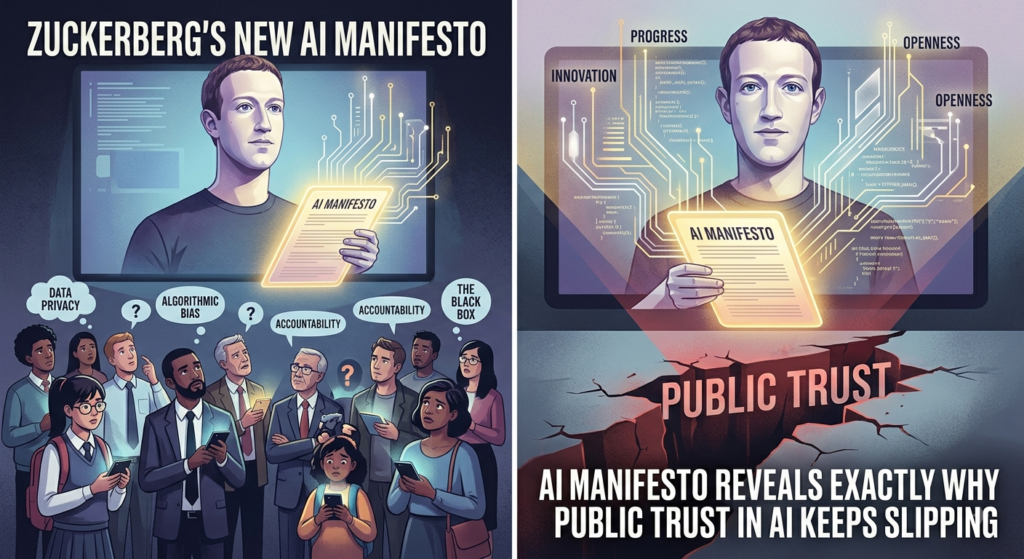
Mark Zuckerberg’s 6,500-word manifesto on “personal superintelligence” paints an optimistic vision for AI’s future — but critics say it inadvertently explains why so many people remain skeptical of the technology.
Meta CEO Mark Zuckerberg published a sprawling 6,500-word manifesto on Monday titled “The Future is for Everyone,” laying out his personal vision for how AI, and specifically what he calls “personal superintelligence,” will reshape society for the better. But critics argue the essay does something Zuckerberg probably didn’t intend: it captures, almost perfectly, why so much of the public remains uneasy about AI in the first place.
What Zuckerberg Actually Argues
At its core, the manifesto centers on a philosophy Zuckerberg describes as “individual empowerment as the source of prosperity.” Rather than AI capability being concentrated in the hands of a small number of powerful companies or governments, Zuckerberg argues the technology should be distributed as widely as possible, giving everyday people direct access to increasingly capable AI tools.
“Rather than centralizing superintelligence, we should distribute it widely and give every person the ability to direct it,” Zuckerberg wrote, framing this distributed approach as the safest path forward. He directly criticized rival AI labs for what he characterizes as an unhealthy concentration of power, arguing that hoping a small group of companies will “benevolently provide for humanity if sufficiently enlightened” is historically a flawed strategy.
Speaking with Axios ahead of the essay’s release, Zuckerberg framed his position as notably different from much of the rest of the tech industry: “One of the ways to achieve both individual empowerment and checks and balances is to make sure you put the technology in everybody’s hands. It’s definitely a different view than what you’re hearing from a lot of other people in the tech industry right now.”
A Vision That Keeps Undercutting Itself
Here’s where critics say the essay runs into trouble. Even as Zuckerberg tries to paint an optimistic picture of a future defined by shared abundance and personal empowerment, he repeatedly acknowledges — sometimes in the same breath — all the ways this technology could go badly wrong. Reviewers have pointed out that despite being described by some as an “anti-doomer” essay, it’s more accurately a personal account of why Zuckerberg is excited about AI’s potential, layered with candid nods to the very real risks along the way.
One frequently cited example involves Zuckerberg’s vision for AI in education, where he describes a future in which everyone has access to a “personalized tutor.” Critics note that this product essentially already exists in the form of consumer chatbots like ChatGPT, Claude, and Gemini — and that in practice, one of the most common current uses for these tools in education is helping students avoid learning altogether, since AI can complete assignments and write essays with no reliable watermarking system in place to help teachers detect it. It’s a relatively low-stakes example of AI-related harm, but critics argue it’s illustrative of a broader pattern in Zuckerberg’s essay: painting an idealized future while glossing over consequences that are already playing out today.
Distillation, Open Source, and Reduced Guardrails
The manifesto also stakes out a clear position on open-source AI development and the practice of “distillation,” where AI models learn from other models’ outputs. Zuckerberg argued that distillation represents “an important principle of how the open source ecosystem works,” writing that “all AI models are derived from human knowledge” and that restricting the ability to learn from what can be observed would put the US at a competitive disadvantage globally.
He also called for closer collaboration between AI companies and government, including giving officials early access to models during training in exchange for support on infrastructure like cybersecurity — a trade-off he argued would prevent slowing down model development or delaying public access once models are ready for release. Critics have raised concerns that this framing effectively argues for reducing, rather than strengthening, the guardrails placed on powerful AI systems during development.
Public Trust Issues Run Deeper Than This Essay
Much of the skepticism toward Zuckerberg’s manifesto isn’t really about the specific arguments themselves — it’s about who’s making them. Commentators have drawn a direct line between current public wariness of AI and the lingering fallout from social media’s well-documented societal harms. Surveys cited in coverage of the manifesto found that 64% of the US population believes social media has damaged democracy and supports stricter regulation of the industry — sentiment that inevitably colors how the public receives reassurances from a company, and an executive, closely associated with that earlier wave of technology.
Critics argue this is precisely the trust gap Zuckerberg’s essay fails to address. The public, broadly speaking, doesn’t currently trust technology leaders to guarantee that their newest inventions will have a net positive effect on society — and a lengthy philosophical essay about empowerment and shared abundance doesn’t necessarily do much to rebuild that trust, especially when it comes from someone whose previous major technology platform is still associated with significant social harm in the public consciousness.
Internal Contradictions, Too
The manifesto has also faced criticism from within Meta itself. Reports surfaced that Meta’s own CTO appeared to contradict some of Zuckerberg’s central promises during an internal company meeting, particularly around the idea that AI would meaningfully expand personal freedom and autonomy for its users. That internal pushback has added fuel to broader skepticism that even the company’s own leadership doesn’t fully buy into every claim made in the document.
The Bigger Picture
Zuckerberg’s manifesto ultimately captures a familiar tension running through much of the AI industry right now: genuine enthusiasm about the technology’s potential, paired with an inability — or unwillingness — to fully reckon with how quickly things can go wrong, and who ends up bearing the cost when they do. For a public already skeptical of Silicon Valley’s promises after the social media era, a 6,500-word essay asking for renewed trust may end up reinforcing exactly the doubts it was meant to dispel.
Frequently Asked Questions
Q: What is Mark Zuckerberg’s AI manifesto called? The essay is titled “The Future is for Everyone,” and it lays out Zuckerberg’s vision for what he calls “personal superintelligence” — AI systems distributed widely to individuals rather than concentrated among a small number of companies.
Q: What is Zuckerberg’s main argument in the manifesto? He argues that AI capability should be distributed broadly to individuals rather than centralized among a handful of powerful AI companies or governments, framing this as the safer path forward compared to concentrating control.
Q: Why are critics skeptical of the manifesto? Critics argue the essay repeatedly undercuts its own optimistic message by acknowledging real risks, uses idealized examples (like AI tutors) that already exist and are being misused today, and comes from a company still associated with significant social media-related harms.
Q: What does the manifesto say about AI regulation and guardrails? Zuckerberg argues for closer collaboration between AI companies and government, including early government access to models in exchange for reduced restrictions that could otherwise slow model development or delay public release.
Q: Has anyone inside Meta pushed back on the manifesto? Yes. Reports indicate Meta’s own CTO appeared to contradict some of the manifesto’s central claims about AI expanding personal freedom during an internal company meeting.